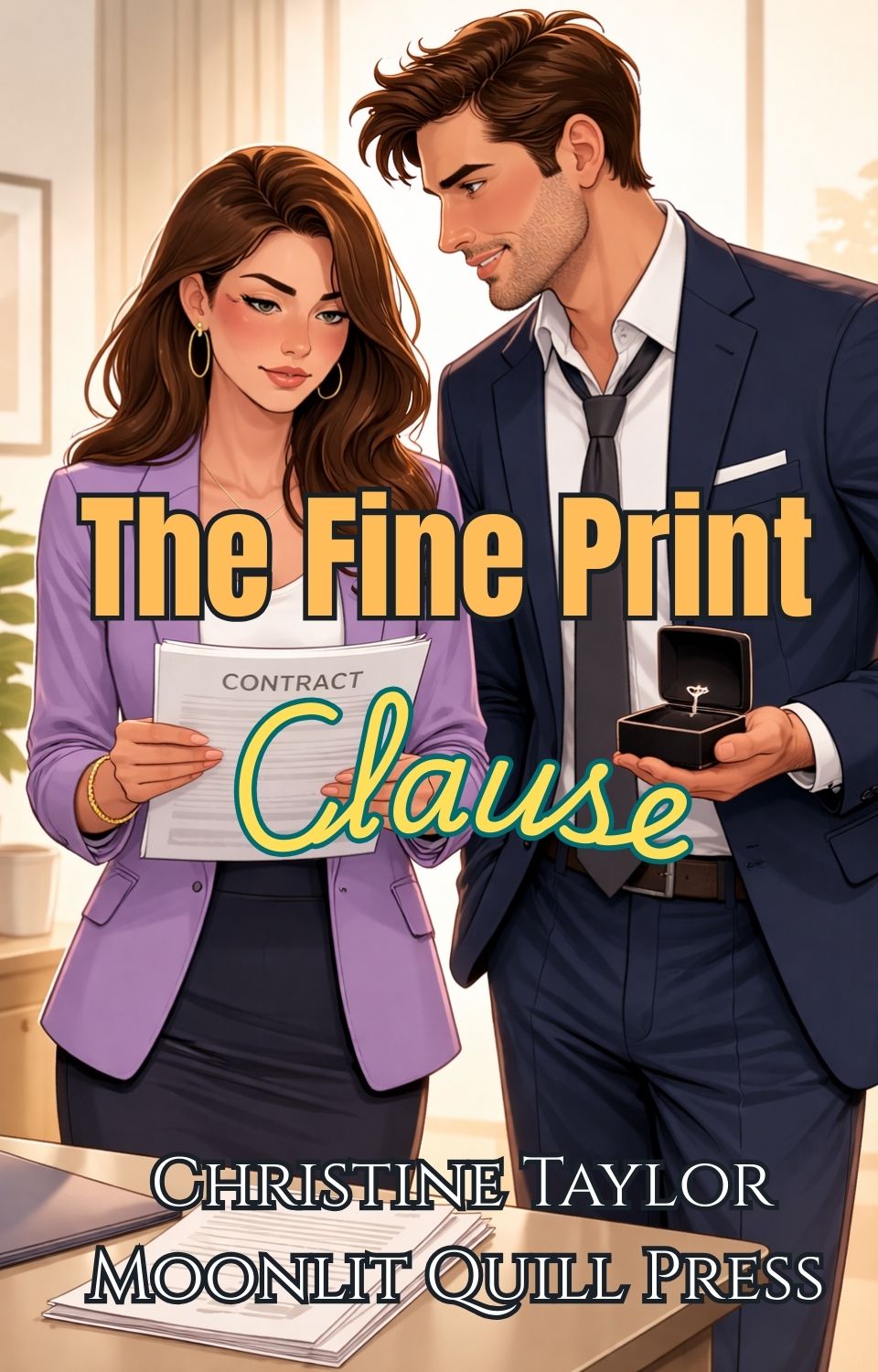
Chapter 1
The Oversight
"If leadership stability is compromised, the merger can be reevaluated."
The words cut through the boardroom like a breach of contract lawsuit—precise, devastating, and entirely Clara Monroe's fault.
Her pen stilled against the notepad. Her stomach executed a clean drop, the kind that came with realizing you'd missed a material fact in discovery. She knew exactly which clause they meant. Section 12.4, subsection (c), the relationship stability provision. The one she'd written eighteen months ago with institutional investors breathing down their necks. The one she'd flagged in draft seven with a memo that used the words "unacceptable personal exposure" three separate times.
The one Adrian Hale had signed anyway.
Around the mahogany table, twelve board members sat in judgment. Most of them men in their sixties, old money and older grudges, all of them watching financial projections flicker across wall-mounted screens. Stock volatility graphed in unforgiving blue. Investor confidence metrics declining in neat percentage points. Adrian Hale's very public, very messy broken engagement, timeline and all.
Clara kept her face neutral—a skill she'd perfected in depositions where showing emotion was the same as losing ground. Her leather portfolio sat open before her, color-coded tabs marking sections of the 847-page merger agreement. She'd memorized every provision, could recite subsections in her sleep, had spent eighteen months making this deal bulletproof.
Apparently bulletproof had loopholes.
No. She'd seen the loophole. Had highlighted it, annotated it, recommended alternative language that would've provided the same investor assurances without creating a target on Adrian's back.
He'd approved the final language on June 28th without changes.
"Ms. Monroe." Richard Pemberton's voice carried the particular authority of someone who'd never been told no in his entire seventy-three years. "Perhaps you would be so kind as to clarify the board's concerns regarding the language in Section 12.4?"
Every head turned toward her. Clara met Pemberton's gaze without blinking, though her pulse kicked up in a way that would've shown on any polygraph. Professional assessment: hostile witness attempting to establish her culpability. Counter-strategy: demonstrate superior command of facts.
Beside her, Adrian Hale sat motionless at the head of the table, his jaw so tight she could see the muscle jump beneath his skin. His fingers lay flat against the mahogany—not relaxed, but controlled. The way a man controlled fury by forcing absolute stillness.
He hadn't looked at her yet.
That would come.
Clara set down her pen with deliberate precision and stood. Taking vertical space in a room full of seated power was basic negotiation psychology, but it worked. The subtle shift rippled outward. She was lead counsel on a $2.3 billion merger that would transform Hale Technologies from a mid-tier player into an industry titan. They could question her work, but they'd listen while she explained it.
"Section 12.4," Clara began, her voice carrying the measured cadence she used for hostile cross-examination, "ties executive relational stability to investor confidence metrics as defined in Appendix G. Specifically, subsection (c) defines destabilizing events to include, but not be limited to, public dissolution of documented romantic partnerships at the C-suite level."
She moved toward the projection screen where the clause glowed in sterile white text against blue background. The language looked so reasonable, tucked between standard material adverse change provisions and regulatory compliance requirements.
"The provision establishes a review mechanism—not automatic termination, but board authority to evaluate—if investor confidence metrics decline beyond the threshold established in Appendix G, which cross-references the baseline confidence levels stipulated in Section 3.7's definitions." She kept her tone clinical. Facts didn't require emotional defense. "This language was included at the explicit request of institutional investors during round three negotiations. Their stated concern was that perceived leadership instability could negatively impact market perception during the twelve-to-eighteen-month integration period."
She let the specificity land. Let them see that she had every cross-reference, every negotiation point, every rationale catalogued in her mind with the precision of case law citation.
"And did you recommend this language, Ms. Monroe?" Margaret Clark, one of two women on the board, asked the question like a scalpel finding the exact spot to cut.
Clara had known this was coming. Had prepared for it during the seventy-three seconds between Pemberton's question and her standing.
"I drafted language per investor requirements," Clara said. "I also flagged the provision in my June 14th revision memo, page three, highlighted section, with specific recommendations for alternative phrasing that would provide equivalent investor assurances while removing personal exposure for executive leadership."
She paused. Let that information redistribute around the room like pieces on a chessboard suddenly rearranging.
"The final language was approved by Mr. Hale's legal team and signed off by Mr. Hale personally on June 28th."
Professional translation: I told you this was dangerous. You signed it anyway.
The room's energy shifted. Not dramatically—these were people who'd spent careers mastering the poker face—but Clara caught it. The subtle glances toward Adrian. The microscopic recalculation of blame distribution. She'd just established a documented trail of her competence and his oversight.
She sat down, hands steady as she returned pen to paper. Inside, her mind ran the exposure analysis with the speed that had made her the youngest senior counsel in Whitmore & Associates' ninety-year history. Legal risk: significant. Timeline jeopardy: severe. Board authority to invoke: absolute. Her professional reputation if this merger collapsed: destroyed.
But she'd flagged the clause. In writing. With specific dates and page numbers.
Three seats down, Marcus Webb cleared his throat. The company's financial counsel was a man who dealt in data, not diplomacy. When he spoke, people listened because he only spoke when the numbers were catastrophic.
"Mr. Hale's engagement to Elizabeth Cabot was publicly dissolved six months ago," Webb said, his tone carrying all the warmth of an actuarial table. "Stock volatility began within forty-eight hours of the announcement. Over the subsequent six-month period, we've tracked an eight-point-three percent decline in the investor confidence metrics as defined in Appendix G. The established threshold is eight-point-five percent."
He pulled up a new graph. Red lines descending with mathematical precision.
"As the market close yesterday, we crossed the threshold. The provision has been triggered."
The silence that followed had weight. Clara could feel it pressing against her eardrums, settling in her chest like water filling a locked room.
The provision has been triggered.
Five words. Legal English for: the board now had grounds to question whether Adrian Hale was stable enough to lead this company through its most critical strategic move.
Adrian's hand flattened harder against the table. A small gesture, barely perceptible, but Clara noticed. She'd spent eighteen months in negotiations with him, had learned to read the micro-expressions he thought he controlled. That hand position meant he was recalculating strategy in real-time.
Five words that meant everything she'd built for eighteen months was suddenly, legally at risk.
Clara's fingers tightened around her pen. The merger was sound. The financials were pristine. The integration strategy was flawless. But none of that mattered if the board decided a broken engagement—a personal matter, a private heartbreak—made Adrian too unstable to be trusted with shareholder value.
It was, she thought with a spike of fury she immediately suppressed, the most legally defensible conflation of personal and professional she'd ever encountered.
It was also completely enforceable.
Forty-eight hours, her mind calculated automatically. Two business days to draft a mitigation strategy for a provision that should never have been triggered. Impossible timeline. She'd make it work anyway. That's what they paid her for.
James Whitmore, the board chair, leaned forward. At seventy-one, silver-haired and possessing the particular gravity that came from having built empires before most people at this table were born, he didn't need to raise his voice to command absolute silence.
"We'll require a mitigation plan," he said. Each word was precisely weighted. "Forty-eight hours. Monday morning, nine a.m., this board reconvenes to evaluate next steps."
It wasn't a request.
"The board serves shareholder interests first and always," Whitmore continued, his gaze fixed on Adrian with the steadiness of a man delivering an ultimatum. "Leadership stability during a merger of this magnitude isn't a luxury, Mr. Hale. It's a fiduciary requirement."
Clara heard the unspoken completion: Fix this, or we'll find leadership who can.
"Monday morning," Whitmore repeated. "Nine a.m. sharp. This meeting is adjourned."
The room emptied with practiced efficiency. No dramatic exits, no raised voices. Just the scrape of leather chairs against marble, the rustle of papers gathered into expensive briefcases, the low murmur of sidebar conversations that would become tomorrow's power plays.
Someone mentioned lunch reservations at Per Se. Someone else confirmed a golf tee time at Winged Foot.
As though they hadn't just detonated a nuclear device beneath two years of work.
Clara remained seated, methodically closing her portfolio, each movement calibrated to project composure she didn't remotely feel. Around her, board members collected their things with the unhurried confidence of people who held all the leverage. Pemberton nodded to Clark. Webb consulted his phone. Whitmore accepted a quiet word from his assistant.
None of them looked at her.
The isolation was deliberate. Professional excommunication pending resolution.
Clara stood, portfolio tucked against her ribs like a leather shield, and joined the general exodus toward the door. Professional. Controlled. Absolutely not calculating how many billable hours she'd wasted if this merger collapsed.
The hallway outside was blessedly empty. All soaring ceilings and floor-to-ceiling windows overlooking Manhattan's midtown canyon, late afternoon light slanting through glass to create geometric shadows on marble floors. Abstract corporate art punctuated the walls at calculated intervals—expensive pieces chosen by consultants to project innovation without risk.
Clara made it perhaps fifteen feet before Adrian's voice stopped her.
"You knew this clause was in there."
Not a question. A statement, delivered in that particular register of controlled fury that made the air feel thinner. She turned slowly, portfolio still clutched against her ribs.
Adrian stood backlit by the windows, his expression in shadow but his posture—shoulders tight, every line of him radiating barely leashed frustration—telling her everything she needed to know.
No witnesses now. The performance could drop.
"Yes," Clara said simply.
He moved closer. Not aggressive, but deliberate, each step purposeful in a way that made the empty hallway feel suddenly smaller. The acoustics were different here—sound carried, echoed off marble and glass. They might as well be on stage.
"You wrote language that made me personally vulnerable to board review based on my relationship status." His voice stayed quiet, but that made it more dangerous, not less. "And you didn't think that warranted pushing back harder?"
Clara's grip tightened on the portfolio. Professional assessment: he was deflecting responsibility, assigning blame to avoid confronting his own oversight. Counter-strategy: establish documented facts.
"I flagged it in draft seven," she said, keeping her voice level despite the anger beginning to simmer beneath her sternum. "June 14th revision memo, page three, highlighted section with a detailed recommendation to modify the language. I specifically noted it created unacceptable personal exposure while failing to provide material additional protection for investor interests."
"You should have refused to include it."
"You should have read the memo."
The words landed between them, sharp and unambiguous. Clara watched his expression shift—surprise, then something that might have been reluctant acknowledgment. Good. She wasn't accepting blame for his signature on a contract he should have read more carefully.
"The investors wanted relationship stability language," she continued, her voice carrying the edge of eighteen months' worth of professional pride wounded by implication of incompetence. "I provided it. I also provided three alternative versions that would have satisfied their concerns without creating a target on your back. You chose to approve the version that included personal exposure. That was your decision. Not mine."
"My lawyers said it was fine."
"Your lawyers were wrong." She met his gaze without wavering. "And I told them so. In writing. With specific citations regarding why this language created unnecessary vulnerability for executive leadership while providing minimal additional protection for institutional investors."
She'd written that memo at eleven-thirty at night, sitting in her Chelsea apartment with cold coffee and the creeping certainty that no one was actually reading her revisions. She'd triple-checked every word, every citation, every alternative provision.
She'd been right to worry.
Adrian was close enough now that she could see the exact color of his eyes—blue-gray, like storm clouds over steel buildings. Close enough to catch the faint scent of his cologne, something cedar-based and expensive that he wore to every negotiation. Professional consistency. She appreciated consistency.
That was all.
"Then fix it," he said quietly.
Clara blinked. "Fix—"
"You're brilliant with contracts. You saw the problem eighteen months before it became a crisis." His jaw tightened. "So find the solution. Draft something. File something. Find a legal precedent, a workaround, an interpretation that makes this go away."
"It doesn't work like that. The provision is triggered. The board has legitimate grounds—"
"Then give them something else to evaluate." He stepped closer, near enough now that she could see the darker flecks in his irises, could notice that his tie had been loosened slightly during the meeting. "Give them a reason to believe leadership is stable."
Her pulse kicked up, though she'd die before acknowledging it. Professional observation only. Heightened awareness due to adrenaline and proximity. Nothing more.
"Such as?" she asked.
The silence stretched. Clara watched him think, watched calculation overtake anger in his expression. She'd seen that look before—usually right before he made a strategic move that would reshape an entire negotiation in his favor.
She didn't like seeing it directed at her.
"A relationship," Adrian said finally. "Public. Documented. Stable."
Clara's legal mind processed the statement before her emotional reaction could catch up. Strategic validity: potentially sound. Practical implementation: catastrophically complicated.
"You want to start dating someone," she said carefully. "Publicly. In the next forty-eight hours."
"I want to get engaged." His tone had shifted, become almost clinical. Strategic rather than emotional. "To someone who understands this is business. Who won't expect romance or grand gestures. Who can maintain professional boundaries while presenting the appearance of personal stability."
The words registered slowly, like contractual language that seemed reasonable until you noticed the liability buried in subsection three.
"You want a fake engagement," Clara said.
"I want a solution to the problem you identified eighteen months ago." He paused, and something flickered in his expression that she couldn't quite read. "You flagged this vulnerability. You saw the exposure before anyone else did. So you must have considered what would happen if it was triggered."
She had. Of course she had. The moment Webb confirmed the provision was live, her mind had already begun running scenarios. Legal challenges—unlikely to succeed within the timeline. Board negotiation—possible but risky, required giving up leverage elsewhere. Alternative demonstration of stability—
A relationship would work. Cleanest solution. Most direct response to the provision's intent.
She'd thought about it for approximately eight seconds before categorizing it as untenable.
"Forty-eight hours," Clara said, "is not sufficient time to develop a comprehensive legal challenge. But it might be adequate to draft a proposal addressing board concerns while maintaining structural integrity of the merger timeline."
"That's not an answer."
"That's the only answer you're getting in a hallway." She straightened, reclaiming the space he'd encroached upon, refusing to be backed against a wall literally or figuratively. "If you want to discuss mitigation strategies, we do it properly. In an office. With full analysis of risks and benefits."
Adrian studied her for a long moment. This close, Clara could see the fine lines at the corners of his eyes, the shadow of stubble along his jaw despite this morning's shave, the exact navy of his custom suit. She catalogued these details with professional detachment.
Eighteen months of close-quarter negotiations. She'd learned to read him. Noticed details. Occupational hazard. Nothing more.
"You think it could work," he said. Not a question.
Clara's mind had already run the analysis. Success probability: moderate to high, depending on execution. Legal defensibility: strong, as long as documentation was pristine. Risk to professional reputation: severe if discovered, but manageable if structured correctly.
"I think," she said carefully, "that any mitigation strategy requires thorough analysis of implementation challenges, exit strategies, and potential exposure."
"But you think it could work."
She did. God help her, the legal framework was sound. A documented, public relationship would satisfy the provision's intent. Would demonstrate stability. Would give the board exactly what they'd asked for.
The fact that it would be fake was irrelevant to the contract language.
"I think we have forty-eight hours to explore all viable options," Clara said.
"That's still not an answer."
"It's the only answer I'm giving you right now."
The hallway stretched empty around them, afternoon light slanting through windows to paint long shadows across marble. Somewhere distant, an elevator chimed. Traffic hummed forty-seven stories below. The city continued its indifferent rotation while Clara stood close enough to Adrian Hale to count the threads in his tie.
She didn't want to count them. She noticed anyway.
Professional hazard of eighteen months working in close proximity. Nothing more.
"I need a solution, Clara." His voice had dropped lower, quiet enough that she had to focus to catch every word. "The board just made it clear they're questioning my fitness to lead. I have two days to prove them wrong or watch everything I've built start to crumble."
There was something in his tone—not quite vulnerability, not quite desperation, but something raw beneath the strategic calculation. The same rawness she'd heard six months ago when news of his broken engagement hit financial networks and stock prices immediately dipped.
Elizabeth Cabot had been perfect on paper. Old money, museum boards, the kind of woman who looked right at charity galas. The breakup had been public and messy, with enough leaked details to make it clear she'd ended things, not him.
Clara had read the coverage. Had noticed the particular way financial analysts questioned his judgment, his stability, his leadership. Had filed it away as professionally relevant information.
Had definitely not thought about how it must feel to have your personal heartbreak become a line item in shareholder confidence metrics.
"Forty-eight hours," she said again.
He didn't move. Didn't step back to restore professional distance. The space between them felt measured in inches rather than feet, close enough that she was aware of his height, his presence, the controlled intensity radiating from him like heat from pavement after a summer storm.
"I'm not asking you to fix this out of kindness," Adrian said. "I'm asking because you're the best attorney I've ever worked with. Because you see things no one else sees. Because if anyone can find a way through this, it's you."
The words should have felt like professional flattery. Instead, they landed with uncomfortable weight.
"And if I can't?" Clara asked.
"Then we're both watching eighteen months of work collapse." He paused. "Your reputation is tied to this merger just as much as mine. If it fails, we fail together."
Truth. Uncomfortable, unavoidable truth.
"Tomorrow," Clara said. "Nine a.m. I'll have a preliminary analysis of all viable options."
"Including the engagement."
"Including all options." She met his gaze steadily. "I'm your attorney, not your solution to a PR problem. I'll give you legal analysis, not personal sacrifice."
Something shifted in his expression. Not agreement, exactly. More like acknowledgment that she'd drawn a line and he'd respect it.
For now.
"Nine a.m.," he confirmed.
Clara should leave. Should turn and walk away, head back to her office, start running the legal analysis that would consume the next forty-eight hours. Should maintain every professional boundary she'd carefully constructed over eighteen months of working with a man who was brilliant, infuriating, and entirely too aware of his own strategic advantages.
She didn't move.
Neither did he.
The moment stretched, pulled taut like a wire under tension. Clara became aware of details she had no business noticing: the way his breathing had evened out since the boardroom, steady and controlled. The exact shade of blue in his tie—the same blue as the stock ticker that had been displayed behind him during the meeting. The way he was looking at her, not with the professional assessment of a CEO evaluating counsel, but with something else. Something that made her pulse respond in ways that had nothing to do with professional adrenaline.
She categorized the response immediately: stress reaction. Heightened awareness due to the crisis situation. Physiological response to confrontation and proximity. Nothing more.
Her body didn't entirely believe her brain's assessment.
"I should go," Clara said. "Start the analysis."
"Yes."
He said it, but he didn't move either. Didn't step back to create the space that should have existed between attorney and client, between professional colleagues who'd spent eighteen months maintaining appropriate boundaries.
The hallway felt too quiet. Too empty. Too much like they were the only two people in the world who understood exactly how much was at stake.
"Clara." Her name, spoken quietly, like he was testing how it sounded outside of formal meetings and contract negotiations.
She waited.
Adrian's hand moved—not toward her, but through his hair, disturbing the careful styling in a gesture of frustration she'd never seen him make in public. More evidence that the performance had dropped. That they were off-stage now.
"The board isn't wrong," he said quietly. "Leadership stability matters. I can't let it be personal—" He stopped. Started again. "I can't let my personal life become a liability to this company."
"So you're willing to fake an engagement," Clara said. "Create a documented lie to satisfy a provision in a contract."
"I'm willing to do what's necessary." His gaze held hers. "The question is whether you're willing to help me do it."
There it was. The real question beneath all the strategic discussion.
Clara's mind ran the calculation one more time. Legal framework: sound. Strategic validity: high. Professional risk: manageable if executed correctly. Personal risk—
She didn't let herself finish that analysis.
"I'll see you tomorrow," she said. "Nine a.m."
"You didn't answer my question."
"I'm your attorney. My job is to provide you with all viable options and let you make informed decisions." She held his gaze. "What you're asking for isn't legal counsel. It's personal involvement. Those are different things."
"Are they?" Adrian asked. "When your professional reputation is just as much on the line as mine?"
Clara opened her mouth to respond, but he stepped closer. Close enough now that she'd have to tilt her head back to maintain eye contact. Close enough that the distinction between professional and personal felt like a technicality she was clinging to.
Close enough that she could see he was serious. Completely, strategically, impossibly serious about this insane proposal.
"Then fix it," he said, his voice quiet and controlled and absolutely determined.
A beat of silence.
City noise filtered through windows. Somewhere a phone rang in an empty office. Clara's pulse beat steady and too fast in her throat.
Adrian's gaze didn't waver.
"Or marry me."
The words hung in the air between them, impossible and practical all at once.