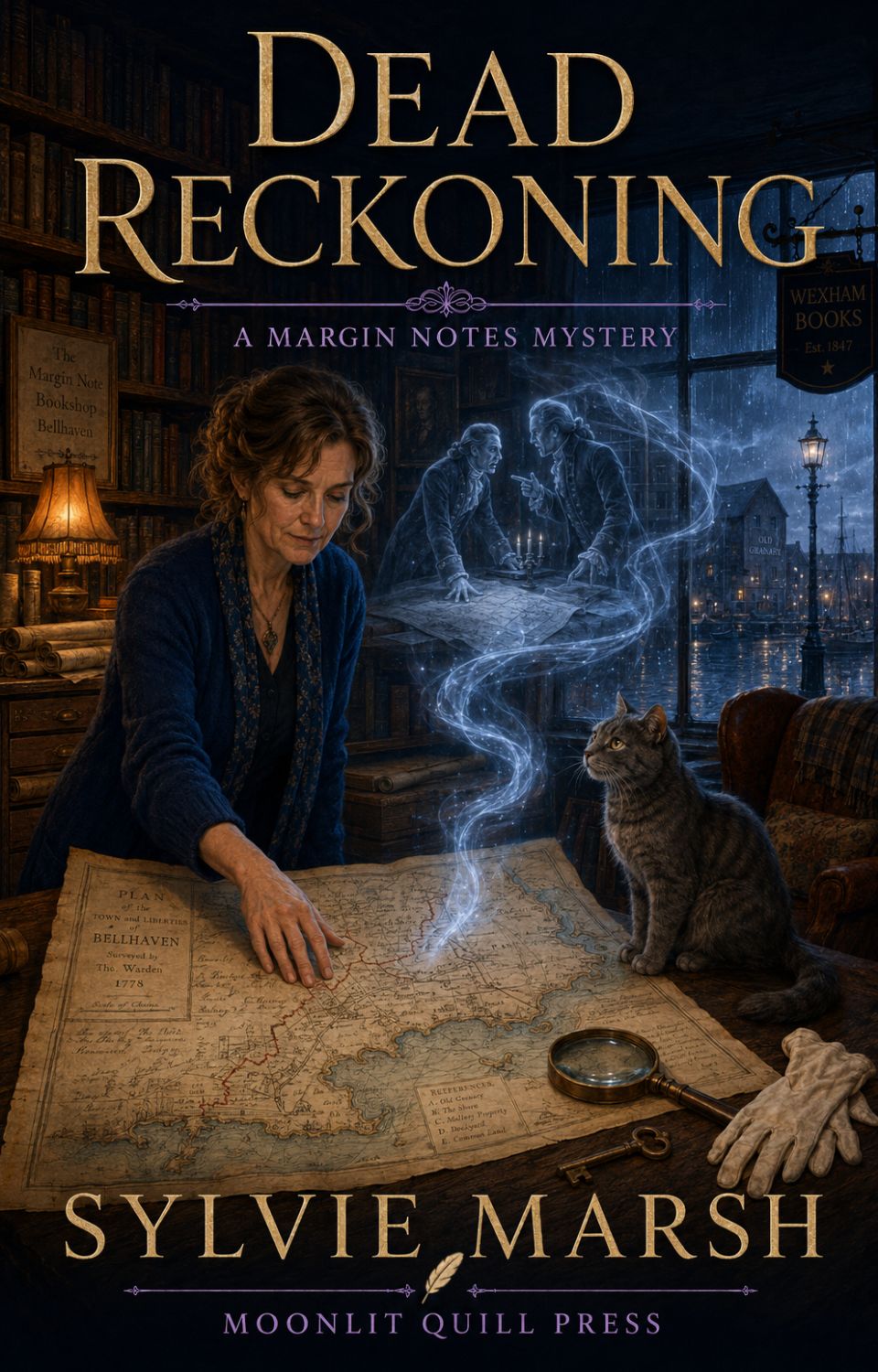
Chapter 1
The Last Transaction
The sea light came in sideways that afternoon, the way it does in October when the sun has given up on height and settles for angle instead. It caught the dust motes above the Local Interest shelf, turned the spines of the Ordnance Survey section briefly gold, and then the cloud moved, and the shop returned to its usual comfortable dim.
She'd been expecting Gerald Soane since half past two. The bracket clock above the travel section said quarter past three when the door finally announced him. It wasn't the bell that gave him away, since it had been stuck on a three-second delay since August and still hadn't been fixed. Instead, it was the familiar draught that found the back of her neck whenever someone opened the door.
He came in the way he always did: purposefully, without lingering on the threshold, as though he'd already decided the visit would be efficient before he arrived. The cardboard map tube was under his left arm. His coat was the good herringbone tweed he wore when he was working rather than browsing, and he had the air of a man who had already composed his next four hours and was treating this one as an obligation, if a tolerable one.
"Miss Mallory."
"Mr. Soane. You're later than I expected."
"Train." He set the tube on the counter with the controlled care of someone who didn't want to say fragile but was demonstrating it. "The Dartmouth connection."
"Tea?" she asked, because she always asked, and because the shop was cold in a way the woodstove was still getting around to addressing.
"Thank you, no." He was already looking at the counter's glass top with the focused patience of a man prepared to get on with things.
She got on with things.
He removed the linen tape himself. It was pale, tied in that asymmetric knot he always used, a bit loose on the right-hand side. He slid the tube's contents onto the clean piece of cotton she'd laid out. The wax seal had already been broken on one end, which he'd mentioned when he called to describe it. He unrolled it by the edges with the practised care of someone who had spent forty years handling documents he valued.
She looked at it properly for the first time.
The paper stood out first. It was heavy rag paper, the kind that had lasted two and a half centuries because it was made well, though it had clearly been looked after too. Its colour was that warm ivory-brown you see in old documents stored in the right conditions: not foxed, not brittle, just aged with a dignity modern paper couldn't match, even in a thousand years. In the low October light, it almost seemed to glow.
The survey itself was drawn in iron gall ink, the original application precise where the cartographer had been confident and faintly variable where he'd corrected himself or worked quickly. The coastline ran along the lower third of the sheet, detailed and specific, the kind of survey done for a purpose rather than for pleasure. Inland, property boundaries were marked in a slightly heavier hand, annotations in a crabbed eighteenth-century script that would take her twenty minutes and decent eyeglasses to properly read.
"1743," she said.
"Surveyed and inked that year, yes. The paper may be slightly earlier, consistent with the period. The cartographic style is attributable to the West Country regional tradition of the period, if you want to footnote it."
She didn't need to footnote it. She wanted to own it. Which is a slightly different problem.
"The coastline detailing," she said, leaning closer without touching, hands behind her back from habit. "The hatching on the headland. That's done by someone who knew what they were looking at."
"The surveyor was competent," Gerald said in the tone of mild praise that was coming from him, effusive. "The annotations in the lower right quadrant relate to the property boundary settlements of that year. Historically interesting. Locally so, particularly." He let that sit without elaboration.
She straightened up and looked at him rather than the map. "What's your price?"
He told her. She had a counter ready, the one she'd prepared before he arrived, based on the description he'd given her on the phone, which she'd considered reasonable then. She heard it die quietly somewhere around her second syllable.
The paper quality, she thought. And the cartographic work. And the specific provenance of Bellhaven, which was exactly the sort of local documentation she'd been quietly building the Interest section around for six years. She thought about what she could move the Dorset railway prints for and whether the Cornish fishing portfolio had any offers outstanding.
"Done," she said.
Something in Gerald's expression showed he understood, though he didn't say anything. He took a receipt from his inside pocket. He always brought a handwritten receipt, written in his precise cursive, and signed it with the good pen he kept clipped to the same pocket. She counted out the notes, and he folded them once and tucked them away in his breast pocket, a gesture from another era that suited him perfectly.
She wrote her copy of the receipt, initialled it, and passed it across.
"I'll want to catalogue it properly," she said, reaching for a piece of archival tissue to re-roll it on. "And probably get it under glass eventually. The Local Interest section has been crying out for something this substantial."
"It will display well," Gerald agreed. He watched her re-roll it carefully, making sure not to touch the drawn surface, with the slightly pained look of someone handing over something he had valued and priced fairly, but was still a bit sorry to let go. She recognised that look. She'd worn it herself.
He pocketed his copy of the receipt. She set the tube upright against the inside of the counter, where nothing would knock it.
"Anything else I can help you with?" she asked. "I had a rather good lot of local history come in last week — a box clearance from the Tidewell estate. I've only half-processed it."
"I might take a look," he said, and his gaze had already moved towards the rear of the shop, towards the Local Interest section in its alcove. "If you don't mind."
"Browse as long as you like."
The door went again — that delayed bell, brring — and a woman in a waterproof came in asking about walking guides for the coastal path around the estuary. She went to find her one, which took rather longer than it should have because someone had shelved the Bellhaven section of the Southwest Coast Path guide behind the cycling books, and the cycling books were not where she thought they were either.
By the time she'd sorted the woman out and she'd gone — with three books, because that's how walking guides work, nobody ever buys one — Gerald was still in the rear of the shop. She could hear nothing from the alcove, which was not unusual. Gerald browsed quietly. She straightened the counter, checked the receipt book, noted the purchase in the acquisitions ledger, and was halfway through writing up the survey description when she became aware, only peripherally, that he was making his way back towards the front.
He wasn't carrying anything. Nothing about the Local Interest section looked different from where she stood, which, admittedly, was the counter and not a close inspection. He had his coat on still, the tweed, and his expression was the expression he'd come in with: settled, interior, slightly ahead of wherever he currently was.
"Anything of interest?" she asked.
"A few possibilities." He reached the counter and retrieved his briefcase — she hadn't noticed he'd set it against the wall when he arrived. "I'll keep an eye on the local clearances."
"I'll let you know if anything significant comes through the estate lots." She pushed the acquisitions ledger aside. "The Tidewell box might have something relevant once I've finished going through it."
"Good." He settled the briefcase strap on his shoulder. "Thank you, Miss Mallory."
"Thank you, Mr. Soane."
He moved to the door, and that was when Ptolemy, who had been on the counter since before Gerald arrived—just as he always was, as much a fixture as the furniture—stopped whatever he had been thinking about and watched.
Not looked. Watched. There was a distinction.
Ptolemy was a huge grey British Shorthair with copper eyes and the air of someone who has sat on committees. He watched her make decisions he disagreed with. He watched customers he had decided might be suspicious. He watched Gerald Soane cross the shop, reach the door, and open it. Then he sat absolutely still, in that way he had—no visible tension, but somehow all his weight focused on what he was observing.
Gerald paused just outside the door and turned back. For a moment, she thought he might say something. There was something about the pause, a hint of reconsideration. Then it passed, and he nodded. The nod carried a feeling she couldn't quite place, something she didn't have a name for.
"Good afternoon," he said.
"Good afternoon," she said.
The door closed. The bell went, three seconds later, into the quiet shop.
Ptolemy sat on the counter and watched the closed door. The draught had subsided. The sea light had moved again, and the dust motes above the Ordnance Survey shelf had gone back to being dust. She could hear the woodstove settling in the back corner, making small adjustments.
She looked at Ptolemy. Ptolemy looked at the door.
"He's gone," she said.
Ptolemy did not revise his position. He sat and watched the door for another full minute by the bracket clock — she knew, because she looked — before determining, apparently, that the visit had concluded to his satisfaction, or his dissatisfaction, or whatever it was that had required that degree of confirmation. Then he stood up, turned twice, and settled into a loaf with his back to the door and his copper eyes half-closed.
Cats, she thought, and went back to the acquisitions ledger.
The end-of-day routine takes roughly forty minutes when she doesn't get distracted, which she usually did. That evening she managed thirty-five, which was efficient of her. The float counted, the ledger closed, the woodstove banked, the kettle off. She did the rounds of the shelves with the half-attention of someone who knows a space well enough to notice displacement without looking for it, a gentle hand along the spines of the top shelves, a nudge here and there.
At the map drawer unit in the Local Interest alcove, she stopped.
The unit was old, made of solid oak, with eight wide shallow drawers. She inherited it from the couple who owned the shop before her. It came with three keys on a ring, labelled in handwriting she couldn't identify. Two keys opened two drawers. The third key had never opened anything she tried, and one of the lower drawers—the fourth—had always been locked since she arrived and had stayed that way. It wasn't a problem. She kept her own map stock in the other seven drawers and had stopped noticing the locked one years ago.
She noticed it now because of the scratch.
It was small and looked recent—a pale mark in the dark wood around the keyhole, the kind you get when metal scrapes against metal if someone's aim is off. She bent down and looked at it. She had a vague memory of the keyhole without this scratch—not a clear memory, just the sense of something familiar now changed.
She crouched there for a moment, hand not quite touching the drawer front. The scratch was perhaps half a centimetre, nothing dramatic, the sort of thing a key would leave if a key had been tried at an angle or in dim light or in a hurry.
Gerald had been at the rear of the shop while she'd been at the front with the walking-guide woman. He'd been near this unit.
She would ask him, she thought, whether he'd tried the handle by mistake. Old map dealer, old map drawers — it was perfectly plausible he'd given it a curious try. Perhaps he'd seen the lock and wondered.
She straightened up and turned off the alcove light.
The shop settled around her as she put her coat on, the particular evening silence of a room full of old paper and wood and the held breath of a hundred unread books. The survey tube was on the counter, waiting for tomorrow's cataloguing, safe and paid for and hers. Outside the bay window, the last of the October light had gone to a flat grey-blue, the kind that meant the sea wasn't far and the evening was closing in properly now.
It was a scratch on an old piece of furniture. She'd ask him about it next time.
She locked up and went home, and didn't think about it again.
Chapter 2
Echoes Without Warning
The woodstove in the back corner had not yet decided whether it was going to cooperate. She'd banked it before leaving the previous evening, and it had spent the night in sullen negotiation with itself, and the result was a shop that was somewhere between cold and merely unhelpful when she unlocked the front door at half eight. Her breath made a small cloud. The dust above the Ordnance Survey shelf was entirely still.
She kept her coat on, filled the kettle, and tried to sort out the morning's priorities in her head. The cataloguing backlog had become a real problem over the past week: the Tidewell box was still only half-processed, the new Cornish coast lots hadn't been accessioned, and three items still needed descriptions. But the survey came first. It had been sitting on the counter since yesterday afternoon in its tube, bought and paid for but not yet properly logged, and that kind of unfinished business always bothered her.
Ptolemy was on the counter. He had presumably been on the counter since the previous evening and saw no reason to revise this arrangement.
The archival tissue was in the flat drawer under the counter, just where she always kept it. She pulled out a sheet, smoothed it next to the tube, and reached up to the narrow shelf above the counter where she kept the cotton gloves. They were the thin, snug kind for handling paper, not the type you use for gardening.
The shelf was empty.
She stared at it. She remembered exactly putting the gloves there. She was sure of it, but she was probably wrong.
She checked the drawer under the tissue. Nothing. She checked the shelf by her elbow where she kept the bone folder and the pH testing strips. Still nothing. The woodstove made a small, disgruntled noise.
Her coat pockets. Nothing. The apron she wore for handling sessions hung on its hook by the stockroom door, so she crossed over and checked both pockets. A pencil, a receipt slip, a rubber band of advanced age. No gloves.
She was cold, the kettle still hadn't boiled, and she decided she would find the gloves after she started the catalogue entry. The first step was just to look at the map, which she'd already done without gloves when Gerald was there. She'd stood six inches away with her hands behind her back. That was different, of course, but she wasn't going to be careless; she would move quickly. The archival tissue would protect the edges. She would be careful.
This kind of reasoning makes perfect sense at half past eight in an unheated shop.
She untied the linen tape. Gerald's asymmetric knot, slightly loose on the right. She set it aside carefully and drew the survey from the tube by the rigid cardboard roll that had been slipped inside for support, which kept her fingers on the cardboard, which was fine.
The kettle reached its conclusion on the hob.
She laid the roll on the tissue, unrolling it along the cardboard support until the paper was flat and its weight held it open. The survey settled onto the white tissue: warm ivory-brown, the iron gall ink in its precise and variable lines, the Bellhaven coastline running along the lower third in its competent, specific way.
The lower-left corner had lifted a bit during the roll. She reached out with two fingers, just to flatten it for a moment while she looked for the paperweight, and her bare fingertips touched the lower left corner of the survey.
The room was low-ceilinged and close, lit by two candles that were doing their inadequate best against the dark. The smell arrived first: salt water and tallow and something else underneath it that she understood, even then, as fury, the way you can smell a fire you haven't seen yet. Then the light resolved, and she was somewhere she had never been, watching.
Two men. The clothing registered peripherally, distant from anything she wore: heavy coats, wigs, the bulk and formality of another century. They were standing over a table. On the table was a paper — a large paper, spread flat, held at the edges by hands she couldn't see clearly. The candlelight moved.
One of them pressed a finger down hard onto the paper. Not a pointing gesture. A pressing, the finger flat against the surface as if he could hold the line there by force of will, keep it from shifting. His shoulders were tight with something, coiled like something that wants to move but is being prevented.
The other man said something.
She caught the shape of the words, the outline of a sentence, a short one. The rhythm suggested it ended in a question or maybe an accusation; she couldn't tell. The sound was like hearing speech through water, just out of reach. She tried to listen, but the sound slipped further away.
The first man, the one with his finger on the paper, turned his head. She saw part of his face. The angle was wrong, the light was wrong, and the candle threw his shadow across his own features. She understood fury. She understood dangerous knowledge. Someone had wanted very much to bury this, to hide it under official silence, to press it down like a finger on a map and keep it there.
The second man turned away.
Then the smell of the sea became sharp and cold, and the tallow caught in the back of her throat, and she—
dropped the survey.
It fell. She heard it hit the tissue and stepped back from the counter. She put her hands behind her and gripped the edge of the shelf because she needed something solid. The shelf was solid, the counter was solid, and the shop was around her. She was here, not in that other room, not in that candlelight.
The survey lay where it had fallen, partially rolled up at the lower-left corner. Ptolemy had not moved. He was watching her with his copper eyes, completely still in the way he could be still, which communicated neither alarm nor indifference but something that occupied the exact centre: awareness. He had already assessed this and reached his conclusions, and was waiting for her to reach hers.
Her heart was doing something emphatic against her ribs.
She stood there until it passed, which took longer than she wanted. The shop was still the same. The woodstove was slowly warming up. The kettle had finished boiling and was steaming quietly on the hob. She needed to take it off before the element scorched, but she wasn't ready to let go of the shelf yet.
She had experienced visions before. Not often, and never predictably. They came when she touched things that had been handled with strong emotion, always without warning, and they left her unsettled in a way nothing else did. Her grandmother called it touching the echo, which was the gentlest name for something that arrived like this—like a punch to the gut, like being somewhere you had no business being and then expelled.
She was never shown enough to make sense of it.
She was never shown enough. That was the real cruelty of it. She only got fragments: a room, a smell, a movement, half a voice. Never a name. Never the end of the sentence. Never an answer—just the nagging sense that there was one, and that someone had once tried very hard to keep it hidden.
She took the kettle off the element. She found the cotton gloves in her coat pocket—the left one, not the right, which explained why she hadn't found them earlier—and put them on. Both of them. She went back to the counter and carefully rolled up the survey by the edges, avoiding the lower-left corner as much as possible. She slid it back into the tube and placed Gerald's linen tape next to it without retying it, since her hands weren't steady enough for knots, and she knew it.
Ptolemy watched the entire operation without comment.
"Stop looking at me like that," she said.
He did not stop.
The emotional aftereffects of a vision were always worse than the vision itself, and this one had left something specific behind. It wasn't exactly fear, but more like the feeling of standing at the edge of dangerous knowledge, of knowing something you weren't supposed to. Deep down, she felt that what had happened in that candlelit, salt-smelling room two hundred and seventy years ago still hadn't settled. Something had been suppressed. Someone had wanted it hidden. The fury in that pressed finger, the other man turning away, the words that wouldn't come clear.
She made the tea. She held the mug in both hands and let the warmth come through, and tried to think about the catalogue entry.
The catalogue entry did not occupy her mind.
The morning went on as usual. The door opened twice before ten: first, a man looking for a specific edition of a local history she didn't have but could order, and then a woman who browsed for forty minutes and bought a book of coastal bird surveys she probably didn't need but seemed happy with. She helped them both with the practised ease of someone doing a familiar job while thinking about something else.
Between customers, she moved the survey tube from the counter to the shelf below, which felt safer. Then she moved it back, since the shelf below collected dust and the tube was made of paper, so she didn't want it on the floor. Finally, she put it on the clean work table in the stockroom and closed the door.
She opened the stockroom door again. It was her stockroom, and she wasn't going to let a map tube make her anxious in her own space.
The Tidewell box was open on the sorting table, half its contents spread out for assessment. She picked up the first item, set it down, then picked up the second. Put them both back. Looked at her notes from the previous session and couldn't follow her own handwriting, which was unusual.
There was a misfiled book. She noticed it at eleven, during a walk through the general fiction shelves—a volume of local history that had somehow ended up between two novels. She stared at it for a moment before taking it out. She couldn't explain how it got there. She was pretty sure she wasn't responsible, but even that uncertainty felt like a sign.
The tea she made at half ten went cold on the counter.
She knew what the vision had given her, and what it hadn't. It gave her a fragment of an argument over a piece of paper—the very paper now in a cardboard tube in her stockroom. It gave her the smell of sea, tallow, and fury. It didn't give her names, dates, clear words, or anything that would actually be useful.
This was always the problem. It wasn't that the visions lied—she didn't think they did. They showed exactly what they showed, nothing more or less. But they only showed enough to know something had happened, not enough to know what. It was like having every other page of a document. You could sense the shape of the whole, but you couldn't read it.
Ptolemy came down from the counter at some point and installed himself in the chair by the woodstove, which had finally warmed up. He sat with his feet tucked and his copper eyes half-open and his tail making a slow, deliberate movement across the seat cushion. Not sleeping. Not doing anything she could name. Being present in the particular way he had of being present that did not require him to be awake or alert or specifically engaged with anything visible.
At half twelve, she stood at the counter with the last of a second cup of tea — this one she'd remembered to drink — and looked at the closed stockroom door. The survey was in there. It would be there at the end of the day. Tomorrow she would catalogue it properly, with the gloves on, the tissue laid out, the bone folder at hand, and the relevant reference books open, and she would make a proper record of the thing she owned.
Whatever she had seen in that other room—that candlelit, close room with its salt smell, its fury, and its two figures arguing over something pressed flat on a table—was not hers to understand from just a glimpse. Old paper held old arguments. That was, in a way, exactly why she had a Local Interest section. History had opinions about the places where it happened. This wasn't a philosophy she needed to dwell on right now.
She was not convinced by this reasoning, but she held onto it through the afternoon.
The shop settled into its usual Wednesday rhythm around her. The woodstove clicked. The bracket clock above the travel section marked the quarter hours. The doorbell rang, always three seconds late, twice more that afternoon. She helped a retired geography teacher find a comparative study of English coastal erosion he'd been looking for over two years. The look of pleasure on his face when she found it on the Geography-Adjacent shelf was the simple, everyday satisfaction of her work, and she held onto that too.
By half four, the light had gone the way October light goes, sudden and definitive. She turned on the shelf lamps and the counter lamp and the stockroom light, and the shop went from its dim autumn state to its lamp-lit evening state, and the survey tube was still on the clean work table where she'd put it, solid and paper and hers.
The feeling left by the vision was still there, like the smell of smoke in clothing—present, specific, faded but not gone. Someone had wanted to suppress it. It was something dangerous, known but held down, never allowed its real shape.
She could not do anything with that. She couldn't take it anywhere, show it to anyone, or write it in a catalogue entry. She could only carry it.
Ptolemy came back to the counter at quarter to five and settled into his loaf, eyes half-closed, apparently satisfied with the day's arrangements. The survey was in the stockroom. She was in the shop. Both of these things were, provisionally, fine.
She finished the afternoon's tasks with the thoroughness of someone trying to be orderly and succeeded in completing most of them.
Tomorrow she would catalogue the survey properly.
Tomorrow was another problem.