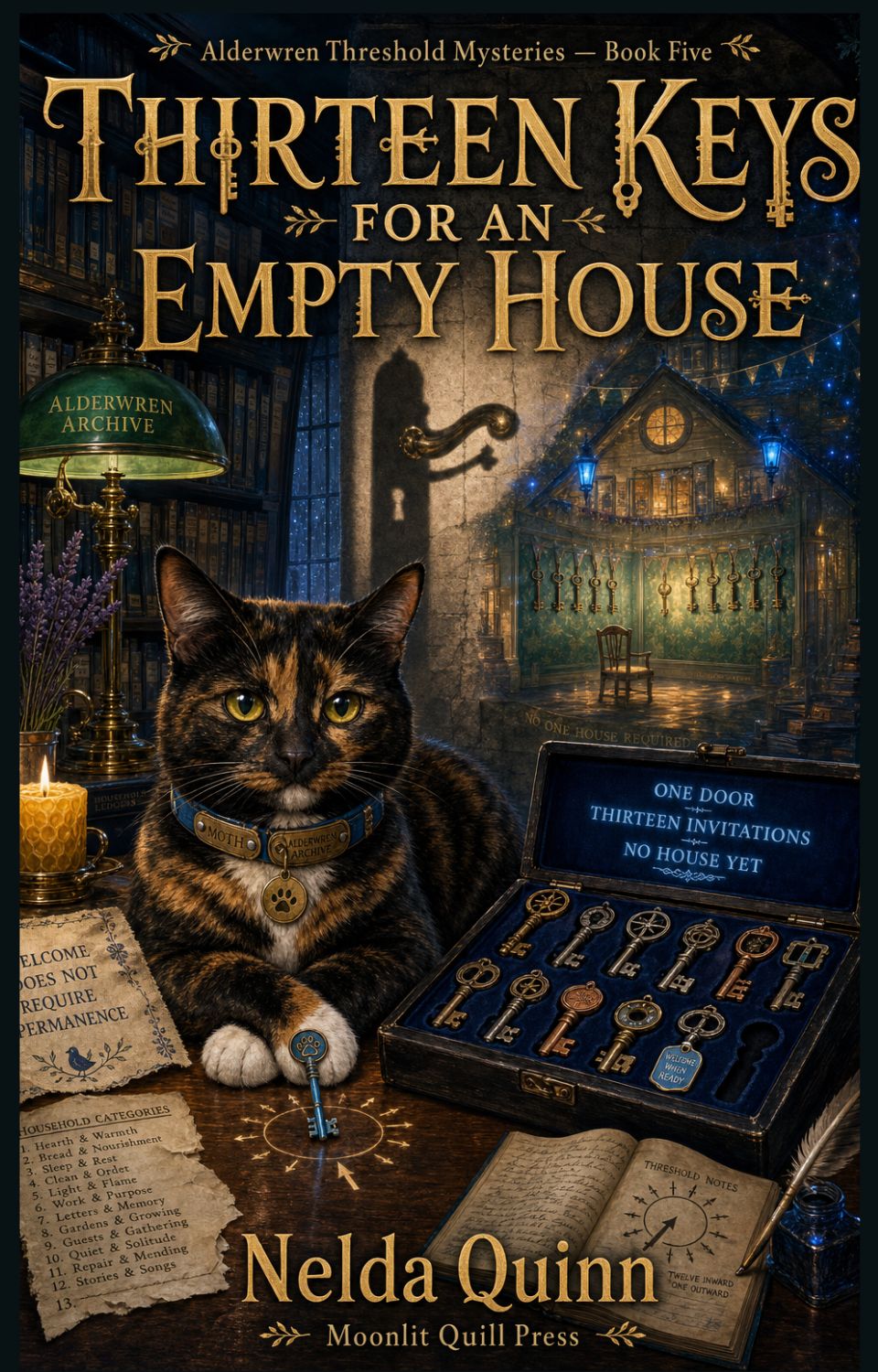
Prologue
Fifty-two years before thirteen keys arrived at the Alderwren Archive, the House of Common Welcome opened its doors for the final time. Blue lanterns glowed along its honey-colored eaves, polished windows reflected the festival bunting, and every room smelled faintly of beeswax, lavender, and fresh bread. From the street, it looked less like a civic experiment than the sort of house people imagined remembering from childhood, even when they had never lived anywhere like it.
Honoria Quill stood inside the entrance hall with the concordance ledger pressed against her ribs. Twelve brass key hooks curved inward along the green-papered wall, each holding a different key. The thirteenth hook faced the rear door and remained empty.
“You may enter,” Aldous Brindle told the invited guests as he welcomed them across the threshold. He spoke the phrase with ceremonial warmth, while clerks beside him recorded each acceptance beneath the Committee for Harmonious Households’ gold seal. “Today, Alderwren will finally learn what every safe and proper home requires.”
Honoria lowered her gaze to the ledger. The original wording had been gentler: what many households might need, what some arrangements might offer, what no home should be forced to become. Aldous had revised the question after the third public demonstration because several committee members complained that uncertainty produced poor administrative guidance.
The first guests entered beneath the category of Residence, followed by representatives for Property, Partnership, Inheritance, Care, Hospitality, Temporary Lodging, Work, Privacy, Emergency Authority, and Moving Homes. Each key changed the house as it crossed the threshold. A second bedroom appeared upstairs, the kitchen table lengthened, a nursery gained an adjoining carer’s room, and cupboards labeled themselves according to who was expected to use them.
At first, the changes inspired applause. A narrow ramp unfolded beside the front steps without blocking the ordinary path. A private workroom developed soundproof walls, while a guest room produced a departure notice stating that no stay renewed itself without permission. Tea arrived exactly as each visitor preferred it, and a warm loaf appeared beneath a linen cloth embroidered with the words WELCOME DOES NOT REQUIRE PERMANENCE.
Beatrice Vale touched the cloth and frowned. “That line was meant for the front door.”
“The kitchen is the heart of a household,” Aldous said. “The house has placed the principle where everyone will see it.”
“Everyone who is permitted into the kitchen,” Honoria replied. She did not look up from the ledger, and her pen stayed where it had stopped, resting against a line she had not yet found a way to write.
Aldous smiled as though she had offered a useful but minor correction. He turned toward Isolde Bellglass, who sat at the central table with her witness pen uncapped. “Eleven perspectives have entered freely. You may record that concordance is approaching.”
“I may record eleven invitations,” Isolde said. “Approaching is not a witnessed condition.”
The Moving Homes representatives entered next. Wheels formed beneath the eastern rooms, and the garden gate shifted toward the lane. For one pleasant minute, the house held several possible locations at once, each visible through a different window.
Then the central hall widened. The moving rooms locked themselves to the foundation, and a brass plate appeared beside their door: TEMPORARY DISPLACEMENT RESOLVED.
“That is not what they requested,” Selwyn Rook said. He stood near the rear passage in his green guide’s coat, one hand closed around the missing thirteenth key. “Their movement is the household form.”
“The house is finding the nearest stable arrangement,” Aldous replied. “Stability is among its purposes.”
Upstairs, a guest-room nameplate changed from VISITOR to HOUSEHOLD MEMBER. In the care wing, a private door lost its interior lock because the house had decided the assigned carer required continuing access. Two married participants who maintained separate residences discovered their rooms merging around one shared wardrobe.
Beatrice hurried toward the care wing, her heels loud on the new boards. “Restore the lock.”
The door produced a second handle on the corridor side instead. A silver notice appeared above it: TRUST REQUIRES ACCESS.
“No,” Beatrice said. “Trust requires choice.”
The house did not restore the lock. It warmed the room, softened the bed, and filled a bedside glass with water, as though comfort answered the objection.
Honoria opened the ledger to the thirteenth category. Departure and Exit had once occupied three full pages of conditions. Aldous’s latest revision had reduced them to a single pending invitation.
“Selwyn,” she said quietly, “do not give them the key.” The words came out lower than she had intended, pitched to travel no farther than the width of the table between them.
He looked toward the central hall. The twelve inward-facing hooks had begun drawing closer together, and the walls between the household wings softened like wax near a flame. At the center waited an empty chair labeled RESIDENT.
Aldous extended his hand. “The house cannot complete its work while one perspective remains withheld.”
“Departure is not withheld,” Selwyn said. “It is available.”
“A proper household cannot be designed around leaving.” Aldous kept his hand out, palm upward, in the manner of a man requesting a document he had every right to receive.
“A proper household must survive the knowledge that someone may.” Selwyn did not move, and the small key stayed inside his closed fist.
The rear door opened behind him. It showed the street, the ordinary festival lanterns, and several people outside who had chosen not to enter at all. The house shuddered as though the sight offended its understanding.
Isolde closed her witness ledger. “I will not certify agreement.”
Aldous’s expression hardened. “Twelve perspectives support the common design.”
“Twelve invitations are not votes,” Honoria said. She kept one finger inside the ledger to hold the page, and did not soften the sentence with anything further.
The central chair turned toward her. Its blank brass nameplate shimmered, testing the shape of her name before rejecting it. The house had not found its resident because it was not looking for a person. It was looking for someone who could stand for everyone.
Selwyn pulled the thirteenth key from his pocket. It was small, blue-bronze, and cut for no front-door lock. He fitted it into a tiny panel beneath the rear stairs, and thirteen seams flashed across the floor.
Aldous stepped forward, one hand raised toward the panel he could no longer reach. “What have you done?”
“Preserved the way out.” Selwyn withdrew his hand from the panel and left the key where it stood.
The rear passage tore free from the house with a sound like cloth parting at a careful stitch. Cold evening air rushed through the hall. Guests fled through ordinary doors, private hatches, garden gates, and openings the official plans had never acknowledged.
Honoria remained long enough to strike one final line through the concordance ledger: THIRTEENTH INVITATION PENDING. She replaced it with REFUSED.
The ink would not hold. Before she reached the street, the word faded back to PENDING, and behind the sealed front door, the empty chair faced the darkened hall.
“May I enter now?”
Chapter 1
Thirteen Objects Without a Door
Tobin Reed unlocked the bakery at eight precisely, which was late enough to feel unnatural and early enough for three customers to be waiting beneath the blue-painted sign. The sign displayed the hours he had chosen after the Lantern Oven crisis in letters large enough to discourage interpretation: OPEN EIGHT TO FOUR. CLOSED TUESDAY AFTERNOONS. FOOD MAY BE PURCHASED ELSEWHERE. Someone had added a small chalk star beside the final sentence, although Tobin had not decided whether it represented approval or mockery.
Flora Beck stood inside the bakery with the first tray of seed rolls already cooling beside the eastern window. She had opened the kitchen under her assigned-shift agreement, lit the ovens, checked the honesty bell, and refused two requests delivered through the letter slot before Tobin arrived. One concerned a bun capable of revealing whether a neighbor intended to return a borrowed ladder, while the other asked for a cake suitable for remembering a husband’s better habits.
“You declined both?” Tobin asked as he tied on his apron.
“I informed the first customer that ladders require conversation and the second that selective memory is not currently an approved ingredient.” Flora shifted the seed-roll tray two inches from the window. Her dark hair fell across one eye as she inspected the crusts. “I also opened without you.”
“So I observed, from the terrifying fact that the building remains upright.” He hung his coat on the hook that had held it every morning for eleven years and did not look at the shelf beside it.
“The building was relieved.” Flora turned the tray a quarter turn and left it alone after that, which was her way of declaring a thing finished.
Tobin looked toward the warm front room, where Kit Marlow was turning the door sign from CLOSED to OPEN with exaggerated ceremony. The tables were clean, the bread shelves full, and the large central oven had behaved as an ordinary oven throughout the morning. No voice emerged from a refuge charm to criticize the glaze, and no silver writing altered a recipe. The absence had become less startling in recent days, but it had not yet become easy.
He reached automatically toward the shelf where Agatha’s brass cottage charm had once rested during bakery mornings. The space now held a jar of wooden spoons and the ordinary recipe card she had left him after her final bake. Tobin adjusted the jar although it required no adjustment.
Flora noticed and did not pretend otherwise. “The orange loaves need scoring.”
“I was about to do that.” He was not, and the dough had reached the stage where it would forgive him for another minute at most.
“You were moving spoons.” She said it without cruelty, in the tone she used for stating oven temperatures.
“They had become complacent.” He crossed the kitchen at last, and the shelf stayed where it was behind him.
She passed him the scoring knife. Tobin accepted it and turned toward the waiting dough rather than the empty place on the shelf. Beyond the front windows, Alderwren had settled into a clear late-summer morning. Lantern Lane smelled of warm stone, tea leaves, damp flower boxes, and bread from more than one kitchen, which Tobin considered a healthy civic development even when the other bread was inferior.
The first customer entered and asked whether the reduced hours meant the bakery was failing. Tobin sold her two seed rolls, one pear bun, and no reassurance beyond the truth that the bakery had chosen different hours and remained open within them. By half past eight, the room filled with ordinary breakfast conversation. Flora managed the front counter while Tobin prepared the orange loaves, and Kit completed deliveries without accidentally assigning any of them prophetic importance.
Nothing magical occurred until the archive bells rang an unscheduled sequence across the lane. Three short notes sounded, followed by one long note and another three. The pattern did not belong to fire, unstable collections, erased addresses, public evacuation, or a committee meeting that had exceeded its food allowance. Tobin set down the scoring knife.
Flora counted the final bell with her head tilted toward the window. “Evidence intake?”
“Evidence intake is two, four, and one.” He wiped the flour from his hands and waited for a repetition that did not come.
“Unclaimed object?” She was already untying the strings of the front apron she would need if she was about to be left alone with the counter.
“One long, then five.” Tobin listened to the silence after the bells, which had a considering quality he did not enjoy.
Kit leaned through the kitchen door with a delivery basket still on one arm. “Cat-related emergency?”
“There is no official cat-related sequence,” Tobin said, and across the lane, Moth appeared in one of the archive’s narrow windows. Her broad tortoiseshell face pressed briefly against the glass before she vanished from sight.
Tobin untied his apron. Flora blocked the kitchen doorway before he had finished the knot. “Where are you going?”
“The archive has rung an unknown alarm, and Moth has appeared in a window.” He said it as though the two facts assembled themselves into a destination without further help from him, which, in Alderwren, they generally did.
“You are scheduled here until four.” She did not move out of the doorway.
“I own the bakery.” It came out with less authority than it had possessed in previous years.
“You also chose delegation.” She glanced toward the clock. “I can manage until eleven. Kit can remain on deliveries and washing-up. You may attend the emergency if it is an emergency.”
Tobin looked toward the cooling trays, the waiting dough, and the customers who would undoubtedly survive breakfast under Flora’s authority. A year earlier, the choice would have felt like abandoning a post. Now it felt merely uncomfortable, which he was beginning to understand as progress.
“Send for me if the ovens develop opinions.” He paused with one hand on the door frame.
“I will close them first.” Flora had already turned back toward the counter, which he chose to read as confidence rather than dismissal.
“Good.” He took one orange loaf from the cooling rack and wrapped it in brown paper. “The archive may require grounding food.”
“The archive always requires grounding food.” She said it to the seed rolls rather than to him.
“That does not mean it knows,” Tobin said. He went out into the lane before she could improve on the argument.
Angela Lark had received the parcel forty-three minutes earlier. It had arrived without a courier, delivery route, postage mark, threshold request, or sound of footsteps in the public hall. Willa Dane had turned away from the accession table to retrieve a provisional-household ledger, and when she turned back, a black wooden box occupied the exact center of the cleared intake cloth.
The box was rectangular, narrow, and deep enough to hold several documents or one professionally disappointing cake. Its wood absorbed the reading-hall light instead of reflecting it, while thirteen tiny brass marks circled the lid. Twelve resembled keyholes, the thirteenth looked like a paw print, and no one had touched it.
Mr. Pell stood on the far side of the table with a sharpened pencil in one hand and the expression of a man whose archive had accepted a delivery without completing the correct paperwork. Willa remained beside him, wearing her green archive apron and the blue scarf she used during evidence intake. Five ledgers lay open around the box, each prepared for a different classification and none yet selected.
Angela examined the intake cloth. No folds, dust lines, heat marks, threshold residue, or displaced fibers showed how the box had arrived. “Did the archive door open?”
“No,” Willa said. “The public door remained visible from my position.”
“The red lower-collections door? The windows?” Angela had not yet looked up from the cloth.
“Closed and latched, all of them.” Willa’s hand rested flat on the table edge, as though holding the morning in place. “I checked before the ledgers came out.”
“Chandelier response?” The truth-sensitive chandelier hung at its proper height above the reading hall, and its crystals gave a small uncertain tremor, which Mr. Pell regarded as unhelpful.
“It lowered one inch when the box appeared,” Willa said. “It rose again after I stated that I had not admitted the object.”
Mr. Pell sharpened his pencil by one additional turn. “The archive should not accept unrecorded household deliveries.”
Angela looked at him. “Why household?”
“The box has placed itself upon the household-intake cloth.” He indicated the stitching with the pencil point, from a distance that respected the intake boundary.
Willa glanced down. The blue cloth beneath the parcel had been set out for their morning training session on disputed flood-claim residences. It contained stitched fields for current address, household form, private routes, temporary access, and information intentionally withheld.
“The box may have chosen the nearest available cloth,” she said. She moved no closer to it while saying so.
“Objects do not choose intake categories.” The chandelier lowered by half an inch, and Mr. Pell looked upward. “Noted.”
Angela opened her small ledger. The morning had begun at Primrose Bend with a requested delivery from Jonas. He had used the limited key only after she sent an explicit note asking him to bring the revised boundary maps while she was upstairs dealing with a Listening House pipe that believed a kettle required three harmonizing notes before boiling. Jonas had entered through the ordinary front door, announced his presence, placed the maps on the kitchen table, and waited rather than following the house’s internal route.
The key agreement had worked exactly as written. Angela found this both reassuring and emotionally significant, although she had not recorded the second point in the access ledger.
She had left Jonas at Primrose Bend drinking tea after he confirmed that the garden remained stable and the false permanent-household key remained sealed beneath the stairs. He was now on his way to the archive with his map board. Pippa and Elsie had also been sent for, while Nera was already present at a borrowed consultation table near the archive’s east windows.
Nera’s Open-Form Writing Support term had begun four days earlier. She operated that morning beneath a plain notice written in her own hand:
OPEN-FORM WRITING SUPPORT
CURRENT LOCATION: ALDERWREN ARCHIVE, EAST TABLE
WORDS REMAIN WITH THE PERSON WHO CHOOSES THEM
NO FIXED OFFICE IMPLIED
Two clients had already come and gone. One had needed help describing a household that moved between a rooftop greenhouse and rooms beyond Gloaming Row. The second had wanted to record a current name without answering whether it would remain permanent.
Nera now stood several yards from the evidence table, holding a wooden writing board against her dark green coat. Her plain name tag still read only NERA. “The box is listening to the household cloth,” she said.
Mr. Pell turned toward her. “How do you know?”
“The private-address field keeps closing.” She nodded toward it without approaching, and Willa looked down. A stitched flap on the cloth had folded itself over the space labeled ADDRESS MAY REMAIN WITHHELD. She opened it, and the flap closed again.
Angela made a note. “Does the box react to your service?”
“No.” Nera’s scarred green eye remained fixed on the parcel. “It reacts to the possibility that something may be part of a household without declaring where.”
The public doors opened, admitting Jonas, Pippa, Elsie, Tobin, and one gust of warm bread scented with orange. Tobin placed the wrapped loaf on a side table well away from the evidence, and Mr. Pell looked toward it.
“Crumbs remain prohibited within six feet.” He indicated the boundary with the blunt end of his pencil.
“The loaf is intact.” Tobin set one hand on the paper as though prepared to defend its condition.
“That is a temporary condition.” Mr. Pell returned to his ledger, having established the boundary to his satisfaction.
Pippa came to Angela’s side. She carried a narrow case of household charms beneath one arm and wore spectacles that had collected a faint line of blue thread across one lens. “Has the object asked for shelter?”
“No,” Angela said. “Nor has any been offered.”
“Good.” Pippa studied the black wood for a long moment, her head tipped as though listening through it. “It feels prepared to be welcomed.”
Elsie removed her folded umbrella from beneath one arm and placed it beside the red door. The sky outside was clear, but the umbrella had correctly predicted indoor weather twice during the previous month and therefore continued attending investigations under provisional relevance. Her silver witness whistle rested against her coat.
Jonas unfolded his map board on the adjacent table. Bellweather Steps, Primrose Bend, the archive, Lantern Lane, Clover Row, Wren Court, and the Shared Edge appeared in familiar brown ink. No route reached the black box.
Moth emerged from beneath the evidence table, and no one had seen her enter the reading hall. She walked once around the parcel, sniffed each corner, and sat beside the paw-shaped brass mark. Her permanent collar displayed its five established addresses, while the dry seed husk remained beneath the blue band by her own choice. Nothing new had appeared on the tag.
Angela crouched several feet away. “Did you bring the box?”
Moth washed one white-tipped paw with great attention. The question appeared to concern somebody else entirely.
“Do you know who did?” Angela asked, and the cat continued washing.
Tobin unwrapped the orange loaf. “Her silence remains procedurally flexible.”
“It is not consent,” Angela said. She did not turn around to say it.
“I know. It may still be disdain.”
Mr. Pell opened a new intake ledger. “We will begin with the exterior inscription.”
“There is no inscription,” Willa said. The box clicked.
Everyone turned. Silver letters surfaced across the lid, not engraved but rising through the dark wood as though the words had been waiting beneath it.
ONE DOOR.
The archive chandelier lowered two inches. A second line surfaced beneath the first.
THIRTEEN INVITATIONS.
The box gave another quiet click. Moth stopped washing.
NO HOUSE YET.
The reading hall became very still. Tobin cut the ordinary loaf and offered pieces without approaching the table, and no one declined. Angela accepted one slice, ate two bites, and waited for the present room to settle around the impossible message.
“What does the box contain?” Pippa asked.
“Unclear,” Angela replied. She was already writing the question down.
Tobin looked at the lid. “Keys.”
Mr. Pell frowned. “That is an inference.”
“The object mentions a door and thirteen invitations.” Tobin gestured at the silver wording with the bread knife, then lowered it when Mr. Pell’s eyebrows moved.
“It does not mention keys.” Something metallic shifted inside the box thirteen times.
Tobin took another bite of bread. “Improved inference.”
Elsie asked whether the group wanted the exterior conditions witnessed before opening. They agreed separately. Her whistle released one low amber note, which passed through the box, the stitched household cloth, the silver inscription, and every person standing within the intake boundary.
“The box is physically present,” Elsie said. “No current person here invited it into the archive. No witness confirms a sender, route, household status, property claim, emergency authority, or right of access. The inscription is present but does not establish an obligation to open.”
Amber light settled around the box. The silver wording remained unchanged.
Pippa placed a small exit charm beside the intake cloth. It resembled a blue wooden door with an interior brass latch. “This does not open a route. It only confirms that any offered shelter must preserve refusal.” The charm remained cool.
Jonas set his compass near the parcel. The ordinary needle pointed toward Bellweather Steps, and a second needle did not appear. Instead, thirteen fine marks formed around the compass rim.
“Twelve point inward,” he said. “One points away.” Moth placed her paw on the outward mark and left it there.
Angela looked at the paw-shaped symbol on the box. “The thirteenth invitation may concern Moth.”
“Moth cannot speak the stated phrase,” Pippa said. She did not sound as though she considered the objection decisive.
“The inscription may not require speech.” Mr. Pell considered the box. “We have not established that any keyholder has been selected.”
The lid opened one inch. No one had touched it. Moth rose, slipped one paw into the gap, and pushed the lid closed again.
Tobin looked down at her. “She objects to premature inventory.”
“Or to the box opening itself,” Angela said. She made a third note beneath the other two.
Willa prepared thirteen separate object sheets while Mr. Pell reviewed the opening procedure. The box would be opened under Witness, Direction, Shelter, and archive intake controls. No object would be handled directly. Names or identifying marks would be recorded without treating them as appointments, household claims, or invitations, and every person named would retain the right to refuse involvement.
Nera added one line in her own handwriting at the foot of the sheet. It read: BEING NAMED BY AN OBJECT DOES NOT MAKE THE OBJECT’S PURPOSE VALID.
Mr. Pell read it twice. “Place that above the signature field,” he said, and Willa did.
Elsie witnessed the procedure. Pippa confirmed the exit charm remained active, Jonas mapped the intake boundary, and Angela used two archive cloths to lift the lid.
The interior was lined with deep blue velvet. Thirteen keys rested in separate hollows, and no two resembled one another.
The first was green brass, with narrow teeth cut like ledger tabs, and a small plate beneath it read ANGELA LARK. The second was dark iron, its circular bow formed by a compass that turned even while the key lay still, above a plate reading JONAS THORNE. The third consisted of three hinged metals joined along one stem, and its hollow contained no surname and no address, only NERA.
A polished silver archive key bore MIREN SABLE, and a heavy black filing key beside it bore MARTIN PELL. The sixth key was warm copper wrapped in faded blue thread for PIPPA VALE, while a narrow silver key ending in a lantern-shaped bow belonged to ELSIE MORROW.
Tobin’s brass key had teeth shaped like scored bread. Willa’s nickel key carried an enamel label that erased and rewrote her name twice before settling. Elspeth Harrow’s old room key possessed seven notches, Mrs. Della Rusk’s small clockwork key ticked faintly against the velvet, and Sella’s wooden key changed its grain when Angela looked away.
The thirteenth hollow contained a tiny blue-bronze key. Its bow bore Moth’s paw mark.
Moth jumped onto the evidence table. She ignored the other twelve objects and hooked one claw beneath the edge of the velvet beside her key. A corner lifted, revealing a narrow piece of cream paper hidden beneath the lining.
Angela removed it with tongs. The paper contained a list in faded archive ink.
RESIDENCE.
PROPERTY.
PARTNERSHIP.
INHERITANCE.
DEPENDENT CARE.
ELDER CARE.
HOSPITALITY.
TEMPORARY LODGING.
WORK WITHIN THE HOME.
PRIVACY.
EMERGENCY AUTHORITY.
MOVING RESIDENCE.
The thirteenth line had been cut away. Mr. Pell leaned closer, keeping his hands behind his back. “These resemble obsolete household classifications.”
“Not current ones?” Nera asked.
“No. Several are no longer acceptable as independent authority fields.”
Willa examined the torn lower edge. “Someone removed the final category rather than leaving it blank.” Moth pressed one paw on the missing line, and a dull knock sounded from the archive wall.
Everyone turned toward the empty stone section between the public household records and the red lower-collections door. The wall had contained no opening that morning, and it contained no opening now. A polished brass handle cast a shadow across the stones, although the handle itself did not yet exist.
Jonas opened his compass. Twelve marks around the rim turned toward the wall.
The thirteenth pointed toward the public doors.
Chapter 2
The People Named by the Keys
The archive refused to admit that a door handle could cast a shadow without existing. Mr. Pell tested this refusal through three separate observations, one measuring string, and a request that Willa inspect the wall from the opposite side of the reading hall. Each attempt produced the same result. The stone remained unbroken, the brass handle remained absent, and its shadow lay across the wall at an angle consistent with morning light from a window that faced the wrong direction.
Angela stood several feet from the impossible shadow with her ledger open. “Has the angle changed since the box was opened?”
“Two degrees clockwise,” Willa said. She held a narrow archive ruler against the floor without touching the wall. “It is also one inch longer.”
Mr. Pell looked toward the public windows. “The sun has moved.”
“The shadow has moved in the opposite direction.” Willa lowered the ruler and wrote the figure down twice, once in the intake ledger and once on her own cuff.
“That is less satisfactory.” Mr. Pell sharpened his pencil, which was his method of postponing a conclusion he did not wish to reach.
Moth sat beneath the projected handle with her tiny blue-bronze key between her front paws. Angela had not offered it to her. The cat had removed it from the black box after Mr. Pell completed the first inventory sheet, carried it across the reading hall, and placed it on the floor beneath the outward-pointing compass mark. She had refused every attempt to return it to the evidence lining.
The other twelve keys remained in their separate hollows beneath witnessed cloths. Each had received a provisional record stating that the named person had not accepted ownership, duty, household membership, property interest, or invitation authority merely because the key bore their name. Nera had insisted upon adding that refusal of the key would not establish refusal of any present relationship represented by it.
“That sentence is long,” Mr. Pell had said.
“It prevents an object from treating one refusal as another,” Nera replied, and Mr. Pell had approved it without shortening.
Tobin stood near the bread table slicing the orange loaf into pieces thick enough to remain structurally responsible. The archive had not called the intake meeting a meeting, because doing so would activate his ninety-minute food amendment and create an argument over whether time began when the parcel appeared or when the first key was identified. He had brought additional butter anyway.
“The handle looks domestic.” He said it around a mouthful of his own bread.
Mr. Pell turned toward him. “Handles do not possess domestic classifications.”
“That one does. Public doors expect hands in gloves, shop doors expect impatience, and pantry doors expect flour. That handle expects someone carrying tea.”
Angela studied the shadow again. Tobin’s description was imprecise but not useless. The projected handle curved downward in a welcoming shape rather than ending in the flat, practical lever used on municipal doors, and a faint oval plate surrounded the keyhole shadow beneath it.
“There is no visible lock,” Pippa said. She had come as near the chalk line as the boundary allowed.
“There is a keyhole.” Jonas had come to stand at her shoulder, his own hands carefully behind his back.
“A shadow of one.” Pippa remained unconvinced.
“That may be enough for the keys.” He returned to his map board, which covered the neighboring table. The twelve inward-facing compass marks remained aligned toward the empty wall, while Moth’s outward mark pointed through the public doors and into Alderwren. No route had yet formed between the keys and the handle. Instead, faint circles had appeared around twelve locations across town.
Angela recognized several immediately: Primrose Bend, Bellweather Steps, Clover Row, Wren Court, Tobin’s bakery, and the archive itself. Other circles floated near the Shared Edge, the old fountain, the Wandering Inn’s last recorded appearance, and a cluster of moving rooms beyond Gloaming Row.
“The map is locating the named people,” she said. The circles held their positions while she counted them.
“Or the household arrangements attached to them.” Jonas tapped the circle near the fountain. “Nera is here, but her mark keeps moving between the archive, Shared Edge, and three unrecorded positions.”
Nera regarded the map without approaching it. “That is accurate enough to be intrusive.”
Jonas folded a blank sheet over her moving marks, and the map did not resist. “Temporarily concealed,” he said.
“Thank you.” She returned to her writing board, and the set of her shoulders eased by a degree that only Angela appeared to notice.
Elsie’s whistle warmed against her coat. “The keys may be attempting to establish current presence before they form a route.”
“Then we should contact the remaining named keyholders,” Angela said. “Before the keys decide that being found is the same as participating.”
Maud Cresset had already prepared notices. She waited near the accession desk in a grey dress and a hat decorated with one restrained blue feather, which she had selected after learning that magical household evidence might react to excessive ornament. Her first draft read:
YOU HAVE BEEN NAMED BY AN UNCLAIMED KEY IN ARCHIVE CUSTODY. ATTENDANCE IS REQUESTED FOR CLARIFICATION.
Nera crossed out REQUESTED. “That may sound official.”
“It is official,” Maud said. Her pen remained poised above the line.
“The archive wants information. The key may want an invitation. Those are separate.” Nera set the pencil down where Maud could reach it, and Maud considered the objection before rewriting the line:
YOU MAY CHOOSE TO ATTEND AN INFORMATION MEETING CONCERNING AN UNCLAIMED KEY BEARING YOUR NAME OR MARK.
Mr. Pell objected to the phrase information meeting because the purpose remained investigative. Tobin objected to unclaimed because the box might believe it had made a claim. Willa proposed unidentified-purpose key, and Angela approved the final notice only after Elsie witnessed that receiving it created no attendance duty.
Ordinary couriers carried the messages, and no thresholds were used. “The keys may interpret threshold delivery as consent to magical contact,” Angela explained when Maud asked whether ordinary couriers would be too slow.
Maud looked toward the remembered handle. Its shadow had lengthened another half inch. “How much time do we have?”
“We do not know,” Angela said. She did not soften it afterward.
“That is not useful for scheduling.” Maud was already gathering the notices into a squared stack. She left with enough brisk determination to inconvenience distance.
The first person to arrive was Mrs. Della Rusk. She entered the archive carrying the pear-shaped tea clock beneath one arm and her small clockwork key under no circumstances, because the key remained in the black box.
“I came because my clocks began packing.” She set the pear clock down with some ceremony.
Angela looked toward the pear clock. A tiny travel scarf had been tied around its brass stem. “Did you tell them you were leaving?”
“No. I told the east clock that I had received a notice from the archive. It informed the west clock, which interpreted archive correspondence as preparation for a change in household support.”
Mrs. Rusk set the pear clock on the intake table. It rang once and displayed the words FUTURE ASSISTANCE ADVISED across its face.
“I require no assistance with tea,” she said, and the words faded. “I may require someone to wind the tall clock if I travel to Merewick, but that is not a household appointment.” The face cleared completely.
Willa recorded the distinction. “Do you currently live alone?”
“I live with seventeen clocks.” Mrs. Rusk delivered this as a correction rather than a joke.
“Do any hold household membership?” Willa asked it without any visible irony.
“Three believe they do. None has been formally recognized.”
Mr. Pell reached for a new form and then stopped. “The archive has no field for sentient or semi-sentient household objects without ownership implications.”
Mrs. Rusk looked pleased. “Then today has already justified the inconvenience.” Her key ticked inside the box, and the remembered handle’s shadow moved by one degree.
Pippa arrived at the evidence table with the copper key’s record sheet. “Would you like to see the key?”
“Yes. I do not want to touch it.” Mrs. Rusk folded her hands behind her back to make the position official.
Angela lifted the covering cloth with archive tongs. The clockwork key lay in its velvet hollow, its tiny internal gears moving in time with the pear clock.
Mrs. Rusk leaned closer. “That is not a house key.”
“What kind is it?” Angela asked.
“A cabinet key. Possibly a clock case.” She examined the teeth without breathing on them. “It opens something narrow. A front door would be insulted.” Moth’s ears moved toward her.
The next arrival was Sella, accompanied by two members of her moving household and a folding stool they declined to leave unattended because it occasionally chose new rooms without notice. Sella wore the same travelling coat she had worn during the false-petition corrections. Her household had occupied rooms above a greenhouse the previous week, shifted beyond Gloaming Row during two nights of heavy rain, and currently used her sister’s upper floor for ordinary street access.
The wooden key inside the box changed grain when she approached. Dark walnut became pale ash, then reddish cedar.
Sella watched the alteration from beyond the intake line. “It is trying to match the current building.”
“Do your own household objects do that?” Jonas asked.
“Some. Floors adjust to weather. Doorframes remember who is sleeping where. The kitchen table refuses locations with poor morning light.” She looked toward Nera. “Nothing changes without someone agreeing to the move.”
Nera inclined her head. “The key has changed without asking.”
“Yes.” Sella did not touch it, and she moved her household two steps further back from the table.
Elspeth Harrow arrived shortly afterward carrying one small travel bag and a written statement from her current lodging confirming that she had not checked out, surrendered her room, or resumed any custodial duty. Her hazel eyes moved first to the black box and then to the old room key bearing her name, where seven notches marked its stem.
Her expression tightened. “That resembles the Wandering Inn’s guest keys.”
“Is it one?” Angela asked.
“No.” Elspeth remained outside the evidence boundary. “The inn’s keys softened at the edges after repeated use. This one has never belonged to a hand.”
Pippa looked toward her. “Does it feel like a room is waiting?”
“Yes.” Elspeth’s voice remained even, though fatigue passed briefly across her face. “That does not mean I am required to enter it.”
“No,” Angela said. She wrote the sentence into the ledger exactly as spoken.
The key gave a small metallic chime. Moth stood and placed one paw upon her own blue-bronze key until the sound stopped.
By midday, Tobin had supplied ordinary soup, brown bread, and enough chairs for everyone except the empty wall, which had begun projecting the faint shadow of a doorframe. The group ate at separate tables rather than gathering around one household-style board. Pippa believed the distinction might prevent the box from interpreting shared food as domestic agreement.
Tobin looked at the scattered arrangement. “This is the least sociable lunch I have served.”
“It remains food in company.” Elsie said it from her table by the red door.
“That is a low but defensible standard.” He carried the butter across anyway, which undermined the arrangement slightly. The archive did not object to the soup, and its chandelier rose a little after everyone had eaten.
Willa used the meal interval to compare the twelve surviving classifications from beneath the box lining with the present keyholders. The matches were not exact, but patterns emerged. Angela’s key reacted to Residence, Jonas’s compass key turned toward Work Within the Home and Privacy, and Pippa’s copper key warmed near Dependent Care and Hospitality. Elsie’s lantern key responded to Partnership and Elder Care without settling upon either, Tobin’s bread key reacted strongly to Hospitality, and Elspeth’s room key aligned with Temporary Lodging.
“The categories overlap,” Willa said. She had drawn lines between four of them already.
“They should,” Nera replied. “Real households do.”
“The old list treats them as separate administrative concerns.” Willa turned the paper so the torn edge faced the table.
Mr. Pell looked toward the missing thirteenth line. “The committee may have believed one representative could speak for each function.”
“That is often how committees create people who do not exist,” Nera said. The chandelier gave one clear note, and Pell did not object.
Tobin returned to the bakery at noon after Flora sent Kit across the lane with a note stating that the archive had consumed two hours of his assigned workday and would not receive a third merely because soup had been served. He left the remaining bread and promised to return at four unless the evidence developed immediate hunger. The absence of one keyholder did not alter the box, and his brass key remained still.
Pippa, Elsie, Willa, and Mrs. Rusk stayed. Elspeth chose to walk outside for several minutes and returned because she wished to hear the remaining names, while Sella’s household members left to check whether their rooms had moved without them.
Nera shifted her Open-Form Writing Support notice from the east table to a smaller desk near the archive windows. She had suspended appointments for the afternoon but refused to let the investigation absorb the service entirely. “The work exists separately from the key,” she said when Angela noticed.
“Good.” Angela recorded the relocation in her ledger, because a service that moved was still a service that could be found.
The final expected arrival was Miren Sable. She entered through the public doors wearing a charcoal coat fastened to the throat. Her silver-streaked dark hair had been pinned more severely than usual, and she carried no archive materials. Since becoming a historical consultant under Mr. Pell’s authority, she had learned to arrive without assuming access to restricted records.
Her gaze found the polished silver key immediately. For one breath, her composure disappeared entirely.
“You recognize it,” Angela said. It was not a question.
Sable stopped outside the intake boundary. “I recognize the shape.”
“From where?” Angela did not move toward her.
“The old household annex.” She did not elaborate, and the silence afterward had edges.
Mr. Pell looked up. “The archive has never maintained a household annex.”
“It did before the current lower collections were built.” Sable kept her hands at her sides.
“You have not mentioned this.” Mr. Pell’s pencil had stopped moving.
“No.” She offered nothing to fill the space around the word.
Willa closed her pencil between two fingers. “Was the omission deliberate?”
Sable looked at the black box rather than at Mr. Pell. “I believed the annex had been dismantled before I joined the archive.”
“That does not answer whether you deliberately omitted it.” Willa did not raise her voice to say it.
“Yes.” Her answer came without defense. “I did not believe an abandoned domestic-classification project was relevant to current threshold reform.” The silver key brightened, and Sable took one step backward. “It appears to disagree.”
Angela opened a clean ledger page. “What was the annex?”
“A set of model rooms used to test household records. Marriage, inheritance, shared care, guests, servants, temporary residents, private rooms, emergency access.” Sable’s mouth tightened around the list. “The archive wanted one system that could determine who belonged inside a household and who possessed authority there.”
Nera’s wooden tag warmed against her coat. “Determine or record?”
“Determine.” The distinction settled heavily across the hall.
“Who operated it?” Mr. Pell asked.
“The Committee for Harmonious Households.” The remembered doorframe darkened upon the wall, and Sable saw it happen. “Do not use the keys.”
“That was already our current position,” Angela said. “Why?”
“Because the model rooms did not merely reflect the household brought into them. They improved it.”
Mrs. Rusk’s tea clock gave an offended ring. “According to whom?”
“The committee.” The clock displayed UNRELIABLE SOURCE and then returned to the time.
Sable looked from one named key to another. “How many are there?”
“Thirteen,” Willa said. She counted the covered hollows again to be certain.
Sable’s face lost color. “There were only twelve accepted household perspectives.” Moth rose from the floor without hurrying.
Angela looked toward the torn paper beneath the box lining. “There was a thirteenth category.”
“Not in the final civic model.” Sable’s voice had gone careful.
“That is not the same as never existing,” Willa said. The chandelier held its height.
Sable’s eyes moved to Moth’s tiny key. “Where did that come from?”
“The box,” Angela said. She indicated the open lid with the tongs.
“No.” Sable stepped closer to the boundary without crossing it. “That key was never stored with the others.”
“How do you know?” Angela asked.
Sable stared at the paw mark for a long moment. “Because the thirteenth key was removed before the Concordance House was sealed.”
The word entered the room with enough force to change the map. Jonas’s twelve inward-facing circles drew together around the archive, and lines appeared between them, forming the outline of a wide central hall. At its rear, one narrow route extended away from the others, and it was Moth’s.
Sable closed her eyes briefly. “I thought the plans were destroyed.”
“What did the Concordance House do?” Pippa asked.
“It tried to decide what a proper household should be.” Sable said it as though the sentence had been waiting fifty-two years.
“And the thirteenth key?” Angela said.
Sable looked at Moth. “It was the only one made to open a way out.”
The archive wall gave a soft knock, and the remembered handle became solid brass. No door formed around it, but the handle now existed, and beneath it a keyhole appeared in the stone. Twelve keys rose from the velvet lining and turned toward the wall.
Moth caught her own key between her teeth and carried it toward the public doors.