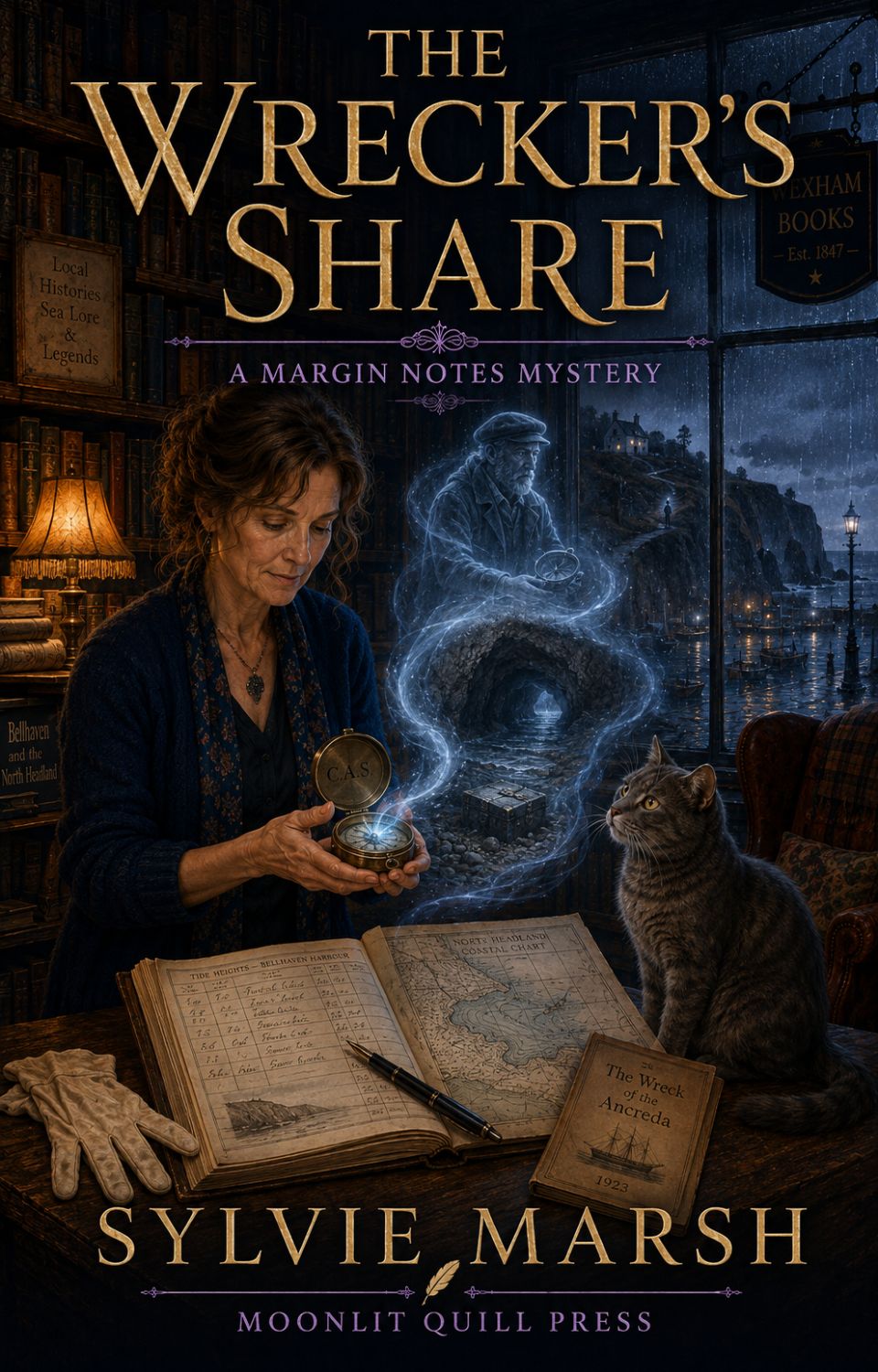
Chapter 1
A Reasonable Amount of Morning
The rain had come in overnight and left Chandler Street polished, every cobblestone catching grey light from a sky that couldn't quite decide what it wanted to do with the morning. Cecily stood at the counter with a box of donated paperbacks at her elbow and worked through them in the methodical way that had become, over seven years, one of the more reliable pleasures of her week.
She wore her archivist's gloves, thin white cotton, fitted. She handled each book the way the work required: spine up, boards checked for water damage, a glance at the title page for edition and any inscription, the particular attention she gave to anything with a handwritten name inside. Most of these she could date by feel before she looked. A mid-century hardback had a different weight from a modern one, a different give to the spine, the smell in the gutter between text block and binding shifted by decade as reliably as any date stamp.
She catalogued as she went, noting provenance in her small, careful hand. *Donated, late October.* Most were recent paperbacks, the kind that left a charity shop and circulated through a town's reading life until they arrived here: holiday reads and celebrity memoirs and a few genre novels whose spines had been broken open flat and never recovered. These she shelved in General Fiction without ceremony.
Then a 1960s Folio Society Pepys with a damp tide mark on the boards that stopped well short of the text block. She set it aside. A collection of Cornish dialect verse, privately printed, worth keeping for Local Interest if it wasn't too far west. She opened it and found, in faint pencil on the flyleaf: *For Megan, who knows what matters.* She kept it.
The shop settled around her as she worked. The Margin Note occupied the ground floor of a Victorian terrace on Chandler Street, three doors from the harbour, and had the particular cold of buildings in which stone walls did most of the structural thinking, cold that didn't shift much between seasons, that a person's body heat barely made a dent in. In October it smelled of old paper and lemon oil and something beneath both of these, something mineral and ancient, the stone itself. The east-facing window caught harbour light when there was any; this morning there wasn't much, just a flat pewter gleam off the wet street and the pale suggestion of water beyond.
She had arranged the shop herself, when she bought it, according to principles she'd developed over a decade of handling rare books: the sections that needed browsing room got it, and the sections that rewarded careful attention were placed where the light was best. Fiction and biography occupied the main run of shelving: narrow aisles, shelves that went a foot too high for comfortable browsing, which was intentional, because the books people didn't have to reach for were not always the books they needed most. The returns shelf ran along the wall by the door, low and accessible, operating on the anonymous-drop convention that had been in place when she bought the shop and that she saw no reason to revise. People left things on it without explanation. She accepted them without inquiry. It suited everyone.
The Local Interest section was in the back-left corner. It was her addition, built up over seven years from donations, private purchases, and the occasional auction lot that nobody else had wanted. Bellhaven's maritime history. The county's agricultural history. Regional geology, folklore, old OS maps in various states of repair. She'd had to put in an extra shelf unit the previous spring and there was already no room on it.
She lifted a large-print thriller from the box, checked it, shelved it. A Penguin Classic in near-perfect condition. A paperback with someone's name written in biro on the fore-edge, which she found faintly melancholy in the way of objects that outlast their owners' intentions.
The morning was hers, and she was in it, and that was sufficient.
She heard Audrey before she saw her: the familiar sound of the passage door from Salt \& Thread opening with its characteristic wooden complaint, and then Audrey's unhurried step on the flagged floor, and the small percussion of two mugs being set down on the corner of the counter.
"Tea."
Cecily looked up.
Audrey had her reading glasses on her head rather than her face, which meant she'd been pricing something in the back of the gift shop. She was wearing something in layered earth tones, a rust-coloured cardigan over a cream blouse, and she had the comfortable, unhurried quality of a person who moved through the world at the pace she had chosen rather than the pace anyone else was setting.
"Thank you," Cecily said, and took one of the mugs.
Audrey settled her elbow on the counter and looked at the box of paperbacks with the mild appreciation of someone who found other people's sorting pleasant to observe. She didn't pick anything up or volunteer opinions on the titles. For a moment she just looked at the window, where the wet street was doing its best with the light.
Then she said, in the tone of a person thinking aloud rather than addressing anyone in particular: "The trouble with things that wash up is nobody ever asks where they came from."
Cecily glanced at the donations box.
"I think in this case they came from the Oxfam on the high street," she said. "The sticker's still on some of them."
Audrey received this without correction. She picked up her own mug, smiled vaguely at the middle distance, and made her way back to the passage door with the ease of someone who had done exactly this thousands of times and found it exactly sufficient.
The door closed behind her with its wooden complaint.
Cecily drank her tea and reached into the box and found a hardback history of the English lighthouse service, published 1971, with a map folded into the back boards. She unfolded it carefully. Devon and Cornwall, survey detail, showing the coastal stations active at the turn of the century. She refolded it along the existing creases and set the book with the other Local Interest candidates.
She was halfway through the box when she became aware that Ptolemy had arrived.
He did this sometimes: appeared in the shop without apparent means of ingress, which she had long since stopped trying to account for and accepted as belonging to the category of things about Ptolemy that were simply true. He was large and heavy and grey, with a coat that was dense enough to seem slightly implausible, and copper eyes that gave away nothing except the fact that they were attending. His left ear had a small notch in it that she had never asked about and didn't intend to.
He crossed the floor from the direction of the back room, navigated the narrow aisle between General Fiction and Biography with the economy of long practice, and went to the Local Interest section at the back of the shop.
She watched him over the top of the donations box.
He was not, she had come to understand, looking for somewhere to sleep. He slept wherever he chose, including once on top of a first-edition *Pevsner* that she had been keeping for a customer and which he had compressed very slightly on one corner. This was different. He moved through the Local Interest section with a quality of attention she recognised but couldn't quite name: the way a person moved through a room when they were looking for a specific thing and were not prepared to leave until they'd found it.
He came to a stop near the end of the second shelf, between the coastal geology and the maritime history. He turned twice, precisely, and settled with the solid finality of something that had made a decision.
Cecily looked at him. He looked at the shelf. She looked at the shelf, but it was too far away and too dark in that corner to make out individual spines without going over, and she was in the middle of the box, and there was a reasonable amount of morning left.
She turned back to the donations box. A paperback cookbook, water-damaged; she set it aside for recycling. A collection of essays on the English essay, which she found charming. A novel by someone she'd published once, in another life. She paused on this slightly longer than was strictly necessary, then shelved it in Fiction with the others.
At the back of the shop, Ptolemy sat on the Local Interest shelf and looked at nothing in particular, with the focused, unhurried attention of a creature that had all the time there was.
Cecily catalogued.
The window faced east and the light off the harbour was still grey and flat, but it was the light that would be there all morning, and it was enough to work by.
The shop was exactly itself.
Chapter 2
What Belongs in an Estate
By mid-morning the street outside had dried to a matte grey, the cobblestones losing their shine but keeping their cold. Cecily had finished the donations box and started on the weekly task she thought of privately as the rounds: checking the shelves for items that had migrated through browsing to wrong sections, pulling anything that needed repair, making a note of the gaps. The shop had rhythms like this, small reliable circuits that anchored the days in a way she had come to depend on without quite intending to.
Ptolemy was still on the Local Interest shelf. She had glanced at him twice in passing. He had not moved and had no plans to.
She was straightening the biography section when the door opened.
The woman who came in paused just inside the threshold in the way of someone who has learned, from entering a great many rooms professionally, to take a reading before committing to a direction. Dark-red hair, cut practically. A waxed jacket over a flannel shirt over something thermal: layers added in the right order, not for appearance, the outermost layer scuffed at the left elbow and bearing a pale tide mark that had been there through several washes and given up. She had the hands, Cecily noticed, of someone who worked with objects: the particular stillness in the fingers that came from spending years not dropping things.
She was not a tourist and she was not here for the holiday fiction. She moved into the shop with a quiet attention, working her way along the shelves without touching anything, the way a person did when they were reading the room rather than the books.
Cecily returned to the biography section and let her look.
The woman made her way toward the back of the shop. She passed the natural history and came to Local Interest, where she stopped. Ptolemy received her presence without any observable acknowledgement: no adjustment of position, no shift of copper gaze, the indifference of something that has made its assessment in advance. She looked at the shelves without pulling anything out.
After a moment she turned, and found Cecily.
"Sorry," she said. She had a faint Scots cadence, the *r* sitting slightly further back than an English speaker would place it. "I'm not sure if you'd have this."
"What are you looking for?"
"Maritime records. Anything specific to the north headland. Primarily pre-twentieth century." She paused. "I'd also take general wrecking history if you have it."
"We have some." Cecily came around the counter and moved down the aisle toward Local Interest. "It's mixed in with the coastal geology. Did you want contemporary histories or primary sources?"
"Both, ideally. I'm not particular about condition."
"The primary sources are in better condition than some of the histories. People were kinder to useful books." She found what she wanted: a county maritime survey and the reprint of a Victorian wreck register. She handed them across. "There are a few more things that might be relevant. I'd need to know more about what you're researching."
The woman took both books and looked at the spines with the automatic assessment of someone who was checking their immediate usefulness before deciding whether to say more. Then she held them back out.
"Perhaps I'll come back to it. I should introduce myself. Neve Soane."
"Cecily Mallory." They didn't shake hands. It wasn't that kind of conversation yet. "Are you staying in town?"
"The B\&B above the harbour. For a few days, I think." She said it with the slight imprecision of someone who genuinely doesn't know how long a thing will take. "I'm here to settle an estate. My grandfather's. I hadn't been to Bellhaven before."
"I'm sorry for your loss."
"Thank you." Brief, not cold. The manner of someone who has received the phrase many times and processes it cleanly.
She seemed to be deciding something. Cecily waited. The shop did what it always did when she waited: it was very quiet, the occasional sound from the harbour reaching them as a kind of atmospheric texture rather than actual noise.
"Actually," Neve said, "there's something else. He had a few things — my grandfather — that I'm not quite sure what to do with. Books, some charts. A few objects." She reached into her jacket pocket. "Including this."
She set it on the counter.
A brass compass, heavy and worn smooth with long handling. The kind of instrument that had been in someone's hand or pocket every day for decades, not a display piece, a working thing that had worked. The brass had the particular depth of patina that came from skin oils and salt air over a very long time.
Cecily picked it up.
She turned it over in her gloved hands. The mechanism was sound. She could feel the slight resistance of the pivot as she tilted it, the needle responding. She examined the dial face: the cardinal points marked in a style consistent with mid-century manufacture, the glass slightly hazed at one edge but intact. She turned it to the base.
*C.A.S.* Engraved, not stamped: a person's initial choice rather than a manufacturer's marking. The letters were incised cleanly, the kind of engraving done by someone who intended the thing to last.
She turned it back over. She was about to say something professional about the condition.
She didn't say it immediately.
Something. She would not have called it a sensation, exactly; it was more of a quality, a register that didn't quite belong to the object as she understood it. She held the thought and lost it, because it wasn't a thought. It was more like an alteration in the weight of the thing in her hands, or not the weight, something beneath that. She was aware of her own gloves between her palms and the metal. She had always been aware of her gloves. This awareness was different in character, like the difference between knowing a room is cold and feeling, suddenly, that the cold has a source.
She set the compass down on the counter.
"It's in good condition," she said. Her voice was entirely even. "The engraving dates it as personal issue rather than commercial. Made to be kept, not sold on. Mid-twentieth century manufacture, probably fifties or sixties. The initials are C.A.S."
Neve was watching her with the kind of attention that didn't announce itself.
"His name was Conal," she said. "He used it his whole life."
"Are you certain you want to part with it?"
"I don't know yet." She picked it up from the counter, turned it in her own hands once, and put it back. "I don't know what belongs in an estate and what belongs somewhere else. That's partly why I'm here."
"You could leave it with me for a few days," Cecily said. "In the meantime, if you want to look properly at the maritime records, the ones worth your time are in the Local Interest section, which is a bit of a muddle at the moment, but I can pull what's relevant. Come back tomorrow."
Neve considered this.
"Yes. All right." She picked the compass up from the counter and held it for a moment, not examining it, just holding it, the way people held things that had been someone else's for a long time. Then she put it back down again, this time with a slight deliberateness, as if she'd made a decision. "I'll come back tomorrow."
"I'll find the maritime surveys in the meantime."
"Thank you." She straightened her jacket. Her expression had not changed much through the conversation, but it had changed slightly: the focused attention had eased a degree, as if a question she'd arrived with had been answered in a preliminary way. "You've been very helpful."
Cecily walked her to the door. The street outside was still quiet, the sort of mid-morning lull before the town remembered what it had meant to do. Neve went left toward the harbour without looking back.
The compass was on the counter where she'd left it.
Cecily stood very still for a moment. Not the stillness of the rounds, not the cataloguing composure she wore as easily as the gloves themselves. A different quality of stillness, the kind that had a reason she hadn't named yet. She was aware of the compass without looking at it. She was aware of her own hands, both gloved, held slightly apart from her sides.
The morning continued around her. Somewhere on Chandler Street a van was making a delivery. Ptolemy was on the Local Interest shelf at the back of the shop.
She went to the back room and sat down.