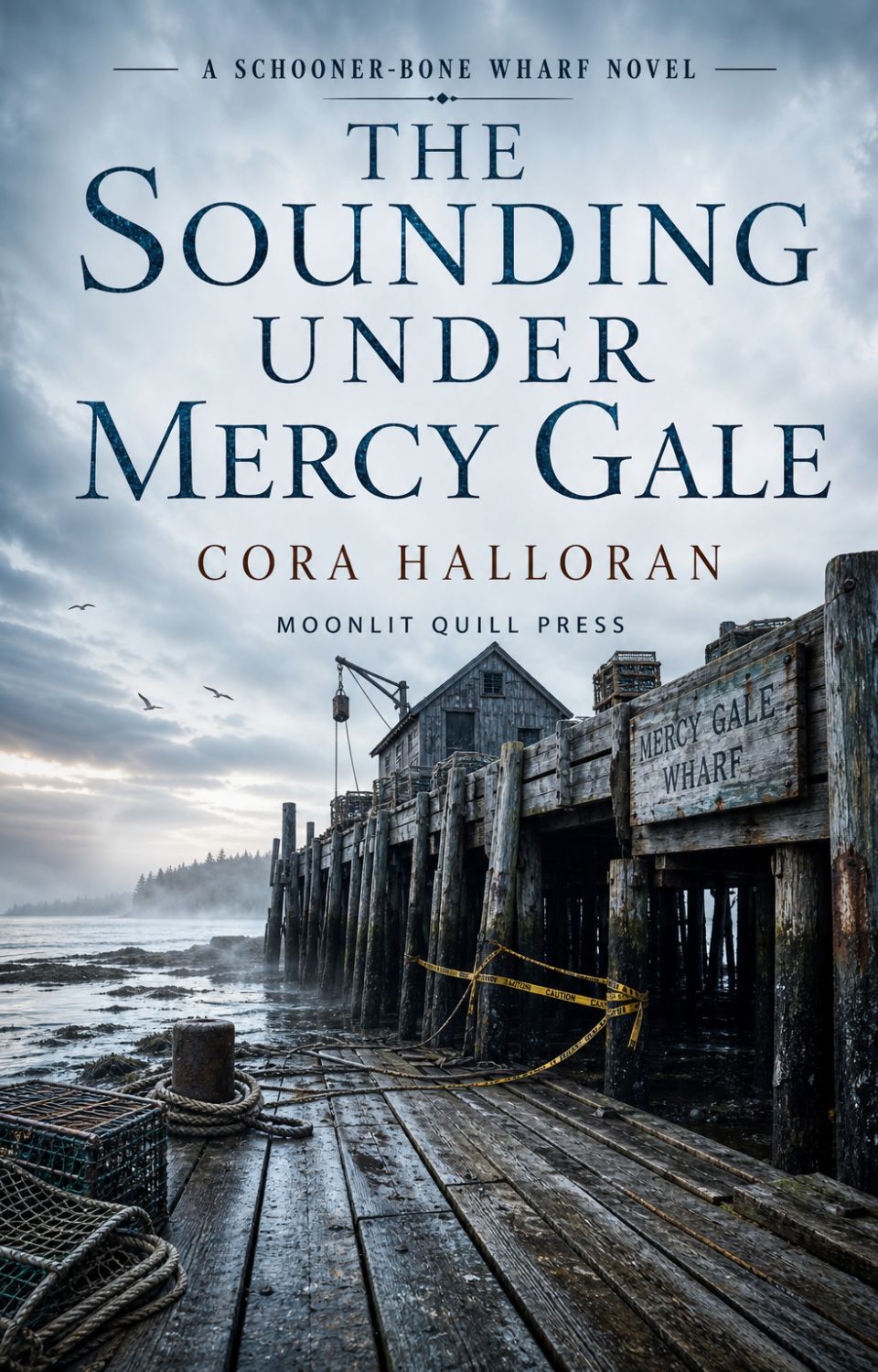
Chapter 1
The Plank That Answered Back
By the time Mara Barstow reached the foot of the wharf, fog had made small possessions of everything.
It hung in the rigging of idle boats and silvered the windshields of trucks backed along the gravel shoulder. It softened the bait shed until the sagging roof looked less derelict than resigned, and it pearled on the orange survey case in Mara's right hand. Somewhere beyond the whitened air, a diesel engine turned over twice, coughed, and gave up. Gulls complained from the fuel-shed roof.
Mercy Gale Wharf waited at low tide.
That was how Mara thought of it before she could stop herself: not as timber, pile caps, decking, crib stone, bracing, fasteners, load paths, deterioration, and liability, but as a thing waiting. It reached from the Barstow lot into the gray-green suck of Harpswell Reach, patched in three shades of lumber, its north shed leaning toward the water. Under it, the pilings stood black and shaggy with weed. Mussels clung to the lower bands.
Sixteen years away, and the place still knew how to stand there accusing her.
Mara stopped with one boot on gravel and one on the first plank. She had promised herself, somewhere around Brunswick, that she would count everything: vehicles, boats, split decking, rust bloom at bolt heads, ponding stains near the threshold, the deflection along the south edge that made the rail line dip where it should have run clean. Counting was a mercy when memory wanted to be theatrical.
She set the survey case down, lowered her other boot onto the wharf, and the plank beneath her answered.
It was not loud. No grand crack, no theatrical shriek of timber giving itself to disaster. Just a dull flex, felt through the sole first and heard a beat later, a wet-throated knock below the deck as if something underfoot had shifted in its sleep. Mara went still. The fog wet her eyelashes. Behind her, one of the gulls dragged its beak along the roof metal with a sound like a knife being tested.
"That's new," she said.
No one answered her at first. The men near the bait-shed doors had stopped speaking when she got out of the car, and their silence had the practiced shape of local judgment. They had all known her when she was small enough to fall asleep on a coil of rope in the sun, and now they watched her with the insulted curiosity reserved for grown children who returned with clipboards. She recognized shapes more than faces: shoulders gone heavy, ball caps faded into family crests, hands that had learned to close around rope, gaff, invoice, coffee cup, grievance.
Then the bait-shed door opened, and her father came out carrying a mug with no steam.
Alden Barstow was fifty-nine and looked, at a distance, like sixty-nine had already walked down the road to meet him. The fog made his beard darker than it was and silvered the edges of his hair under the brim of a cap that still bore the old Barstow Lobster & Wharfage patch. His orange bib overalls were clean at the chest and filthy at the knees. He had dressed for work in front of her. Of course he had.
"Morning," he said.
He did not say her name.
Mara bent, pressed two fingers against the plank seam, and felt dampness pump up from below.
"Morning," she said. "Is this section usually this active?"
"Active?"
"Moving under point load."
Alden looked past her toward the men at the shed, inviting them to admire the language. One shifted. Another coughed into his fist. The wharf breathed salt and old bait up through its seams.
"It is a plank," Alden said. "Planks move."
"Healthy decking distributes load. This is localized deflection."
"It is low tide. Everything complains at low tide."
"Not everything with a person standing on it."
His jaw worked once, not quite chewing the inside of his cheek, not quite forming words. Mara remembered that motion from kitchens where drawers were slammed carefully instead of loudly because her mother had been asleep after a double shift, or because Jonah had been in the next room, or because everyone in that house had believed volume was less dangerous than precision.
"You said eight," he said.
"It is seven fifty-two."
"Boats start landing at eight."
"Then I am eight minutes early for a structure that may not be able to carry them."
Alden's eyes moved over her face, quickly and without permission, as if inventorying what Portland, college, engineering firms, and her own stubbornness had done to the girl who left. A woman in waterproof boots and a dark field jacket. Her mother's eyes. A mouth held too flat because if she softened it, he might mistake restraint for forgiveness.
He looked away first.
"You can do your measuring after the morning boats clear."
"The letter from the town says immediate assessment before continued commercial use."
"The letter from the town was written by your cousin because she likes the sound of her own stamps."
"Etta did not hire me."
"No. Some insurance man did. Which is worse, probably."
Mara lifted the survey case and stepped farther onto the deck before he could block her without making a scene. The plank flexed again. She marked the location in her head: approach bay, third plank in from south edge, roughly twelve feet from landward abutment, moisture intrusion from below, likely failed fastener or compromised joist. The numbers calmed the first hot rise in her chest. Anger was noisy. Data could be held in the hand.
"I'm going to start with the accessible deck, then the pile line at low water," she said. "If you have drawings, repair records, inspection notes, permits, anything from the last ten years, I need them."
Alden gave a short laugh. "Existing drawings."
"Records, then."
"You think I have a file cabinet full of this place?"
"I think you have bills."
That reached him. She saw it in the skin around his eyes, the almost-flinch. Around them, the men pretended not to listen by listening harder.
"What I have," Alden said, "is boats waiting."
"And what I have is a license number and an obligation to say whether those boats can use this structure without putting a crewman through it."
"You always did like saying obligation."
There it was. The first true blow, small enough to deny afterward. Mara felt it land somewhere under her ribs and hated him for knowing the old address.
"Yes," she said. "It has served me better than improvisation."
One of the men at the bait shed made a low noise, not quite amusement. Alden turned his head.
"Something funny, Royce?"
"Nope," said Royce, who had once given Mara a half-melted orange ice pop from the bait freezer when she was eight and had told her not to tell Jonah because bait freezers were not for children or dessert. He was older now, beard gone white at the chin, but his ears still stuck out from under his cap. "Just clearing my throat."
"Do it quieter."
Mara opened the survey case on a section of decking she trusted more than the first plank and laid out her tools: laser distance meter, moisture meter, crack gauge, flashlight, inspection mirror, notebook sealed in a plastic cover. She wanted the first pass on foot. Structures told on themselves if you listened before imposing theory. Old structures, especially.
The wharf had delayed long enough.
"Where do you want us?" Royce asked, and the question was for Alden, though his eyes slid once toward Mara.
"Working," Alden said.
"Not on the south lane," Mara said. "Not until I clear it."
Alden turned slowly. "You do not give orders here."
"I do if you want the insurer to accept a preliminary report. If any load is placed on a section before assessment, I note it. If I note it, they act on it."
"You threatening me?"
"I'm explaining the cost of ignoring me."
The words sharpened as they left her, and for one small, awful second Mara heard her mother in them. Tessa had used that exact phrase once when Alden tried to haul with a torn ligament and a storm coming down. The cost of ignoring me. Three weeks later she was dead on a winter road outside Topsham, and every ordinary sentence she had ever spoken became a relic.
Alden heard it too. His hand tightened around the mug until his knuckles paled.
For a moment neither of them moved.
Then a voice behind Mara said, "South lane's no good for the Lowell boat anyway. Her stern sits heavy when they come in full."
Mara turned.
The man crossing from the float carried a coil of green line over one shoulder and moved with the unshowy balance of someone whose body had learned that land and water were both temporary agreements. He wore oil pants faded at the thighs, a gray sweatshirt under an open jacket, and boots rinsed black by tide. Older than she had expected from the voice. Younger than the wear in his hands.
He did not look at her first. He looked at the deck.
"She kicks a little toward the south when the buyer's crate is aft," he said. "You put her on the north cleats, she'll sit cleaner."
"Finn," Alden said, warning packed into one syllable.
Finn glanced up then, and Mara had the inconvenient impression of steadiness. Steadiness was different.
"What?" Finn said. "You want her to inspect it, let her inspect it. You want the Lowell boat through without touching her bad plank, put them north."
"I did not ask you."
"No," Finn said. "But you hired me to tell you when timber's lying."
Mara looked from him to Alden. "You're the timber contractor?"
"No," Finn said. "I fish."
"He does odd repairs when he needs money," Alden said, and made the work sound both useful and faintly disreputable.
Finn smiled without showing teeth. "Which is most of the time, on account of liking groceries."
Royce laughed outright. The humor changed the air just enough to let everyone breathe. Mara had forgotten that about working waterfronts, how jokes did not soften danger so much as make a handle for it.
"Finn Deveraux," he said, shifting the coil higher when it slid. He did not offer his hand because hers were full of tools and because, perhaps, he understood that introductions on a wharf belonged to the work first. "I know where the bad boards are, but not always why they're bad."
"Mara Barstow."
"I know."
Of course he did. Everyone knew. She had been gone long enough to become a sentence people could attach to her name: Tessa's girl, Alden's daughter, the engineer down to Portland, the one who did not come for Jonah's last week. People kept the version of your absence that suited them.
"If you know where the bad boards are," she said, "I need them marked."
"Already did some."
Alden made a sound. "Finn."
"Paint dots," Finn said to Mara. "Under the gull mess, mostly. Blue for soft. Red for don't be stupid."
Royce said, "Professional system."
"Universally understood," Finn said.
Despite herself, Mara almost smiled. The almost was enough to irritate her.
"Show me."
Finn stepped forward, then paused. He looked down near her left boot and, without comment, nudged the green coil off the walkway with the toe of his boot. A loop had fallen where her heel would have caught when she turned. It was a small thing, done quickly, without flourish, and he was already pointing toward the second bay before she could decide whether to thank him.
"There," he said. "See the blue?"
Mara crouched. Under a chalky smear of gull droppings, faint blue paint marked the edge of a plank. She pressed the moisture meter prongs into the timber. The reading climbed too fast.
"How long?"
"This one? Soft last fall. Bad by March."
"Why wasn't it replaced?"
The question belonged to Alden, but Finn answered because he was the one she had asked. "Because you replace that plank, you find out the joist under it is gone. You replace the joist, you open the bay. You open the bay in March, you lose the berth until June. June comes, and everybody needs the berth."
There was no defense in his voice. No accusation either. Just the arithmetic of delay.
"That is not a maintenance plan," Mara said.
"No," Finn said. "That's lobstering."
Alden's mouth tightened, but he did not contradict him.
Mara wrote the reading in her notebook. She moved down the south lane, setting her weight carefully, mapping paint dots, dips, and wandering fastener lines. Beneath her boots the wharf changed voice: hollow over voids, dull over saturated joists, firmer where newer planks crossed old oak. She could read enough of it to know the first page was bad.
Men resumed work around her in cautious currents. Royce and a younger crewman redirected crates toward the north lane. Finn spoke to a boat easing in from the fog, one hand lifted, voice carrying low over the engine. Alden stood near the bait-shed door with his cold mug, watching every minute of work that did not happen on schedule turn into money he did not have.
"You keep frowning at that cap," Finn said.
Mara looked up. He had come back without her hearing him. The green line was gone from his shoulder. A smear of mud marked one sleeve.
"Pile cap," she said.
"Cap, then."
"It has crushed fibers along the bearing line. Either the cap is degraded internally, or something shifted below it."
Finn crouched beside her, close enough that she caught the smell of salt, wool, and bait soap, but not so close as to crowd. He looked where she pointed. Really looked. Some people, when shown an engineering problem, watched your finger. Finn watched the timber.
"That one runs back to the old crib," he said.
"The oldest section?"
"So they say."
"Mercy Gale timber?"
"That's the story."
He said story without mockery, but the word struck differently from history.
"Who says?"
"Alden. Jonah before him. Everybody at some point after two beers."
"You don't believe it?"
"I believe old men know which stories keep a wharf standing."
She glanced at him. "Stories do not carry vertical load."
"Depends on the family."
It should have sounded glib. It did not. His eyes remained on the timber, and Mara had the sense that he had not meant to say anything revealing. The fog shifted around them. Somewhere in the shed, Alden barked at someone about crate counts. A truck door slammed up on the road.
"Did you mark this one?" Mara asked.
"No."
"Why not?"
"Didn't feel it from above."
"You test from above?"
"Boot, pry bar, bad mood."
This time she did smile. Finn saw it. Something eased at one corner of his mouth.
"Professional system," she said.
"Universally understood."
Alden's voice cut across the deck. "Mara."
The name hit harder than his earlier refusal to use it. She stood too quickly and felt the wharf shift beneath her, not danger, exactly, but response. Alden was at the shed threshold, and beside him stood a man in a clean navy vest, hair trimmed close, boots too new at the seams. Cal Pike had his father's square head and his mother's pale eyes, and the Pike Bait & Fuel logo on the folder under his arm made the men around the shed go quiet in a different way.
Pike. Her grandmother's name before Barstow took it and then failed to keep her. Marion Pike Barstow had left this house in 2002 with two suitcases, no settlement, and enough silence that Mara had learned to treat the name as weather: always present, rarely discussed, dangerous when it shifted.
Cal was Marion's nephew, which made him kin in the town's loose, inconvenient arithmetic and creditor in every document that mattered. That combination should have been impossible. In Harpswell Reach, Mara was already remembering, impossible things often arrived in clean vests carrying folders.
"Didn't know you were coming today," Cal said.
"That makes two of us," Mara said.
Cal smiled as if she had been warmer than she was. He tapped the folder against his palm: fuel account, bait account, line of credit adjustment, all of it nothing she needed to worry about, he said, unless operational viability entered her report. Mara told him she was figuring structural condition. Cal opened one hand.
"With an old wharf, those sit pretty close together."
She hated that he was not wrong. Load traveled through bank notes, tax bills, fuel tanks, family pride, and men waiting with boats full of lobster.
"If debt terms have affected repairs, I will need summaries," she said.
Alden's refusal came before Cal's answer. "No."
"If Pike's business controls whether unsafe repairs were delayed," Mara said, "it is already in this."
For one breath Alden looked not angry but cornered, wearing work clothes like armor repaired too many times. Cal set the folder on a crate.
"We're all trying to keep the place open," he said.
"Generous," Mara said.
Cal looked pleased to have been insulted by someone worth telling about later. "Good to have you home, Mara."
Home.
The word moved across the wharf and found every weak fastening. Cal left with a nod to Alden, a nod to the men, and no nod at all to Finn. That omission had its own weight.
The morning thinned and brightened. Boats moved in a slow, constrained choreography around the north lane while Mara worked the main deck inch by inch. She found two more soft sections, one failed rail post, fasteners so corroded they had swollen the surrounding wood, and an old repair near the centerline where three lumber dimensions met in a knot of compromises. Each discovery tightened Alden's shoulders. Each note she wrote felt less like documentation and more like adding stones to his pockets.
At eleven, Mara reached the pile cap tied to the oldest cribbing.
The fog had burned up enough for sunlight to strike through in patches. This section sat just seaward of the main shed, near the structural heart of the old wharf. The deck boards changed there, newer planks over older framing, and the air seemed colder rising through the seams. Mara knelt, set the moisture meter, waited. The reading climbed high. She took it again. Higher. Through the inspection mirror she saw darkness, weed, and compression failure along the cap edge.
"I need this area clear," she said.
Alden was there in three strides. "Why?"
"Because this cap is not behaving like a cap."
"Meaning?"
"The member that helps carry weight from the deck system into the piles may be crushed, rotten, or unsupported underneath. I cannot clear traffic over this bay until I inspect below."
Alden looked toward the float, where a boat was coming in heavy with crates. "Now?"
"At low tide, yes."
"That boat needs ten minutes."
"Then put it north."
"North's backed up."
"Then wait."
"You pay them for the wait?"
The question was not rhetorical. A crew waiting with product lost more than time: buyer schedules, fuel burn, bait thaw, the invisible favor economy of who got serviced first tomorrow.
"No," she said. "I do not pay them for the wait."
"Easy, then."
"No. Necessary."
Alden looked away, and she saw him count in his head. Two boats waiting. One buyer. Fuel invoice. Repair lumber. Her fee. Insurance. Cal's folder. Behind all of it, the old family sentence: one more season.
Finn stepped into the space before Alden could choose wrong.
"I can bring Lowell to the outside float and run crates by hand," he said. "Slow, but clear of this bay."
"That's a stupid use of time," Alden said.
"Less stupid than dropping them through your grandfather's wharf."
The words quieted the men within earshot. Your grandfather's wharf. Something older.
Alden stared at him. "You got something to say, Deveraux?"
Finn's face did not change, but Mara felt the air tighten.
"I just did."
For one sharp instant Mara thought Alden might fire him, might throw him off the wharf in front of everyone and satisfy some old hierarchy she did not yet understand. Instead Alden turned toward Royce.
"Move Lowell outside."
Royce lifted both hands. "Moving Lowell outside."
Work shifted around them, grudging but efficient. Finn took the incoming line, wrapped it, and leaned his weight at exactly the right moment as the boat nudged the float. Competence again. The kind that made itself visible only when trouble came looking.
Mara returned to the cap.
She pressed the inspection mirror deeper through the seam and angled her flashlight. For a moment the beam caught only water movement and marine growth. Then the light struck a strip of old paint on a hidden timber face. The paint had faded to the color of a bruise, but a curve of lettering remained. Not enough to read. Enough to suggest a name had once been there.
Mercy, perhaps.
Her thumb tightened on the flashlight.
She had been told the story of the schooner before she understood what a schooner was: Mercy Gale broken on the ledges, Silas Barstow hauling her bones ashore, the wharf rising from wreckage because Barstows did not waste what the sea gave back. Only later had she learned that salvage required papers, rights, timing, permission. The sea might give. The county still wanted forms.
"Find something?" Finn asked behind her.
She did not jump, but it was close.
"Old paint."
He crouched again, careful not to put weight near the marked plank. She handed him the mirror. Their gloves brushed, rubber against leather, a small practical contact that rang through her more clearly than Alden's anger. Finn angled the mirror and looked.
"That's her," he said quietly.
"The Mercy Gale?"
"Looks like the old lettering."
"You've seen it?"
"There is a piece in the shed. Alden uses it as a shelf because reverence only goes so far when you need somewhere to put valve grease."
Mara let out a breath that almost became a laugh. It surprised her, and him too, by the look he gave her. Not a long look. Just enough to register that she was not only a professional problem sent to ruin the day.
"I need below-deck access," she said.
"You'll want the tide another foot down."
"How long?"
"Forty minutes. Maybe less with this wind."
"Can we reach from the south side?"
"You can reach. Whether you can get back without smelling like the bottom of a bait barrel depends on how much dignity you brought."
"Not much."
"Good. Dignity gets slippery."
This time she laughed, just once. It came out rusty from disuse. Alden heard it from the shed and looked over as if the sound belonged to a stranger using his daughter's mouth.
The laugh died.
Finn followed her gaze, then busied himself with the mirror. "I'll show you the access when you're ready."
"Thank you."
"Don't thank me yet."
He walked away, leaving Mara with the old paint, the crushed cap, and the uncomfortable knowledge that she had expected resentment, not steadiness.
At noon, she laid her preliminary notes on a crate beside the bait shed and found Alden watching the columns of figures as if they were written in a language he had once known but could no longer afford.
"I have enough for an interim restriction," she said.
"Already?"
"Yes."
"You haven't even been under."
"Which is why it is interim. The south lane closes. No heavy loads over the center bay until I inspect below. North lane limited to one boat at a time. No stacked crates within six feet of the marked cap."
He stared at her. "That cuts landing capacity by half."
"At least."
"You know what that costs?"
"Not exactly."
"Then do not stand there like cost is a clean word."
Mara folded her notebook shut. "I know cost is not clean."
"Do you?"
The men had drifted away. Not far. Far enough to grant the illusion of privacy and keep the privilege of witnesses. Finn was coiling line near the float with his back partly turned, though Mara suspected he could hear every word.
"Yes," she said.
Alden set his mug down too hard. "You come back here with your instruments and your city boots--"
"These are not city boots."
"Do not interrupt me."
"Then do not perform for me."
His mouth shut.
Mara's pulse moved in her neck. Good, she thought irrationally. Good. If he was going to make this ugly, let it be honest ugly, not the polite rot of schedules and tide windows.
"You think I wanted this?" he asked.
"I think you avoided this until someone else had to want it."
"I kept it standing."
"You kept it open."
"Same thing here."
"No," Mara said. "That is the problem."
He looked as if she had slapped him. Maybe she had. There were families where truth was a blow because no one had built any other delivery system.
"Your grandfather kept this place through years you do not know anything about," Alden said. "I took what was handed to me and did the best I could."
"I believe you."
That stopped him more completely than argument would have.
Mara swallowed. The salt air had dried on her lips. "I believe you did the best you could with what you were willing to face. Those are not the same thing."
For a long second, Alden's face held too many years at once: father, widower, debtor, owner, the man standing in front of a failing wharf while his daughter wrote its weaknesses down. Then the old shutters came down.
"Close what you want," he said. "Put your tape up. Make your report. Boats still need a place to land."
"Not on a structure that may fail."
"Then you better tell me how to fix it."
There, at last, was the ask he had hidden under resistance all morning: solve this without making me beg.
Mara looked past him to the wharf, to the old shed and the patched deck and the faint, secret paint beneath the cap. She had come prepared to diagnose. Condemn, if necessary. Leave, certainly. She had not come prepared for the way the wharf seemed to gather the morning into itself and return one clear demand.
Look underneath.
"I need access below the deck," she said.
Alden's eyes narrowed. "You said that."
"I'm saying it as the next step. Now. Before the tide turns."
"Finn can take you."
It was not permission so much as surrender disguised as delegation.
Finn looked up from the float. The green line lay neat at his feet. Behind him, the water moved around the pilings with small, patient sounds, licking weed, lifting loose splinters, keeping its own counsel.
"South side ladder's still there," he said. "Mostly."
"Mostly?" Mara asked.
"Enough ladder to start a conversation."
Royce, passing with an empty crate, said, "Put that in the report."
Mara looked at the south edge, at the dip in the rail line and the dark seam where the deck hid its understructure. Her first plank had answered back. The oldest cap had failed to keep silent. Somewhere below, in the cold air between tidewater and timber, the wharf held the part of the story no one had yet priced.
She closed her notebook, picked up her flashlight, and followed Finn toward the ladder.
Chapter 2
Below the Working Tide
The ladder on the south side of Mercy Gale Wharf had once been painted red.
Mara could tell because the color still lived in protected places, under bolt washers and along the underside of one rung where weather had not worried it bare. Everywhere else, salt and sun had reduced it to a mineral blush. The ladder dropped from the deck edge into the underwharf shadow, its lower rungs furred with weed where the tide reached twice a day.
Finn leaned over the rail and gave it a considering look.
"Still there," he said.
Mara tightened the strap on her tool belt. "That is a generous assessment."
"I said mostly, earlier."
"Mostly is doing heroic work."
"Heroic is what we call something right before it becomes expensive."
She glanced at him despite herself. The fog had thinned into a bright marine haze, and his face was clearer now: pale eyes narrowed against glare, a faint scar crossing the bridge of his nose, a day's worth of stubble though it was barely noon. Mara did not lack balance. Still, there was a difference between knowing how not to fall and belonging to a place that kept changing the terms.
Below them, the tide had pulled away from the lower rung but had not gone far. Water sucked and released around the pilings with small, private sounds. Exposed mud shone black between ribbed mats of rockweed. It smelled of brine, rust, old bait, and something metallic that might have been the ladder or might have been the back of Mara's tongue.
"How much time?" she asked.
Finn checked the water against a stain line on the piles. No watch. No app. Just the mark where tide habit had taught timber to remember.
"Forty minutes before it starts pushing hard. Maybe fifty if the wind keeps it out."
"That is not a measurement."
"It is if you plan to come back up dry."
A younger crewman laughed from the bait-shed door at something Royce said. Alden did not. Mara felt her father nearby without looking: the particular weight of his silence, the way it made men decide whether to speak or swallow. He stood ten feet back with his arms folded, watching the ladder, Finn, and Mara in a way that made every buckle on her harness feel louder.
"I need the south lane kept clear," she said.
"You said," Alden answered.
"No loads over the marked cap. No exceptions while I'm under."
"You said that too."
"Say it back."
His eyes hardened. "What?"
"Say it back so I know we agree."
The wharf held them all in a bright, wet pause. A gull landed on the bait shed and gave a harsh cry, offended by human repetition. Mara smelled coffee from somewhere behind her and diesel from the idling Lowell boat, heard crates knocking faintly as the crew waited to unload outside the safest path available. That wait was already costing someone. She knew it. Alden knew she knew.
"No loads over the marked cap," he said at last. "No exceptions while you're under."
"Thank you."
"Don't."
The word came out raw enough that she did not answer. Finn stepped between them without seeming to.
"I'll go first," he said. "Second rung's got a twist. Keep your weight near the rail till your foot finds the third."
"I can climb a ladder."
"Good. Then you'll be fussy about this one."
He swung over the rail and descended with the economical care of a man who did not confuse familiarity with safety. The ladder creaked once under his weight. He tested the second rung, skipped most of his weight past it, then went down until his boots found the mud-coated stone ledge beneath the wharf.
"Your turn."
Mara clipped her flashlight to her belt and swung one leg over. For one absurd second she remembered climbing down this side as a child because Royce had dared her. Her mother had found her halfway down and said, very calmly, that the tide did not care whose daughter she was.
Now the second rung did indeed twist under her boot.
"I have it," she said before Finn could speak.
"Never doubted you."
"You inhaled."
"Habit."
The third rung held. The fourth was slick enough that her boot slid a fraction, and Finn's hand rose below her, not touching, just present in case gravity developed an opinion. Mara descended the last few feet and stepped onto the stone ledge. Mud accepted her boot with a soft, obscene sound.
"Dignity," Finn said, "has left the premises."
"It was overvalued."
"Common in waterfront property."
She almost laughed, but the underwharf air took the sound from her. It was colder below, as if the structure held its own season between tide and deck. Light fell through plank seams in thin blades. Water dripped from weed, bolt ends, and the bellies of old timbers. Rust flakes salted the air. When Mara breathed through her mouth, she tasted iron.
Above, footsteps moved carefully. Voices blurred into weight and vibration. Down here, the wharf stopped being a view and became a body.
Mara turned on her headlamp.
The beam struck granite cribbing, blackened piles, diagonal braces furred with marine growth, and newer blocking set at angles no engineer would admit in daylight. Some repairs still showed pale saw marks. Others had gone gray and soft. Near the old crib, water moved through a dark cavity and made a hollow gulping sound.
"There," Finn said, pointing. "South line. Stay on stone where you can. Mud drops faster than it looks."
"How fast?"
He picked up a broken length of lath and pushed it into a black patch beside the ledge. It sank past half its length before meeting bottom.
"Like that."
"Noted."
"That's engineer for 'hell no'?"
"Among other things."
They moved bent under the deck, Finn ahead at first, Mara following with one hand gliding near the nearest pile. Her glove came away damp when she steadied herself against a brace. The understructure smelled layered: old oak, creosote ghost, marine rot, diesel sheen, bait juice soaked down through decades of plank seams.
"You ever been under here?" Finn asked.
"Not since I was a kid."
"Voluntarily?"
"On a dare."
"Royce?"
"Yes."
"He has not grown as a person."
"Comforting, in its way."
Finn paused to duck under a low beam. "Alden know?"
"Then? Yes. Eventually."
"I meant now. That you remember it."
Mara looked at the back of his jacket. "Why would that matter?"
"Things matter different when everybody thinks you left clean."
The remark annoyed her. It also found its mark.
"I did leave," she said.
"Didn't say otherwise."
"Clean is your word."
"Fair."
He moved on, giving her space to be irritated. That was new.
They reached the first marked bay. Mara crouched lower, set the flashlight under her chin, and tapped the suspect joist with the small hammer. The timber answered dully. She tapped six inches down. Duller. She pressed the awl point into a darkened seam, and the wood accepted too much of it.
"Fungal decay," she said.
"Rot," Finn said.
"Yes."
"Had a feeling."
"Your boot-pry-bar-bad-mood method?"
"Also the mushroom."
Mara angled the light. A small shelf fungus had formed along the hidden side of the joist, pale as bread dough.
"Useful observation."
"I contain multitudes."
"Apparently."
He was smiling when she glanced over. Because the space was close and he did not push the joke past its useful life, Mara looked away faster than she meant to. Her shoulder brushed the underside of a beam. Cold water ran down the back of her neck.
"Lovely," she said.
"Wharf's way of saying welcome."
"The wharf has poor manners."
"You met the owner?"
This time she did laugh, softly, and the sound vanished into the drip and suck below them. From above came a thump and the scrape of something dragged. Mara froze.
Finn's head turned.
"Alden," Mara said.
"Maybe."
Another scrape.
She moved toward the opening between braces. Finn matched her pace.
"Dad!" she called.
The sound struck timber and came back smaller.
Above them, Alden's voice: "Moving crates off the south lane."
"No loads over the marked cap!"
"I'm not on the cap."
Finn muttered something she did not catch.
"What?"
"Nothing useful."
"Say it."
"He hears 'cap' and thinks six feet. The timber hears load differently."
Mara looked at him. "Exactly."
"Don't sound surprised. I listen sometimes."
"Then help me make him listen."
Finn braced one hand on a pile and called up, voice level but carrying. "Alden. If you're moving anything bigger than your lunch, move it north of the blue paint. She is not making that up."
Silence.
Then a crate thudded farther away.
Mara waited until the vibration stopped. Her pulse had risen from the old familiar rage of being right and still needing translation. She hated that Finn's voice had done what hers had not. She hated more that he did not look pleased by it.
"Thank you," she said.
"He has known me longer."
"That isn't why."
Finn looked toward the waterline. "No. Probably not."
They went on.
The access narrowed near the main crib. Mara had to turn sideways between two braces, one newer pressure-treated member bolted over an older oak diagonal that had split but not been removed. She photographed the connection. The bolt pattern was wrong, holes too close to the split, washer plates improvised from cut steel.
"Who did this?" she asked.
Finn crouched behind her. Their shoulders nearly touched.
"Which this?"
"This sistered brace. Cut plate. Offset bolt."
"Jonah, maybe. Could be Alden. Could be Peter before he sold everything that wasn't nailed and some that was."
"No permit?"
Finn looked at her.
"Right," she said. "Question withdrawn."
"You want a list of unpermitted wharf fixes in Casco Bay, you're going to need more paper."
"Unpermitted does not always mean unsafe."
"Hear that, Jonah?" Finn said to the dark timber. "You got a compliment."
Mara studied the connection again. The workmanship was ugly but not careless. Whoever made it had been fighting geometry, tide, time, and likely an empty checkbook. She marked it in her notebook, then traced the older oak diagonal with her light. It disappeared toward the crib she had seen from above.
"This repair redirects load toward the old section," she said.
"Bad?"
"It may have kept the deck functioning while increasing stress where the original cribbing was already vulnerable."
"So yes."
"So complicated."
"That's usually yes with paperwork."
She gave him a look. "Do you make a habit of reducing technical assessments to insults?"
"Only when I'm hungry."
"Are you hungry?"
"Always, according to my sister."
"You have a sister?"
"Older. Maeve. Three kids, one husband, zero patience for me. She works the school office in town."
"And steals trap tags through her children?"
"Allegedly."
Mara smiled before she could file the information away safely. Maeve Deveraux. Three children. A school office. A life with ordinary gravity.
Their shoulders brushed as he shifted to let her angle past a pile. The contact was brief, filtered through canvas and field jacket, but in the tight underwharf space it seemed to occupy more room than it should. Mara focused on her notebook. She wrote: diagonal repair, unknown date; load redirection; document request; local report from F.D. pending. F.D. for Finn Deveraux. Initials were safer than names.
"This way," Finn said. "Careful. Stone drops off."
They came to the oldest cribbing.
Even before Mara saw the Mercy Gale timber clearly, she felt the difference. The framing here was heavier, darker, less regular. Massive timbers sat low over granite crib stones, scarred by older fastener holes and long-closed checks. Newer joists had been laid above them like a second story built on an ancestor's back. Water moved through stone gaps, making the hollow sound she had heard from above.
Finn lowered his voice without seeming to decide to. "This is the part everybody talks about."
"As in reverence?"
"As in after two beers, like I said."
Mara stepped onto a flat granite stone and swept her light along the timber face. There: paint, more visible now from below. Not a word exactly, but a curl of faded lettering, a ghost of white edging under black varnish, and beneath it deep scoring where some older hardware had been stripped away. She took photographs from three angles.
"This was exterior vessel timber," she said.
"Meaning the story might be true."
"Meaning this piece came from a boat."
"Careful. That is nearly romance."
"Don't spread it around."
The corner of his mouth moved.
Mara tapped the timber. The sound was not as dead as she expected. Old oak could endure with a stubbornness almost moral. But endurance was not capacity. The cap above showed crush damage, and the newer loads had found this old member in ways its original builders could not have anticipated.
"Alden ever run vehicles out here?"
Finn was quiet a beat too long.
"Finn."
"Small ones."
"Define small."
"Pickup, empty."
"A pickup is not small."
"Empty, I said."
"That is not better."
"Didn't say it was."
She closed her eyes once, then opened them. "When?"
"Last winter. Maybe before. Snow made the approach slick. Easier to back down with sand and salt than haul by hand."
"Over this bay?"
"Close."
"That needs to be in the record."
"Then put it there."
She looked at him. "Will you say it if asked?"
His expression changed. Not refusal. Calculation. A man's license, income, berth, fuel, reputation, and family habits all lived within the radius of a question like that.
"Depends who asks," he said.
"That matters."
"So does eating."
"And safety."
"I know."
"Do you?"
The words came out sharper than she intended. Finn took them without flinching, but something shuttered.
"My uncle went through a float in February when I was nineteen," he said. "Bad cleat, rotten edge, everybody knew and nobody wanted to lose the landing. He lived six hours. So yes, Mara. I know."
The underwharf drip seemed suddenly too loud.
"I'm sorry," she said.
"It was a long time ago."
"That does not make it less true."
He looked at her then, fully, and the space between them changed. Not softened. Clarified. Finn looked away before it could become anything more than recognition.
"His name was Patrick," he said. "He would have hated being used to make a point."
"Then I won't use him."
"Good."
They worked in silence. Mara photographed, tapped, measured, and marked. Finn held the light when she needed both hands. Their hands met once over the probe rod: her fingers reaching for the grip, his already there. Both stilled. The rod lay between them, ridiculous and cold.
"Sorry," he said.
"No, I--"
They both let go.
The rod slid, clattered against stone, and nearly rolled into the mud.
Finn caught it with his boot.
"Very smooth," he said.
"Universally understood."
The humor came back, awkward and grateful. Mara took the rod. This time their gloves did not touch.
She probed the seam between the old Mercy Gale timber and a newer sill set above it. The first two inches resisted. Then the tool punched through into a hidden void.
Mara froze.
"What?" Finn asked.
"Pocket."
"Rot?"
"Maybe."
She withdrew the probe and angled the flashlight. There was no clean line of decay visible, but the seam drank light. She inserted the probe again, slower. Resistance, then nothing. She moved six inches left. Solid. Six inches right. Hollow.
"This isn't uniform deterioration," she said.
"Meaning?"
"It may be a cavity behind the sill."
Finn shifted closer, all humor gone. "Natural?"
"Could be washout. Could be failed crib stone. Could be animal activity."
"Under a working wharf?"
"Animals are not impressed by commerce."
"Fair."
She extended the probe deeper. Something inside the void shifted.
Not much. A faint, internal slide. Wood against stone, perhaps. Shell. Debris. The small sound traveled through the rod into her hand before it reached her ear, and her body understood it before her mind made language.
Finn heard it too. She knew because he stopped breathing.
Above them, a crate thudded on the north lane. Water sucked through the crib stones. Somewhere outside the wharf, the Lowell boat's engine coughed into idle.
"Mara," Finn said softly.
"I heard it."
"What was it?"
"I don't know."
She hated the answer. She had built a life around narrowing the distance between observation and conclusion, but here the distance widened in the dark behind the sill. The flashlight showed wet wood fibers, a pale fleck that might have been shell, and darkness behind it.
"I need the borescope," she said.
"In your car?"
"Yes."
"Tide's turning soon."
"Then we move fast."
Finn looked toward the ladder, toward the waterline beginning to creep back over a lower stone. "I'll get it."
"I can--"
"You stay. Mark the spot. If you go up, we both lose time."
She wanted to object because the logic was his and it was sound. Instead she pulled flagging tape from her belt and tied a strip around the nearest brace.
"Orange case. Side pocket. Black hard case, camera cable."
"Got it."
He moved back through the low framing fast, still careful, still reading footing. At the ladder he climbed past the bad second rung and disappeared above. Mara remained under the wharf with the old timber, the hollow pocket, and the tide beginning its return.
For the first time that day, she was alone with Mercy Gale Wharf. It dripped around her and held weight overhead while light came through the deck seams in bright, narrow wounds. She set one palm against the old timber. Cold. Solid in places. Hiding failure in others.
Something moved above the marked bay.
Not a footstep. A drag.
Mara lifted her head. "Alden?"
No answer.
The drag came again, farther north, then stopped. She could not see through the deck, only the understructure taking vibration and translating it into tremor. He was moving equipment. Away from where she had asked to look next.
Her mouth went dry.
"Dad!"
Still no answer. Or no answer that reached below.
Mara shifted to move back, then stopped herself. If she left the spot, she might not find the exact probe line again before the tide rose. If she stayed, Alden might move whatever he did not want her to see. Structure or father. Evidence or argument.
Finn's boots appeared on the ladder.
"You yelling?" he called.
"Alden's moving something."
Finn dropped the last two rungs and landed in a crouch. He had the borescope case tucked under one arm. "He said he was clearing gear."
"From the north cribbing?"
"I didn't see."
"Did he look guilty?"
"He always looks guilty. It is a Barstow facial tradition."
She should not have laughed. She did, once, under her breath, because fear sometimes needed a crack to escape through.
Finn handed her the case. "What do you need?"
"Light here. Then tell me when the tide reaches that lower stone."
"Already close."
"Then tell me before close becomes stupid."
"Professional threshold."
"Universally understood."
They worked quickly. Mara fed the camera cable into the seam while Finn held the flashlight and kept one eye on the water. The small screen glowed blue-white, showing wet fibers, flecks of rust, barnacle shell, a void larger than the probe suggested. The camera bumped something and blurred. She withdrew a fraction and pushed forward again.
The image steadied.
Inside the pocket lay a rusted spike, a nest of blackened rope fibers, and a flat piece of wood wedged where no washout would naturally place it. Not structural blocking. Not current repair. A shim, perhaps, or a concealment board. Its edge had been cut by hand and softened by years of tide breath.
"That board shouldn't be there," she said.
Finn leaned close. His shoulder pressed lightly against hers, and neither of them moved away because the screen was small and the discovery had taken precedence over manners.
"Could be old formwork?" he asked.
"Maybe. But it is behind the sill, not under it."
"Somebody patched from inside?"
"Somebody patched something."
The camera scraped the board. A hollow sound came through the cable, tiny and intimate. Behind the board, darkness opened deeper.
Then the water reached Finn's boot.
"Mara."
"One second."
"No. Tide."
She advanced the camera another inch. The screen flashed pale and vanished into blur as water surged through the pocket. She pulled back too fast, cable catching on the seam. Finn dropped the flashlight beam, reached across her, and freed it with two fingers.
"Now," he said.
There was no argument in the word. Only fact.
They retreated through the understructure with less grace than they had entered. Water moved over stones that had been dry ten minutes before. Mud sucked at Mara's boot and released it with a pop that would have been funny if her heart were not beating in her throat. She banged her shoulder on the newer brace and tasted rust when she hissed a breath through her teeth. Finn turned once, saw she was still upright, and kept moving.
At the ladder, he went up first, fast, then leaned over the rail.
"Second rung," he said.
"I remember."
"Humor me."
She climbed. The bad rung twisted. Her wet boot slipped enough to send a jolt up her leg, and Finn's hand closed around her forearm. Not hard. Not claiming. Just there, warm through the damp sleeve, steady as a cleat taking line.
For one beat she hung between tide and deck, between the cold air below and the watching world above, and all she could smell was salt and wool and her own pulse.
"I've got you," Finn said.
"I have the ladder."
"Both can be true."
She found the third rung, pushed up, and came over the rail with less dignity than she had hoped and more mud than any professional report required. Royce, holding a crate nearby, looked her over.
"Bottom of a bait barrel," he said.
Mara wiped mud from her sleeve. "Accurate."
"Want that in the report too?"
"Only if you can spell it."
Royce grinned. "I can spell most of it."
Even Alden's mouth twitched before he remembered himself. The small almost-smile hurt more than his anger.
Then he saw the borescope case in Mara's hand.
"Find what you needed?" he asked.
"No," she said. "I found what I need to keep looking at."
His face went still.
Finn climbed over the rail beside her and shook water from one boot. "Old patched sill near the Mercy Gale timber."
Alden looked at him sharply. "I did not ask you."
"No," Finn said. "You keep mentioning that."
Mara unhooked the camera cable with hands that had begun to shake from cold and something else. "There is a hidden void behind the sill. Some kind of older board set inside it. It doesn't match the visible repair pattern."
"Old wharf is full of old fixes."
"This is different."
"You been under there one tide and know what's different?"
"Yes."
The single word struck harder than explanation. Alden looked toward the center bay, then toward the north cribbing. She followed his glance. A stack of cracked plastic bait totes now sat beside the shed door, badly arranged, as if hurried.
"What did you move?" she asked.
"Gear."
"From where?"
"From where it was in the way."
"Of what?"
"Work."
They stared at each other across the wet deck. Around them, the wharf resumed its uneasy business. A boat engine revved. A gull dropped a shell on the shed roof. Someone cursed mildly from the float. The tide rose below, covering the place where the hidden pocket had shifted at her touch.
Finn said, quieter, "Mara."
She looked at him.
He did not say not here. He did not have to. The wharf was full of ears, and Alden knew how to turn an audience into defense. Mara looked down at her notebook, at the mud on its plastic cover, at the orange tape now invisible beneath the deck but present in her mind like a lit match.
"Fine," she said. "For now."
Alden's jaw set. "You going to shut more of it?"
"Yes."
"Of course."
"The south lane remains closed. The center bay remains restricted. No one goes below without me present. No one removes material from the old cribbing."
"This is still my wharf."
"Then act like ownership means responsibility."
The words landed in the open. Royce turned away. The younger crewman found urgent interest in a stack of crates. Finn looked at the deck. Alden's eyes went flat in the way Mara remembered from the years after Tessa left.
"You got your look underneath," he said.
"Not enough."
"It never is with you."
She absorbed that. Let it pass through the part of her that was daughter and settle in the part that could still read timber, tide, and risk.
"No," she said. "Not when something is hollow."
Alden walked back into the bait shed.
No slammed door. That would have been easier. Just the slow scrape of it closing, the latch catching with a tired click.
Mara stood at the rail with mud drying on her boots and rust on her tongue. Finn remained beside her, close enough to speak without giving the town more than it already owned.
"You all right?" he asked.
"I am wet, angry, and professionally concerned."
"So yes?"
"So no."
He nodded as if that answer made sense. "You want me to mark the tote stack?"
She looked at him.
"The gear he moved," Finn said. "If you want to know where it came from, I can make a guess."
"Would your guess be admissible?"
"Probably not."
"Would it be useful?"
"Probably."
Mara looked toward the bait shed, then down through the seam where the old wharf breathed cold air against her knees. She had come here for a report, and already the place was asking for a map no paper record had ever held. Above, men moved crates around the restricted lane. Below, a hidden board waited behind a sill that did not match any repair she had seen. Between those two facts stood Finn Deveraux, who had lost a morning's work to guide her under another family's wharf and now offered a guess as if it were nothing.
"Mark it," she said.
Finn pulled a red lumber crayon from his pocket.
"Professional system?" she asked.
"For this?" He looked toward the closed bait-shed door. "No. This is the other kind."
He crossed to the stack of bait totes and drew one small red line on the deck beside it, so quick no one watching from the road would have known it mattered. Mara saw. That was enough for now.
Below them, under the Mercy Gale timber, the tide filled the hollow place and made it speak in water.