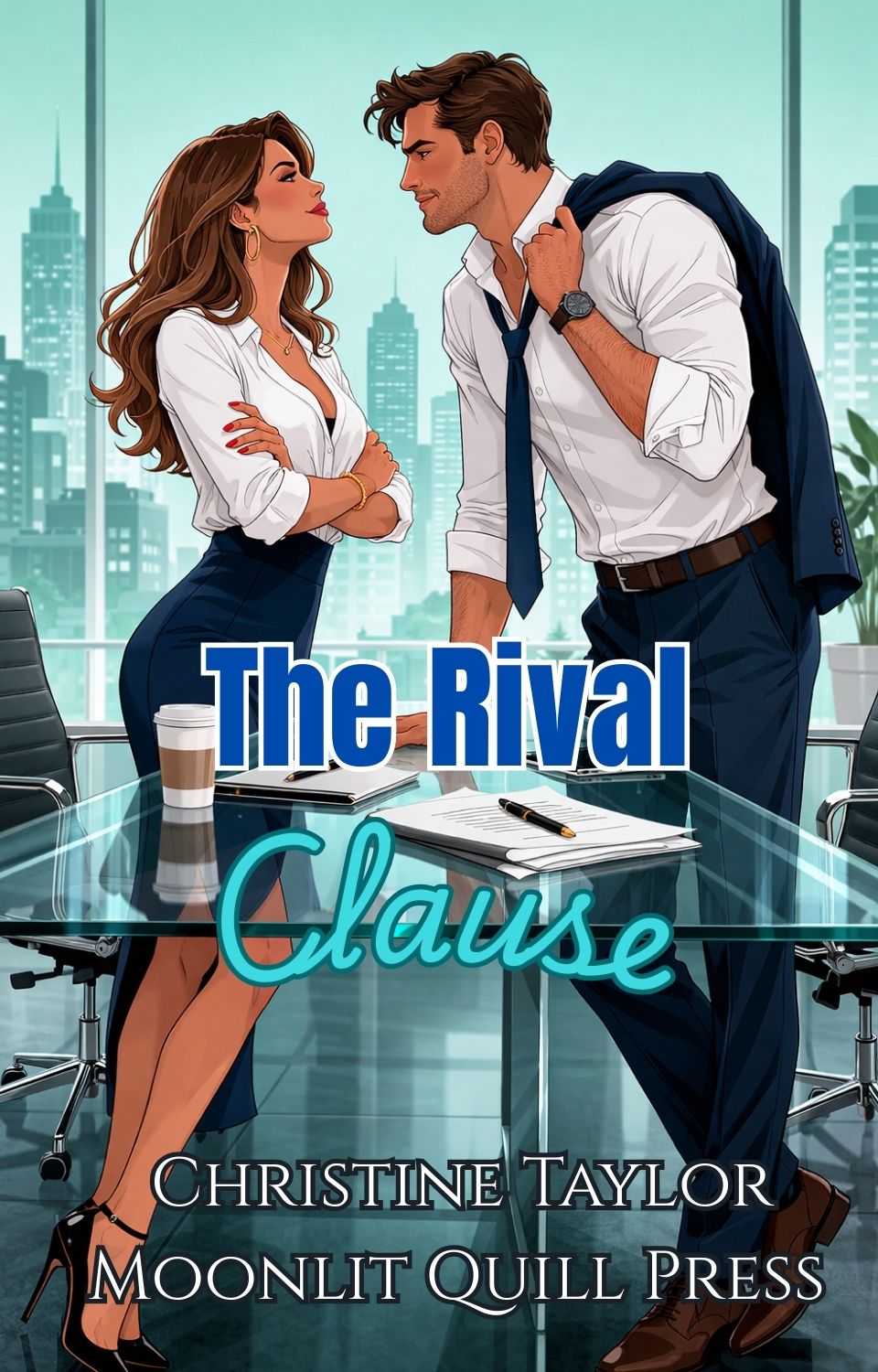
Chapter 1
Public Collision
"The data doesn't lie—secondary markets outperform urban centers by forty-three percent when you factor in acquisition costs versus revenue velocity."
Evelyn advanced to her next slide, watching the numbers materialize on screen behind her. Five members of the Stellar Hospitality acquisition board tracked the upward trajectory of her projected ROI curve with the focused attention that meant she had them. Actually had them, not just polite-listening had them.
The morning light through the floor-to-ceiling windows made everything look aspirational and cinematic, like she was the protagonist in a movie about successful women making power moves in corner offices. She'd take it.
"Which is why boutique hotels in secondary markets represent your highest growth opportunity for the next eighteen months." She clicked to her final slide—clean, confident, irrefutable. "Questions?"
Patricia Clark, the Board Chair, exchanged glances with her colleagues. Several were nodding. Mark Webb, the VP of Strategic Development and most likely to play devil's advocate, was reviewing his notes with the careful attention of someone actually considering an investment.
Nailed it, Evelyn thought, allowing herself exactly three seconds of internal celebration before her brain pivoted to calculating next steps. She'd prep the contract negotiation strategy this afternoon, loop in her CFO, maybe take the team out for—
"Impressive work, Ms. Park," Patricia said. The but was coming. Evelyn could hear it in the pause. "Though I do have one concern."
There it was.
Mark looked up from his notes. "The implementation timeline. Rolling out to fifteen properties simultaneously with your current team structure—how do you maintain quality control at that scale?"
Evelyn opened her mouth, her rehearsed answer already queued up—
The boardroom doors opened.
A man entered with the kind of quiet confidence that didn't apologize for disrupting anything. Dark suit that probably cost more than her monthly office rent, perfectly tailored. He caught Patricia's eye, offered a slight nod—familiar, easy—and took the empty seat at the far end of the table.
Directly in Evelyn's sightline.
Every professional alarm she possessed started clanging. She knew exactly who had just walked into her presentation like he had every right to be there.
Dominic Hale. CEO of Hale Creative Group. The competition. The only other firm in the running for this acquisition.
What the actual hell?
"Scalability is always the challenge with boutique approaches," Dominic said, his voice carrying that effortless authority of someone used to boardrooms listening when he spoke. He wasn't looking at her—his attention was on Mark, like joining someone else's pitch mid-stream was perfectly normal Tuesday behavior. "The key is building flexibility into the infrastructure from day one."
Mark nodded. "Exactly my concern."
Oh, so that's how this was playing. Show up during her pitch, casually demonstrate his expertise, remind everyone there was another option. Subtle. Strategic.
Fine. She could work with subtle and strategic.
"Mr. Hale makes a fair point," Evelyn said, her voice smooth as silk over steel. She made eye contact with him for the first time. Dark eyes, assessing, with an attentiveness that was oddly disarming. Like he was actually listening, not just performing. "Which is precisely why Park Strategy's model incorporates modular training protocols and real-time feedback systems. We scale the process, not just the people."
She clicked to a backup slide—thank god for over-preparation and mild paranoia—showing her implementation framework in color-coded detail.
Dominic tilted his head slightly, studying the screen. "Smart," he said, and it sounded genuine. "Though you'd want to build in redundancy for your senior strategists. If your top talent is spread across fifteen properties simultaneously, you risk diluting the very expertise you're selling."
Damn it. He was right, and she could see Mark nodding again, along with two other board members.
Of course he looks like he stepped out of a menswear catalog, Evelyn thought irritably. Probably timed his entrance for maximum dramatic impact. I should check the security footage later to see if he waited in the hallway for the perfect moment.
"Unless," Evelyn countered, warming to the challenge despite her annoyance, "you're training mid-level staff to execute senior-level strategy. Which requires fundamentally different thinking about knowledge transfer."
"True." Dominic leaned forward slightly, engaged now. "But knowledge transfer at that level requires—"
"—cultural buy-in from property managers," they said simultaneously.
Both stopped. A beat of surprised silence.
Patricia's smile was no longer subtle—she looked delighted. A woman next to her, whose name Evelyn couldn't remember, leaned over to whisper something. Whatever it was made them both look more entertained.
Great. We're performing for them now.
"Which is achievable," Evelyn continued, recovering first because she was damned if she'd let him have the last word, "if you involve property managers in the development phase rather than treating them as implementation vehicles."
"Agreed." Dominic's smile shifted into something that looked almost... pleased? "And if you structure incentives around adoption metrics rather than just outcome metrics."
"We do." She clicked to another backup slide with possibly more satisfaction than was professional. "Tiered bonuses based on training completion, staff satisfaction scores, and guest feedback integration."
"Of course you do." He sat back in his chair, and that smile widened just slightly. "Well then. I stand corrected."
The thing that was deeply unfair about this moment was that he didn't sound remotely bothered by being corrected. He sounded like he was enjoying himself. Like this was fun.
Evelyn's brain was running calculations—what was his angle? Was this some kind of advanced mind game? Meanwhile, her mouth apparently had other plans and kept engaging in what could only be described as professional flirtation disguised as strategic consultation.
"If I may," said the woman whose name Evelyn still couldn't recall, "this is fascinating. Mr. Hale, you mentioned building flexibility into infrastructure. Could you elaborate on how that differs from Ms. Park's modular approach?"
And just like that, they were off again.
"They're complementary, actually," Dominic said, which was a generous way to frame it. "Modular training assumes consistent baseline competency. Infrastructure flexibility accounts for variable property contexts—urban versus rural, seasonal versus year-round, different regional labor markets."
"Which is why the modular framework includes context mapping," Evelyn added, pulling up another slide because apparently she was doing this now. "Each property gets assessed across twelve operational variables before training protocols are customized."
"Twelve?" Dominic raised an eyebrow. "That's thorough."
"Anything less is guessing."
"Fair point. Though you'd want to weigh those variables by impact rather than treating them equally."
"Obviously. The weighting algorithm is—" She stopped herself. "Actually, that's proprietary."
His smile turned knowing. "Of course it is."
Mark was grinning now, not even pretending to hide it. Another board member had given up on notes entirely and was just watching them like this was the best entertainment he'd had all month.
This is absurd, Evelyn thought. I'm in a corporate version of a tennis match and everyone's enjoying the volley more than they care about who wins.
"I think," Patricia said, her voice carrying clear amusement, "we've gotten a bit off track from Ms. Park's presentation. Though this has been illuminating." She glanced at her watch. "Perhaps we should move to the actual reason we asked both of you here today."
Evelyn blinked. "I'm sorry?"
"Both of you," Patricia repeated, the words landing with distinct weight. "The reason we scheduled this meeting with both Park Strategy and Hale Creative Group."
Both.
Oh no.
Dominic had gone very still. He hadn't known about this either, then. That was oddly reassuring and deeply concerning in equal measure.
"Park Strategy and Hale Creative Group have both submitted exceptional proposals," Patricia continued, folding her hands on the polished mahogany table. "Your approaches are complementary in fascinating ways, as we've just witnessed firsthand. Ms. Park's emphasis on cultural integration and employee development. Mr. Hale's focus on scalable systems and operational efficiency."
A beat of silence. Evelyn's throat felt tight.
"Stellar Hospitality is committed to innovation," Patricia said. "We believe the future of marketing requires both boutique creativity and scalable systems. Both vision and execution. Both the human element and the operational framework."
Just say it, Evelyn thought, her hands gripping the edge of the table. Whatever this is, just say it.
"We've decided to introduce what we're calling the Rival Clause."
The words hung in the air like a challenge and a trap simultaneously.
Patricia looked between them, clearly enjoying this reveal. "Both firms will be evaluated over the next eight weeks on three criteria: campaign ROI, leadership integration potential, and cultural synergy with Stellar's values. Whichever firm demonstrates superior performance across these metrics will be selected for acquisition."
Evelyn's stomach dropped somewhere in the vicinity of the first floor. Eight weeks. Not a decision today, not even next week. Two months of every move scrutinized, every campaign measured, her team's entire future hanging in the balance while she—
"The twist," Patricia said, and Evelyn really didn't like the gleam in her eye, "is that you'll be collaborating on a joint pilot campaign while being evaluated separately."
The silence was absolute.
"I'm sorry," Evelyn said carefully, her voice remarkably steady considering her internal screaming. "Could you clarify what you mean by 'collaborating'?"
"We want you to co-lead a pilot campaign for our newest property acquisition—a boutique hotel in Portland. You'll work together on strategy and execution. We'll evaluate both your individual contributions and your ability to integrate different leadership approaches." Patricia smiled like this was a perfectly reasonable request. "Think of it as a live case study in synergy."
Think of it as a corporate thunderdome, Evelyn thought.
Dominic spoke for the first time since Patricia started dropping bombs. "You want us to work together while competing against each other."
"Precisely." Patricia's smile widened. "We believe the process will reveal which firm—or which leader—is the better fit for Stellar's future. The campaign launches in two weeks. We'll provide full briefing materials and access to the property management team by the end of the week."
Mark cleared his throat. "We understand this is unconventional. But Stellar has always valued innovation in process as well as product. Consider it an opportunity to demonstrate your capabilities in real-time, under real pressure."
Opportunity. That was one word for it.
The rest of the meeting passed in a blur of logistics that Evelyn absorbed through sheer professional autopilot. Kickoff meetings. Success metrics. Reporting structures. Weekly check-ins. She smiled and nodded and asked intelligent questions while her brain ran worst-case scenarios at emergency speed.
Working with Dominic Hale meant exposure. He'd see her processes, her team dynamics, her strategic thinking up close. Every advantage she'd built by being smaller and nimbler would evaporate. He'd know how she worked, how she thought, where her strengths were.
Where her weaknesses were.
But she couldn't say no. The acquisition was everything—the validation that leaving her old agency had been right, that she could build something meaningful, that she belonged at this table. That she was more than the assistant whose ideas got presented by someone else. This was proof she could lead.
She just had to win it while working alongside the one person who could take it from her.
Board members finally started filing out, offering congratulations that felt distinctly premature. A few stopped to shake hands with both her and Dominic, clearly entertained by the corporate drama they'd just orchestrated.
Evelyn gathered her materials with mechanical precision, muscle memory taking over while her mind raced. She needed to call her team. Restructure the next two months. Figure out how to collaborate without revealing too much, compete without seeming ruthless, and somehow come out the other side with her company intact.
"That was unexpected."
She looked up. Dominic was standing a few feet away, hands in his pockets. For just a flash—barely a second—something crossed his face that looked like frustration. Maybe exhaustion. Then it was gone, replaced by that controlled neutrality.
"The understatement of the year," Evelyn said.
They were alone in the boardroom now. The silence felt different than during the meeting—less performed, more uncertain. Through the windows, she could see the city stretching out below them, indifferent to corporate drama.
"For what it's worth," Dominic said, "your presentation was excellent. The modular training framework is genuinely smart."
Evelyn studied him, looking for the angle. His expression was neutral, maybe slightly tired around the eyes. No obvious manipulation visible, but that didn't mean it wasn't there.
"Thank you," she said carefully. "Your point about senior talent dilution was valid."
"So we're starting with professional courtesy?"
"As opposed to?"
"I don't know." A slight smile. "Immediate sabotage? Corporate espionage? Declaring blood rivals and refusing to acknowledge each other's existence?"
Despite everything—despite the ambush meeting and the impossible situation and the next eight weeks of hell—Evelyn felt her mouth twitch. "The day is young."
He laughed. An actual laugh, not a networking chuckle or a boardroom performance. It was surprisingly warm.
"Fair enough," he said.
Evelyn picked up her laptop bag, slinging it over her shoulder. The weight was grounding. Real. "Did you know about this? The joint campaign setup?"
"No." He said it simply, and she believed him. "I thought I was here to present to a different subset of the board. Got an email this morning that the meeting had changed, showed up to find..." He gestured vaguely at the room. "This."
"Convenient timing."
"For them, maybe." He tilted his head slightly. "Not particularly convenient for either of us."
That was honest. Unexpectedly so. Evelyn tried to remember the last time a competitor had been straight with her instead of playing games.
She couldn't.
"Come on," Dominic said, moving toward the door. "I need coffee and I'm guessing you do too."
It wasn't really a question, but Evelyn fell into step beside him anyway. They walked through the boardroom doors into the hallway—cream walls with abstract art that probably cost more than her car, recessed lighting creating pools of shadow and warm light, the muted corporate hush of expensive hotels.
The elevator bank was at the far end. Dominic pressed the call button, then leaned against the wall with the kind of casual ease that should be illegal in situations this stressful.
"Can I ask you something?" Evelyn said.
"Shoot."
"Why did you contribute to my presentation? You could have just watched me handle Mark's question. Let me succeed or fail on my own."
"Could you have handled it badly?" He raised an eyebrow. "You had backup slides prepared for every possible angle. I watched you cycling through them."
Observant. Great. Wonderful. Exactly what she needed.
"Still," Evelyn pressed. "You made me look better by engaging. That doesn't strategically benefit you."
Dominic was quiet for a moment, considering. When he spoke, his voice was thoughtful. "Honestly? The question wasn't about making you look bad or good. It was interesting. Your approach to the scalability problem is different from how I'd solve it, and I wanted to understand the mechanics." He shrugged. "Turns out we think similarly about implementation, just come at it from different angles."
"So this was intellectual curiosity."
"Is that so hard to believe?"
Kind of, yes. In Evelyn's experience, corporate rivals didn't engage in good-faith exploration of each other's strategies. They smiled politely and sharpened knives behind closed doors.
The elevator dinged. The doors opened to an empty car.
Neither of them moved to enter.
The doors closed again.
"I looked into your firm when I heard Park Strategy was the other finalist," Dominic said. "What you've built in three years is impressive. Most boutique agencies don't survive past eighteen months, much less compete for acquisitions like this."
"Most boutique agencies don't have former big-agency strategists willing to work for equity and passion projects instead of safe paychecks."
"True. But that takes leadership to pull off. People don't follow equity—they follow vision." He paused, and something in his expression softened slightly. "You clearly have both."
The compliment landed differently than the one about her presentation. Professional praise she could deflect, file away, use as ammunition. This felt more personal. Like he saw something beyond the pitch deck.
Evelyn's carefully maintained defenses wavered.
"Why do I feel like you're trying to disarm me?" she said.
"Probably because I am." His smile was self-aware, slightly crooked. More human than the boardroom version. "But that doesn't make it insincere."
He pushed off from the wall, closing the distance between them by exactly one step. Not invasive—there was still professional space, still appropriate distance—but deliberate. Evelyn was extremely, acutely aware of the shift.
And aware that she didn't step back.
"Here's the thing," Dominic said, his voice dropping slightly. "I've spent the last five years acquiring smaller agencies, absorbing their talent, optimizing their processes. It's effective. It's profitable." He paused. "It's also incredibly boring."
"My heart bleeds."
"I'm serious." He met her eyes directly. "When was the last time someone challenged your thinking in a pitch? Actually made you work for a win instead of just presenting the safe bet that gets the contract?"
Evelyn wanted to have a snappy comeback ready. Instead, she realized he had a point. Most of her recent pitches had been about reassuring clients, demonstrating reliability. Not pushing boundaries or taking risks.
Safe. Predictable. Winning, but not exciting.
"The thing I realized during your presentation," Dominic continued, "is that I haven't been intellectually challenged in a long time. And then you started talking about emotional journey mapping for guest experiences, and I thought—" He smiled. "Oh. There it is."
"There what is?"
"The feeling of wanting to win because the competition is actually worth beating."
Evelyn's pulse did something annoying and completely inappropriate. She was not going to be charmed by the man who represented an existential threat to everything she'd built.
She wasn't.
"So what are you saying?" she asked. "That you're looking forward to this corporate thunderdome Patricia just dropped us into?"
"I'm saying I prefer worthy opponents." His smile shifted—less professional polish, more genuine warmth. "This should be interesting."
The silence that followed wasn't uncomfortable exactly. But it stretched a beat too long, became aware of itself. Evelyn noticed things she shouldn't be noticing—the way he'd loosened his tie slightly, the precise way his hands rested in his pockets, the fact that he was close enough that she could see the slight stubble along his jaw.
She looked away.
"I should—" she started.
"Yeah," he said, at the same time.
The elevator dinged again. This time Dominic stepped into it, holding the door with one hand. His other hand—she noticed it, couldn't help noticing—had long fingers, confident grip. She looked away from that too.
"See you at the kickoff meeting, Ms. Park."
"Looking forward to it, Mr. Hale," Evelyn said automatically, because professional courtesy was apparently a reflex she couldn't shut off even when her brain was screaming warnings.
The elevator doors closed on his slight smile.
Evelyn stood in the empty hallway for a long moment, staring at her reflection in the polished elevator doors. Her expression looked exactly as composed as it should—professional, thoughtful, calm.
Her heartbeat told a different story entirely.
She pulled out her phone, intending to call her CFO, then stopped. Looked at her reflection again. She was biting her lower lip—a tell she'd trained herself out of years ago.
"Great," she muttered to herself. "Just great. Corporate warfare with a side of inconvenient attraction."
The worst part—the absolute worst part—was the tiny, traitorous voice in her head pointing out that eight weeks of working with Dominic Hale might not be the nightmare she should be treating it as.
Eight weeks to win an acquisition that would define her company's future.
Eight weeks of working alongside a man who was brilliant, charming, and apparently viewed professional rivalry as some kind of intellectual foreplay.
Eight weeks of proving she belonged at this level. That Park Strategy deserved to survive. That she was more than just the assistant who got lucky going solo, more than someone's second-in-command who got brave enough to leave.
This was her shot at proving all of it.
She just had to do it while collaborating with someone who made her forget to maintain professional distance.
Evelyn straightened her shoulders, smoothed her jacket, and pressed the elevator call button with more force than strictly necessary.
She'd figure it out. She always did.
Though she was definitely going to need more coffee.
And possibly a better poker face.
And maybe—just maybe—a reminder that falling for the competition was the worst possible strategy in a game where only one of them could win.