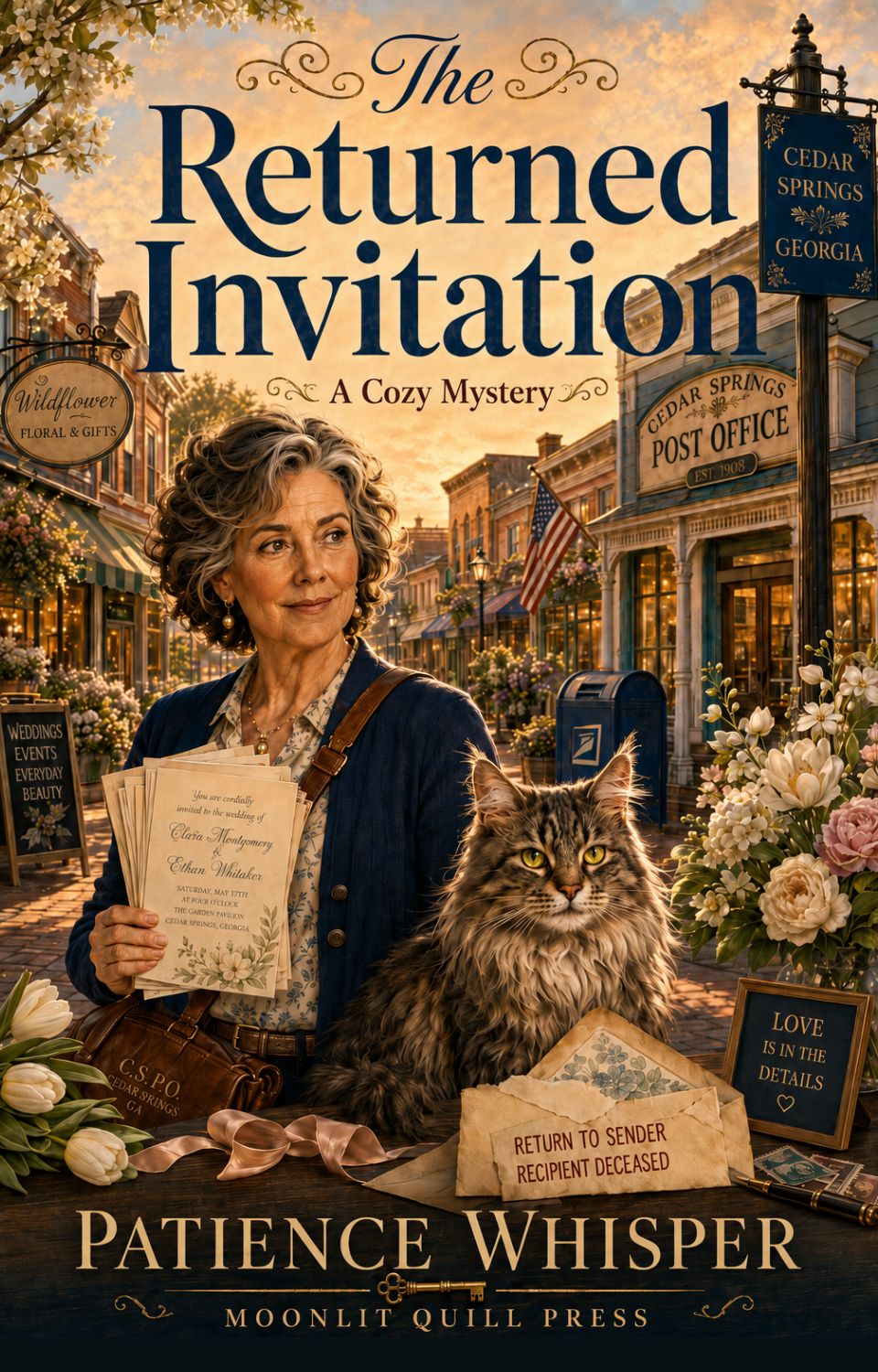
Chapter 1
Return to Sender, Trouble Enclosed
The trouble arrived between a seed catalog and three utility bills, wearing cream linen paper and a bruise-colored postal mark.
Tessa Quill spotted it before anything else that morning, which was impressive, since the Cedar Springs post office was already busy with its usual Tuesday sounds. The front door squeaked every third customer. The brass PO boxes clicked and clattered as retirees checked for church bulletins, coupons, and proof their grown children still remembered stamps. Behind the counter, Archibald let out a single, dramatic sigh from his favorite sunny spot, as if the whole mail system had let him down.
Tessa stood at the sorting table, reading glasses low on her nose, a stack of envelopes in one hand, and a pencil behind her ear. At fifty-four, she knew mornings didn’t usually announce drama. Instead, they hid something unusual among the routine, waiting for someone observant to spot it.
This particular oddity was a wedding invitation addressed in Ivy Merle Sutton’s graceful hand to Mr. Graham Bellweather, care of the Bellweather family farm out past Juniper Road. The envelope had been returned to the Cedar Springs post office with a black mark stamped across the front.
Recipient Deceased.
Tessa stared at the words.
She looked at them again, because sometimes your mind needs another look before it believes something is truly wrong.
Graham Bellweather was not dead. Unless death had suddenly started craving Eula Mae Pritchett’s buttermilk biscuits, Graham was definitely alive. Tessa had seen him just twenty minutes earlier through the post office window, standing in Eula Mae’s Bakery across Main Street, having a friendly debate about biscuit texture with a man who probably never baked anything harder than a frozen waffle.
Archibald rose from his patch of sun, stretched each enormous silver-brown paw, and padded toward the sorting table. His solemn golden eyes fixed on the envelope.
“No,” Tessa said quietly. “You may not sit on federal evidence.”
Archibald placed one paw on a stack of circulars instead, which was close enough to obedience for a cat of his station.
The post office door opened, admitting a bright square of spring sunshine and Mrs. Delphine Cowper, who believed all public services improved when she narrated her errands aloud.
“Morning, Tessa. I’m expecting a package from my sister in Macon. She says it contains hand-painted soup bowls, though after last Christmas’s incident with the ceramic goose, I am reserving judgment.”
“Good morning, Delphine.” Tessa slid the returned invitation under the edge of a ledger, not hiding it exactly, but shielding it from the town’s most mobile broadcast system. “Let me check.”
She found Delphine’s package, listened to a long story about the ceramic goose, and sent her off with the parcel under one arm and a bit of doubt under the other. Two more customers came and went. A high school boy dropped off scholarship forms, looking as serious as if he were mailing himself into adulthood. Mr. Drayton bought stamps and grumbled that the dogwood festival banners were crooked, though Tessa thought his attitude was probably more off-kilter than the banners.
All the while, the cream envelope waited.
By nine-fifteen, when the rush thinned and the old wall clock ticked loudly enough to sound official, Tessa lifted the invitation again.
The paper was expensive, the kind with a faint texture that caught against the fingertips. Ivy’s return address was printed in soft green ink on the flap: Cedar Springs Floral & Gifts, Main Street. The stamp had been canceled properly three days earlier. The return mark, however, had not come from any machine Tessa recognized.
That made the little hairs at the back of her neck rise.
Fake postal marks didn’t happen in Cedar Springs. Gossip did. People often mixed up casserole dishes. Some folks sent padded mailers with too little postage, insisting, “it barely weighs anything if you don’t count the jam.” But marking a living man as deceased on a wedding invitation wasn’t an accident.
It was a message.
Archibald sniffed the lower corner of the envelope, then sneezed.
Tessa frowned. “Your commentary is noted.”
He gave her a look suggesting that, once again, humans had failed to record the most important testimony.
The phone rang before she could examine the envelope further. Tessa answered with her usual calm, practical greeting, listened to a woman from County Dispatch ask whether a parcel had been misrouted, and gave the required information. By the time she hung up, Eula Mae appeared at the post office door with a pastry box balanced on one palm and alarm already gathering behind her flour-dusted expression.
When Eula Mae Pritchett entered a room, she seemed to take charge of everyone’s mood.
“Tessa Quill,” she said, letting the door swing shut behind her. “Tell me you have not eaten breakfast.”
“I have had tea.”
“That is not breakfast. That is hot discipline.” Eula Mae set the box on the counter and leaned closer. Her silver hoop earrings swung with the urgency of church bells. “Also, something is wrong.”
“In Cedar Springs, or in your bakery?”
“Yes.”
Tessa folded her hands over the returned invitation. “Begin with the bakery.”
Eula Mae narrowed her eyes. “You’re covering something.”
“I am standing at my counter.”
“You are standing too still at your counter. There is a difference.” Eula Mae pushed the pastry box forward. “Pecan twists. Don’t think that means I’m distracted.”
From beneath the counter, Archibald made a sound like a creaky door passing judgment.
“Oh, hush, Your Honor,” Eula Mae said, bending to peer at him. “You’ll get a corner if she behaves.”
Tessa sighed. “What is wrong at the bakery?”
“Graham Bellweather is back.”
“That is not news. Half the town saw him arrive last week.”
“Yes, but this morning he was talking to Caleb Rusk.”
That gave Tessa pause.
Caleb Rusk owned the hardware store two doors down from the pharmacy. He was a widower, a steady man with kind hands and the habit of measuring twice even in conversation. In six days, he was supposed to marry Ivy Merle Sutton, owner of Cedar Springs Floral & Gifts and the woman who had been Cedar Springs’ favorite source of corsages, funeral sprays, and tactful silence for nearly twenty years.
Graham Bellweather had once been engaged to Ivy.
Fifteen years ago, Cedar Springs watched their engagement fall apart with the kind of sad curiosity small towns have for breakups and house fires. Graham left town. Ivy stayed. People only mentioned it when arranging flowers and pretending to be discreet.
“Were they arguing?” Tessa asked.
“Not exactly.” Eula Mae opened the pastry box and selected one twist as though nourishment might help her report accurately. “Caleb was civil. Graham was charming in that scuffed Bellweather way of his. But Ivy walked in to pick up the cake tasting schedule, saw both of them, and turned the color of biscuit dough.”
Tessa’s fingers tightened slightly on the invitation.
Eula Mae noticed.
“Tessa.”
“Yes?”
“What are you hiding under your hand?”
“A piece of mail.”
“I gathered it wasn’t a squirrel.”
Tessa thought about the rules she’d followed for twenty-three years behind the counter. Privacy was important. Mail wasn’t gossip. An envelope could hold sadness, money, an apology, a threat, or even a seed packet from an aunt who thought zucchini cured loneliness. It wasn’t her job to make someone’s private matters public.
But secrets that harmed people had a way of becoming public business.
She lifted the invitation and turned it so Eula Mae could see the postal mark.
Eula Mae read it once. Her mouth fell open. Then she read it again, slower, as if the words might rearrange themselves into something less unsettling.
“Recipient deceased?” she whispered. “But Graham was in my bakery this morning, complaining that my biscuits were too delicate.”
“He said that?”
“He implied it. Which is worse, because implication has manners.” Eula Mae’s gaze snapped back to the envelope. “This was sent by Ivy.”
“Yes.”
“And returned saying Graham is dead.”
“Yes.”
“But Graham isn’t dead.”
“So far as I can tell, no.”
Eula Mae pressed one hand to her chest. “Do not say that in your calm postmistress voice. That makes it worse.”
Tessa examined the black marking again. “This didn’t come through properly. Not from our office.”
“Could it have been stamped elsewhere?”
“Possibly. But the style is wrong. The placement is wrong. And this envelope never should have come back here with that notation unless someone entered it into the return stream or made it look as though they did.”
Eula Mae leaned close enough that the scent of cinnamon and butter drifted across the counter. “Which means somebody wanted Ivy to see it.”
“Perhaps.”
“Or Graham.”
“Perhaps.”
“Or both.”
Tessa did not answer.
Archibald chirped once, sharply.
Eula Mae looked down at him. “Exactly.”
The door opened again before Tessa could reply. Ivy Merle Sutton stepped inside, carrying a bucket of white tulips in one hand and wearing the composed smile of a woman who had learned to arrange other people’s grief beautifully. She was forty-two, neat and warm-eyed, with auburn hair pinned at the nape of her neck and a florist’s apron dusted with pollen. Her shop always smelled of damp stems and ribbon, and Ivy herself seemed to carry some softer version of that scent wherever she went.
This morning, the softness had frayed.
“Tessa,” Ivy said. “I’m sorry to bother you. I just wondered if any returned invitations had come in. Nadine said sometimes a few addresses are old and—”
She stopped.
Her eyes had found the cream envelope.
For one long second, no one moved except Archibald, who stepped from beneath the counter and sat in full view, tail wrapped around his paws like a magistrate taking the bench.
Ivy set the bucket of tulips down too carefully. “Is that mine?”
Tessa came around the counter with the envelope in hand. “Yes. Ivy, before I give this to you, I need to ask whether you expected any difficulty with Graham Bellweather’s address.”
The name landed between them with an audible silence.
Eula Mae inhaled through her nose, which was her version of remaining discreet.
Ivy’s face closed, not rudely, but like a shop door turning its sign from Open to Please Come Back Later. “No. Graham’s invitation was sent to the Bellweather farm. His cousin said mail was being collected there again.”
“It was addressed correctly.”
“Then why was it returned?”
Tessa handed it over.
Ivy read the mark.
The tulips slipped sideways in the bucket, their white heads bobbing as water sloshed against the metal. Ivy did not drop the envelope. She held it in both hands, thumbs pressed near the corners, and Tessa saw the small tremor she was trying to master.
“That’s not funny,” Ivy said.
“No,” Tessa replied. “It isn’t.”
“Graham is alive.”
“Yes.”
“I saw him this morning.” Ivy’s voice sharpened, and then faltered. “Everyone saw him this morning.”
Eula Mae softened. “Honey, sit down.”
“I don’t need to sit.”
“That sentence is almost always spoken by someone who does.”
Ivy ignored her, staring at the envelope as if it had betrayed her personally. “Who would do this?”
“That’s what I’d like to know,” Tessa said.
Ivy looked up quickly. Fear had entered her expression now, not the dramatic kind that called attention to itself, but the private kind that slipped under the skin. “Could it be a mistake?”
“Most mistakes have habits. This one has intentions.”
Eula Mae muttered, “That is exactly the sort of thing you say before I need more coffee.”
Ivy touched the black mark with one fingertip. “I didn’t want to invite him.”
The confession seemed to surprise even her.
Tessa waited.
Ivy drew a breath, then another. “Caleb thought it would be kind. Graham is back in town, and we’re all adults, and people already talk enough without giving them a reason to imagine we’re ashamed of anything. Caleb said, inviting him would show there were no hard feelings.” She laughed once, thinly. “As though feelings obey invitations.”
“That was generous of Caleb,” Tessa said.
“Yes.” Ivy’s answer came too fast. “It was.”
Eula Mae crossed her arms. “But it wasn’t your idea.”
“No.”
“Did Graham know he was invited?”
“I don’t know. I mailed it three days ago.” Ivy swallowed. “I mailed all of them from here.”
Tessa remembered the stack. Ivy had come in near closing, cheeks flushed from a day of spring arrangements, and placed a ribbon-tied bundle of invitations on the counter. Tessa had weighed them herself. Cream envelopes. Green ink. Love, postage-paid and properly sorted.
“All the invitations went into the outgoing mail,” Tessa said. “I handled them.”
Ivy’s lips parted, then closed.
“What is it?” Tessa asked.
The florist looked down at the returned envelope. “Nothing.”
“Ivy.”
“It’s silly.”
“Silly is rarely this pale.”
Eula Mae nodded. “She has a point.”
Ivy lowered her voice. “When Graham left before our wedding, there was a letter.”
Tessa sensed the post office grow quiet around them. Even the old wall clock seemed to tick more carefully.
“A letter from Graham?” she asked.
Ivy nodded. “At least, I thought it was. He wrote that he couldn’t marry me. That he needed more than Cedar Springs, more than a shop and church suppers, and my aunt asking him where he planned to be in five years. He said by the time I read it, he’d be gone.”
Eula Mae’s expression softened with old anger. “Oh, Ivy.”
“I didn’t tell people details. I couldn’t bear it.” Ivy smoothed the envelope's edge with trembling fingers. “He left. That was enough for everyone to build a story around. And then he married someone else, and I told myself the letter had been honest, even if it was cruel.”
Tessa asked gently, “Did Graham ever confirm he wrote it?”
Ivy’s eyes flicked to hers.
“No,” she whispered. “We never spoke of it. Not properly.”
Outside, a delivery truck rattled down Main Street. Across the road, a bell jingled as someone entered the bakery for coffee and gossip, not knowing that something important had just changed in Cedar Springs.
The post office door opened again.
Sheriff Miles Bartlett stepped in, hat in hand, gray mustache trimmed, tired brown eyes taking in the room with the cautious patience of a man who had learned that three women standing too quietly was often worse than shouting. His gaze moved from Eula Mae to Ivy, then to the envelope in Ivy’s hands.
“Tessa,” he said. “Eula Mae sent Deputy Arlen over to tell me there was a situation.”
Tessa looked at Eula Mae.
Eula Mae lifted both palms. “I sent him before I knew what the situation was. That is called efficiency.”
Sheriff Bartlett sighed. “In some jurisdictions.”
Ivy handed him the envelope without a word.
He read the mark, frowned, and read it again. “Graham Bellweather?”
“Yes,” Tessa said.
“He’s alive.”
“So we are all relieved to keep establishing.”
Bartlett gave her a look. “Was this processed here?”
“No.”
“Could be a prank.”
“It could be,” Tessa said.
The sheriff heard what she did not say. His frown deepened. “But you don’t think so.”
“I think someone made a returned invitation look official enough to frighten the bride six days before her wedding.”
Ivy flinched at the word bride.
Bartlett noticed. To his credit, he softened his voice. “Ivy, have you had any threats? Strange calls? Trouble with Graham since he came back?”
“No. We barely spoke. I saw him yesterday outside the pharmacy. He tipped his hat like we were strangers in an old photograph.”
Eula Mae made a wounded sound. “That man always did have more charm than timing.”
Bartlett tucked the envelope carefully inside a clean evidence sleeve he took from his jacket pocket. “I’ll look into it.”
Tessa’s eyebrows lifted. “You brought an evidence sleeve to the post office?”
“I’ve known you a long time.”
“That sounds accusatory.”
“It is historical.”
Archibald, who had been silent during the sheriff’s arrival, suddenly rose and padded to the tulip bucket. He sniffed the flowers, rejected them, then turned his attention to a damp spot on the floor where water had splashed. His ears tilted forward.
Tessa watched him.
Archibald lowered his nose to Ivy’s shoe.
Ivy blinked. “Hello to you too.”
The cat sniffed once, sneezed again, and retreated beneath the counter, visibly offended.
“What’s wrong with him?” Bartlett asked.
“He has standards,” Eula Mae said.
Tessa crouched and touched the toe of Ivy’s shoe. A faint powdery residue clung near the sole, pale and granular, almost invisible against the leather.
“Ivy,” she asked, “were you in your flower cooler this morning?”
“Yes. Why?”
“Do you use preservative powder?”
“All florists do. I mixed some before I came over.” Ivy looked from Tessa to the shoe. “Did that matter?”
“Probably not.”
Bartlett’s mouth tightened. “Tessa.”
“I said probably.”
“That word does a lot of mischief in your care.”
Before Tessa could respond, the phone rang behind the counter. She stood and answered.
“Cedar Springs post office, Tessa Quill speaking.”
For a moment, there was only static. Then a woman’s voice, tight and unfamiliar beneath its whisper, said, “Tell Ivy to let the dead stay dead.”
Tessa straightened.
“Who is this?”
The line clicked.
The dial tone hummed in her ear.
Across the room, Ivy’s face drained of color again, as if she had heard the words without hearing them. Sheriff Bartlett stepped closer, alert now in a way that made the post office feel smaller.
Tessa slowly replaced the receiver.
“What was that?” Eula Mae asked.
Tessa looked at the returned invitation in the sheriff’s hand, then at Ivy, then toward the bakery window across Main Street where Graham Bellweather’s reflection had stood that morning, alive and unsuspecting.
“Not a prank,” she said.
Archibald emerged from beneath the counter, leapt neatly onto the sorting table, and placed one enormous paw on the outgoing mail tray.
This time, Tessa did not move him.