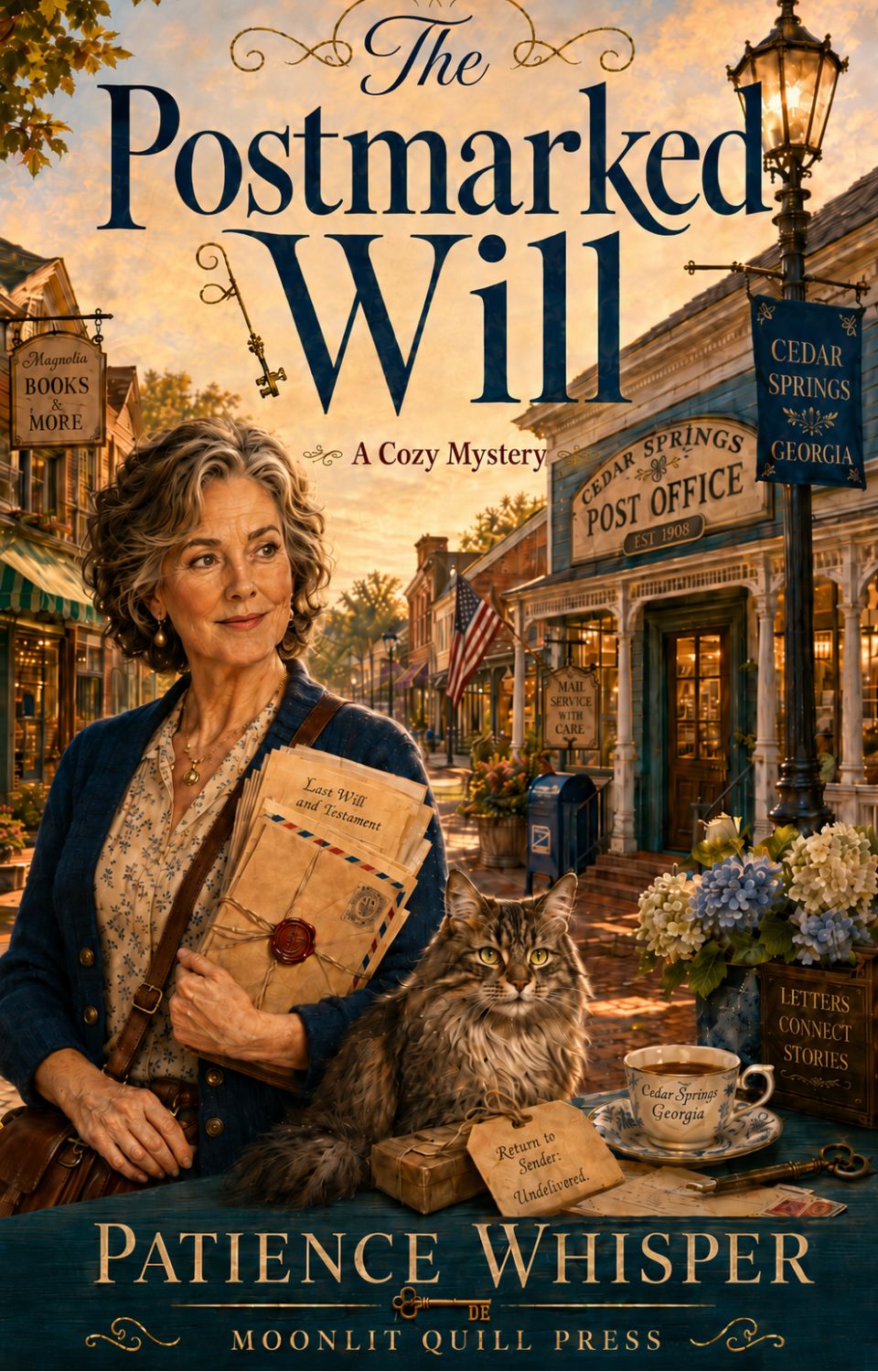
Chapter 1
The Package Behind the Past
Tessa Quill always said that spring cleaning could make anyone regret both the season and the idea of being tidy.
At 8:12 on a Tuesday morning, Tessa stood in the Cedar Springs post office. She held a broom, had a dust rag tucked into her navy skirt, and frowned at the big oak bookcase by the sorting counter. That bookcase had been there longer than most marriages in town. It was packed with postal manuals, old change-of-address forms, a tin of rubber bands, three chipped mugs nobody claimed, and a potted ivy so long dead that people treated it like a piece of history.
“You,” Tessa said to the bookcase, “have been getting away with far too much.”
The bookcase, being oak and stubborn, said nothing.
Outside, Cedar Springs, Georgia, was waking up in its usual gentle April way. Dogwoods bloomed along Main Street, and the air carried hints of wet grass, warm biscuits, and fresh-cut azaleas. A delivery truck rumbled past the window. Across the street, Eula Mae’s Bakery had set out cinnamon rolls, so soon half the town would wander over, looking as innocent as churchgoers.
Tessa knew those expressions. She knew nearly every expression in Cedar Springs.
She knew that Mayor Harlan Pike smiled with his top teeth when he wanted votes and his bottom teeth when he wanted forgiveness. She knew that Miss Opal Griggs pretended her hearing had failed whenever someone asked about her late sister’s china cabinet. She knew that Deputy Nolan Wray could not keep a secret unless it was wrapped in three regulations and stamped confidential. And she knew, because she had served as postmistress for twenty-three years, that people revealed themselves most clearly in how they handled their mail.
Some people opened bills at the counter and sighed like martyrs. Some tucked letters against their hearts. Some peered too long at return addresses. And some, like old Jebediah Hughes, had always waited until the post office was nearly empty before sliding his key into his box and removing his letters as if they might bite.
Tessa paused with her hand on the bookcase.
Jebediah Hughes had been dead nearly a year.
The thought settled over her with the faint chill that sometimes drifted through old buildings even on warm days. Jebediah had died on a storm-split night the previous May, found at the foot of the stairs in his family home on Hawthorn Road. The official word was that it was an accident. The unofficial word had filled every porch, pew, and produce aisle in Cedar Springs for weeks. He had quarreled with half the town, owed favors to the other half, and kept a locked study that no one had been allowed to enter without an invitation.
That same night, the offices of his lawyer, Milton Pruitt, had burned down to the foundation.
That, too, had been called an accident.
Tessa had never cared for two accidents arriving together like cousins at a funeral.
She gave the bookcase another hard stare.
“Well,” she said, “we cannot stand here all day considering the dead.”
She set her broom aside, planted both palms against the bookcase, and pushed.
The bookcase resisted.
Tessa Quill was fifty-four, five foot six, and had a backbone tough enough for postal inspections, church meetings, and the winter when everyone in town mailed fruitcakes. Some called her strong-willed when they meant difficult, inquisitive when they meant nosy, and dependable when they knew the difference.
She leaned her shoulder into the side of the shelf and shoved.
The bookcase slid across the old pine floor, making a noise like someone waking up grumpy from a nap. Dust floated up. A paperclip slid out, followed by a rock-hard peppermint and a 2017 receipt for two rolls of stamps and a 'Thinking of You' card in pink letters.
Then something thumped softly against her shoe.
Tessa looked down.
A package lay at her feet.
It was small, flat, and wrapped in brown paper, its edges brittle. The address label had yellowed, but the handwriting remained bold and careful, the sort used by people who still believed ink should show character. A faded strip of tape ran diagonally across one corner. Dust clung to every seam.
Tessa bent down, picked it up, and immediately felt that sharp awareness that comes when something ordinary suddenly seems important.
The package had not been processed properly. No delivery scan. No forwarding mark. No return stamp. No note of damage. It must have slipped behind the bookcase after arriving, hidden in that narrow gap like a swallowed word.
She turned it over.
The return address stopped her cold.
Pruitt & Larkin, Attorneys at Law.
Tessa’s lips parted.
Pruitt & Larkin had closed after the fire destroyed the building, the files, and the antique desk Milton Pruitt always talked about. Mrs. Larkin’s nephew, who was sleeping upstairs, barely made it out. He recovered but left town soon after. Milton Pruitt didn’t rebuild. He moved to Florida, where people said he started fishing and kept to himself.
Tessa read the recipient’s name.
Mr. Jebediah Hughes
Hughes House
18 Hawthorn Road
Cedar Springs, Georgia
The post office seemed to quiet around her.
In the back room, the refrigerator hummed, still holding a yogurt that had expired in March. The wall clock ticked. Outside, a crow called from the power line, sounding like it was making an announcement nobody wanted.
Tessa held the package very still.
“Now what,” she whispered, “were you doing behind my bookcase?”
The bell above the door jingled.
Tessa nearly dropped the package.
“Morning, Miss Tessa!” called Deputy Nolan Wray, stepping inside with his usual cheerful disorder. His uniform shirt was pressed, but his tie sat slightly crooked, and his sandy hair had the look of a man who had fought with a comb and called it even. He carried a stack of outgoing mail in one hand and a paper sack from Eula Mae’s in the other.
Tessa slid the package behind a pile of postal forms with more speed than grace.
“Nolan,” she said. “Do you make it a habit to enter federal buildings carrying contraband sugar?”
He grinned. “Only on Tuesdays.”
“Tuesdays do not have an exemption.”
“They ought to. I brought you a cinnamon roll.”
“That is not a legal defense.”
“No, ma’am, but it’s a persuasive argument.”
He set the sack on the counter. The smell of cinnamon and melted butter filled the post office, making it hard for Tessa to stick to her principles.
She eyed the sack. “You are attempting to bribe a federal employee.”
“I am attempting to improve a federal employee’s morning.”
“That may be worse.”
Tessa watched him, but her thoughts were on the package hidden under the forms, not on cinnamon rolls or postal rules. Deputy Nolan was a good young man. He was kind to older ladies, took traffic cones seriously, and once rescued a goat from the feed store roof without asking questions. But he reported to Sheriff Miles Bartlett, who had been quick to accept simple answers for both Jebediah Hughes’s death and Milton Pruitt’s fire.
Tessa did not dislike the sheriff.
She just didn’t trust anyone who said 'case closed' before the door had even stopped squeaking.
Nolan turned back. “You all right? You’ve got that look.”
“What look?”
“The one that says somebody has used commemorative stamps incorrectly.”
“Commemorative stamps are not stickers for personal expression.”
“I’ll make a note.”
“You should.”
His gaze drifted toward the displaced bookcase. “Big cleaning day?”
“Spring comes for us all.”
“Need a hand putting that back?”
Tessa glanced at the package’s hiding place. “No.”
The word emerged faster and sharper than intended.
Nolan blinked. “All right, then.”
Tessa spoke more gently. 'Thank you, but I can handle it. Sometimes you need to move the furniture yourself. It builds character—and you find old peppermints.'
“Can’t argue with that.” Nolan tapped the counter with two fingers. “You hear anything about the town council meeting tonight?”
“I hear many things.”
He smiled. “Course you do.”
“The council intends to discuss the Founders’ Day festival budget, Mrs. Bixby intends to argue that the quilting display deserves better placement than the tractor exhibit, and Mayor Pike intends to pretend he is not worried about the petition against his parking meters.”
Nolan’s eyebrows rose. “That all from mail?”
“That is from having ears, Nolan.”
“Right.”
He reached for the door, then paused. “Oh, and Sheriff said if anyone asks, the old Hughes place sold officially yesterday. Some developer from Atlanta. Papers went through quickly.”
Tessa’s fingers tightened on the edge of the counter.
“Sold,” she repeated.
“Yes, ma’am. Guess the heirs finally sorted things out.”
“The heirs,” Tessa said carefully.
Nolan nodded. “That niece of his, Marianne Vale, signed off, from what I heard. And maybe a cousin? I don’t know the details. Sheriff just said there may be contractors in and out, so folks shouldn’t call in every strange truck.”
“That would be a terrible blow to Cedar Springs as a pastime.”
He grinned again, oblivious. “You have a good one, Miss Tessa.”
The bell jingled behind him.
Tessa stood very still until his patrol car pulled away.
Then she retrieved the package.
The old Hughes place was sold officially yesterday.
Papers went through quickly.
Tessa set the package on the counter as though it were a teacup filled to the brim. Jebediah Hughes had died nearly a year ago. His lawyer’s office had burned the same night. Now, a package from that office, addressed to Jebediah before his death, had appeared from behind a bookcase just as his estate had been sold.
Tessa didn’t trust coincidences. She only accepted them when she had no choice.
She checked the faintly stamped date in the corner. May 14 of the previous year.
Two days before Jebediah died.
Her pulse quickened.
There were rules about undeliverable mail. There were procedures. Forms. Supervisors. A person did not simply open a package addressed to another person because curiosity tugged at her sleeve and whispered, Go on, just a peek. Tessa had built her career on respect for privacy. She had kept confidence after confidence, not because secrets failed to tempt her, but because trust was the mortar holding a small town together.
Yet the recipient was dead. The return office no longer existed. The package had been lost inside her post office for nearly a year. It might contain documents critical to the proper handling of an estate. It might contain something that should have reached Jebediah before the events of that terrible night.
And she, Tessa Quill, was responsible for undelivered mail.
She looked at the package.
Then she looked at the cinnamon roll Nolan had left behind.
“Do not judge me,” she told it.
The cinnamon roll offered no objection.
Tessa flipped the sign on the front door to Back in Ten Minutes, though she had no intention of being gone at all. She lowered the blinds halfway, locked the door, and carried the package into the sorting room. Her hands moved with the precision of long habit as she set it on the cleanest part of the table. She found a letter opener in the drawer, one shaped like a magnolia leaf, a gift from the Cedar Springs Garden Club after she had successfully located a missing shipment of heirloom seeds.
“Careful,” she murmured.
The tape gave way with a dry crackle.
Inside lay a stiff manila envelope, sealed but unmarked. Tessa opened that too, easing the flap loose so as not to tear the contents. A stack of papers slid onto the table.
At first glance, they appeared to be legal documents. Deeds. Survey maps. A notarized statement. A cover letter on Pruitt & Larkin letterhead.
Tessa adjusted her glasses.
Dear Mr. Hughes,
Enclosed are the revised documents pertaining to the ownership and transfer restrictions on the northern parcel of the Hughes family property, including the springhouse tract and adjoining mineral rights. As discussed, I urge you to execute and file the enclosed will immediately, given your concerns regarding pressure from interested parties.
Her breath caught.
She turned to the next page.
Last Will and Testament of Jebediah Augustus Hughes.
The room seemed to tilt by one small, dangerous degree.
Tessa read the first paragraph, then the second. Legal language could be dry, but she had handled enough certified letters to know when words mattered. This will canceled all previous ones. It didn’t name Marianne Vale or any distant cousin as the main heir to the Hughes property.
Instead, Jebediah had left the house, land, and northern springhouse tract to a charitable trust for the preservation of Cedar Springs historical sites.
Tessa sat down.
The chair squeaked beneath her.
If this will was valid, selling Hughes House might not just be too soon—it could be illegal. The northern parcel, with its old spring and possible mineral rights, might be worth more than anyone had said. And if Jebediah was worried about pressure from others two days before he died, his fall down the stairs seemed less like an accident and more like something someone wanted to hide.
A sharp knock rattled the back door.
Tessa snatched the will off the table and pressed it to her chest.
“Tessa?” called a woman’s voice. “You in there?”
Tessa closed her eyes briefly.
Only one person in Cedar Springs knocked like a woodpecker with a schedule.
“In a moment, Eula Mae.”
“I saw the front sign. Nolan said he left you a cinnamon roll, and I wanted to make sure he didn’t get the cream cheese one by mistake. That one’s for Pastor Dale. He needs cheering. His sermon notes blew into the baptismal font.”
Tessa gathered the documents, slid them back into the envelope, and tucked the envelope beneath a stack of bulk mail flyers advertising lawn care services. Then she opened the back door.
Eula Mae Pritchett stood on the step in a pink apron dusted with flour, her silver curls pinned up and her eyes sharp with the curiosity of someone who baked early and knew all the town’s news by lunchtime.
“You look flushed,” Eula Mae said.
“I moved a bookcase.”
“At your age?”
“I am fifty-four, not a museum piece.”
“Didn’t say you were. Museums get climate control.”
Tessa stepped aside enough to block the view of the sorting table. “The cinnamon roll appears to be standard issue.”
Eula Mae nodded, then leaned subtly to the left.
Tessa leaned with her.
Eula Mae leaned right.
Tessa matched her.
“Something going on back there?” Eula Mae asked.
“Mail.”
“Well, I should hope so.”
“Federal mail.”
Eula Mae’s eyebrows lifted. “That tone means secrets.”
“That tone means trespassing.”
“I am standing on a step.”
“Spiritually trespassing.”
Eula Mae’s mouth twitched. “You found something.”
“I found dust, a peppermint of uncertain vintage, and the limits of my patience.”
“You always know where your patience is. You keep it on a very short leash.”
Tessa gave her a look.
“All right, all right.” Eula Mae raised both hands. “I’ll go. But you'd best eat that cinnamon roll before it turns tough. And don’t forget the council meeting tonight. If Harlan Pike thinks I’m letting him put the quilting display beside the portable toilets again, he’s got another thing coming.”
“I pity the man.”
“You should. He’s about to be educated.”
Eula Mae turned to leave, then glanced back. “Oh, and Marianne Vale’s in town.”
Tessa’s attention sharpened.
“Is she?”
“Saw her outside the bank this morning. All white linen and dark glasses, like she was expecting photographers instead of gnats. She went in with Harlan Pike and a man I didn’t recognize. Suit too shiny for church, shoes too clean for Georgia.”
“A developer?”
“Wouldn’t surprise me. He looked at Main Street like he was deciding where to put a parking garage.”
Tessa’s stomach tightened.
“Thank you, Eula Mae.”
The baker’s expression softened, just a fraction. “You be careful with whatever you haven’t found.”
“I told you, I found dust.”
“And I told you, museums get climate control.”
With that, Eula Mae crossed the alley toward the bakery, leaving behind the scent of yeast, sugar, and impending gossip.
Tessa closed the door and locked it.
For one full minute, she did nothing.
Then she returned to the sorting table and pulled the documents back into the light. She read more carefully this time, making note of names. Milton Pruitt, attorney. A witness named Carla Finch, who had once worked as a paralegal before leaving town abruptly after the fire. A second witness, Amos Bell, caretaker of the Hughes place, who had died of pneumonia three months after Jebediah. The trust named three local board members: Pastor Dale, retired teacher June Whitlock, and Tessa herself.
Tessa stared.
Herself.
“Jebediah,” she whispered, “what in heaven’s name did you do?”
The front bell jingled.
Tessa froze.
She had locked the front door.
The sorting room seemed to shrink around her. Slowly, she gathered the papers again and slipped them into the envelope. The bell jingled once more, impatiently this time. Tessa moved toward the front, every board beneath her feet suddenly too loud.
Through the half-lowered blinds, she saw a shape at the door.
A woman stood outside, slim and elegant in white linen, dark glasses covering half her face, though the morning sun had shifted away from the storefront. Her lipstick was red as a warning flag. One hand rested on the handle of the locked door.
Marianne Vale.
Jebediah Hughes’s niece.
Tessa opened the door halfway.
“Marianne,” she said. “The sign says Back in Ten Minutes.”
Marianne lowered her sunglasses just enough to reveal cool gray eyes. “Then I’m fortunate to have arrived within the ten.”
“That depends on what you need.”
“A change-of-address form.” Marianne smiled. It did not warm her face. “For Hughes House.”
Tessa did not move. “Hughes House has a new owner?”
“It will shortly. These things take signatures, and signatures take time. Though I’m sure you know all about paperwork.”
“I am fond of accuracy.”
“So was Uncle Jeb.” Marianne’s smile thinned. “When it suited him.”
Tessa reached beneath the counter for a form. “Will mail be forwarded to you?”
“For now.” Marianne accepted the paper. Her nails were polished pale pink, immaculate, and sharp. “Until all remaining matters are settled.”
“Remaining matters?”
“Oh, you know.” Marianne tapped the form against the counter. “Utilities. Taxes. Forgotten odds and ends. Old family dust.”
Tessa held her gaze. “Dust has a way of turning up.”
“So it does.”
For a moment, the air between them seemed to hold something unsaid and unwelcome.
Then Marianne’s eyes drifted over Tessa’s shoulder toward the displaced bookcase.
“You’re redecorating,” she said.
“Cleaning.”
“How industrious.”
“How necessary.”
Marianne put her sunglasses back on. “Do let me know if any mail for my uncle appears. One hates loose ends.”
Tessa’s fingers rested lightly on the counter. “The dead receive less mail than the living.”
“Usually.”
The word landed softly, but Tessa felt it like a pin beneath her shoe.
Marianne turned to leave. As she stepped onto the sidewalk, Mayor Harlan Pike appeared from the direction of the bank, his round face flushed beneath a straw hat and his seersucker suit straining at the buttons. Beside him walked a tall man with silver hair, a narrow jaw, and shoes indeed too clean for Georgia.
The stranger’s gaze flicked to the post office window.
Then to Tessa.
He smiled.
Tessa did not smile back.
By noon, the post office had resumed its usual rhythm. Mrs. Bixby complained about a missing seed catalog that had not yet been mailed. Pastor Dale bought stamps and left damp sermon notes on the counter. Two teenagers came in to ask whether stamps still existed, which Tessa answered with the dignity of a woman defending civilization itself.
But beneath every transaction, her mind circled the same facts.
The package had been mailed two days before Jebediah died. It contained a will that changed everything. It had disappeared inside the post office. The lawyer’s office had burned the same night Jebediah fell. Marianne Vale wanted loose ends. Mayor Pike was involved with the sale. A clean-shoed stranger had arrived in town. And Tessa’s own name sat in the middle of Jebediah’s final wishes like a candle in a dark room.
By five o’clock, she locked the post office, tucked the envelope inside a canvas tote beneath a folded cardigan, and walked home by way of Sycamore Lane.
Tessa’s cottage was three blocks from Main Street, painted pale yellow with green shutters and a porch swing that creaked when it was damp. Her late mother had planted hydrangeas along the fence, and every spring they came back, big and blue. A brass mailbox shaped like a little house stood by the gate. Tessa polished it every Saturday for fifteen years.
Inside, the cottage smelled of lemon oil, old books, and catnip.
Archibald awaited her in the hallway.
He was a large, serious Maine Coon with a silver-brown ruff, tufted ears, and long whiskers. He sat with his tail around his paws, looking at Tessa as if he’d been waiting and she was a bit late.
“Don’t start,” she said.
Archibald blinked.
“I had a complicated day.”
He blinked again, slower.
“Yes, I know you warned me about spring cleaning. You sat on the dust rag.”
Archibald rose, stretched to an improbable length, and led the way into the kitchen. Tessa followed because Archibald preferred conversations where snacks were available. She set the kettle on the stove, placed two sardine treats in his blue dish, and carried the envelope to the table.
Archibald leapt onto the chair opposite hers with the grace of a judge taking the bench.
Tessa spread the documents before him.
“I found this behind the post office bookcase,” she said.
Archibald sniffed the edge of the paper.
“It is not for eating.”
He sat back.
“It was addressed to Jebediah Hughes from Milton Pruitt. Mailed two days before Jebediah died, and the law office burned. Inside are deeds, land papers, and his last will and testament.”
Archibald’s ears twitched.
“Yes,” Tessa said. “Exactly.”
The kettle whistled. She got up, poured tea, and came back to the table. Steam rose between her and the papers. Outside, the evening turned purple. Down the block, a lawn mower tried to start and then quit.
Tessa read portions aloud, not because Archibald understood probate law, but because saying things plainly often shook loose what silent thinking could not.
“He left Hughes House to a historical trust,” she said. “Including the springhouse tract. That means Marianne should not be selling it. Unless she doesn’t know. Or unless she does know and prefers no one else to.”
Archibald placed one enormous paw on the survey map.
Tessa leaned closer.
“What?”
His paw covered the northern parcel, where the old springhouse stood beyond a line of cedars. Tessa remembered the place from childhood: a stone structure half-sunk into moss, always cool even in August, with water that tasted faintly of iron and rain. Jebediah had once claimed his great-grandfather chose that land because the spring never ran dry. Others said there had been more practical reasons buried beneath the surface.
She slid the map gently from beneath Archibald’s paw.
A notation appeared in the margin. It was written in the same bold hand as the address label.
Do not trust the first inventory. Look beneath the lion.
Tessa read it twice.
Then a third time.
“Look beneath the lion,” she said.
Archibald gave a low, thoughtful chirrup.
“That is easy for you to say. You are not the one being instructed by a dead man through misplaced mail.”
She tapped the margin. 'What lion? The only lion in Cedar Springs is the high school mascot, and that costume smells like old gym socks.'
Archibald began washing one paw.
Tessa frowned at the map. “The first inventory. That must mean an estate inventory. Or perhaps an inventory of the house contents. Jebediah collected things. Clocks, canes, dreadful oil paintings. I remember a carved lion at the foot of the staircase.”
She stopped.
The staircase.
The place where Jebediah had fallen.
A small, cold thread wound through her.
Archibald stopped washing and looked at her.
“Yes,” Tessa whispered. “I thought of that too.”
A knock sounded at the front door.
Tessa gathered the papers quickly, but not before Archibald placed one paw on the will as if to hold it in evidence.
The knock came again.
“Tessa?” called a man’s voice. Smooth, careful, and unfamiliar. “Miss Quill? My name is Everett Sloan. I believe we met briefly this morning.”
The clean-shoed stranger.
Tessa slipped the papers into the envelope and tucked it beneath the cushion of Archibald’s chair. Archibald remained seated on top of it, looking both regal and immovable.
She went to the door but did not open it fully.
Everett Sloan stood on her porch, holding his hat. Up close, he was better looking than she preferred, with neatly combed silver hair and a smooth smile. He wore a charcoal suit, a blue tie, and had pale green eyes.
“Good evening,” he said. “Forgive the intrusion.”
“Intrusions rarely improve with forgiveness.”
His smile paused, then resumed. “I’ll be brief. I’m assisting with the Hughes property transfer. Marianne mentioned stopping by the post office today.”
“How nice for Marianne.”
“She said you were cleaning.”
“Cedar Springs is full of breaking news.”
He chuckled. “Quite. I wondered whether any old correspondence for Mr. Hughes had surfaced. Documents, perhaps. Estate matters. Things easily mislaid in a busy office.”
Tessa held his gaze.
A cricket began chirping beneath the porch.
“Mr. Sloan,” she said, “are you asking whether the United States mail has misplaced something?”
“Not at all. I’m suggesting old buildings have old corners.”
“They do.”
“And old corners sometimes hold surprises.”
“They also hold spiders.”
His smile sharpened. “Miss Quill, the Hughes sale is a delicate matter. It would be unfortunate if confusion complicated it.”
“I have always found confusion clears nicely when people tell the truth.”
“Truth can be expensive.”
“So can postage, but people manage.”
For a moment, Everett Sloan looked at her without smiling. The porch light hummed above them. Then he put his hat on.
“Should anything turn up,” he said, “I trust you’ll handle it responsibly.”
Tessa’s hand tightened on the door.
“I always do.”
He descended the steps and walked toward a sleek black car parked beneath the sycamore. Tessa watched until he drove away.
When she returned to the kitchen, Archibald sat exactly where she had left him, broad paws planted, golden eyes bright.
Tessa closed the curtains.
Then she took the envelope from under the cushion and spread the documents on the table again. The kitchen felt different now, almost like the walls were listening in.
“Archibald,” she said, “I believe someone knows that package existed.”
The cat’s tail flicked once.
“And I believe someone is very worried I found it.”
She looked down at Jebediah’s handwritten note.
Do not trust the first inventory. Look beneath the lion.
Outside, a car rolled slowly past the cottage.
Too slow.
Tessa turned off the kitchen lamp and stood in the dark next to her cat, watching headlights move across the curtains.