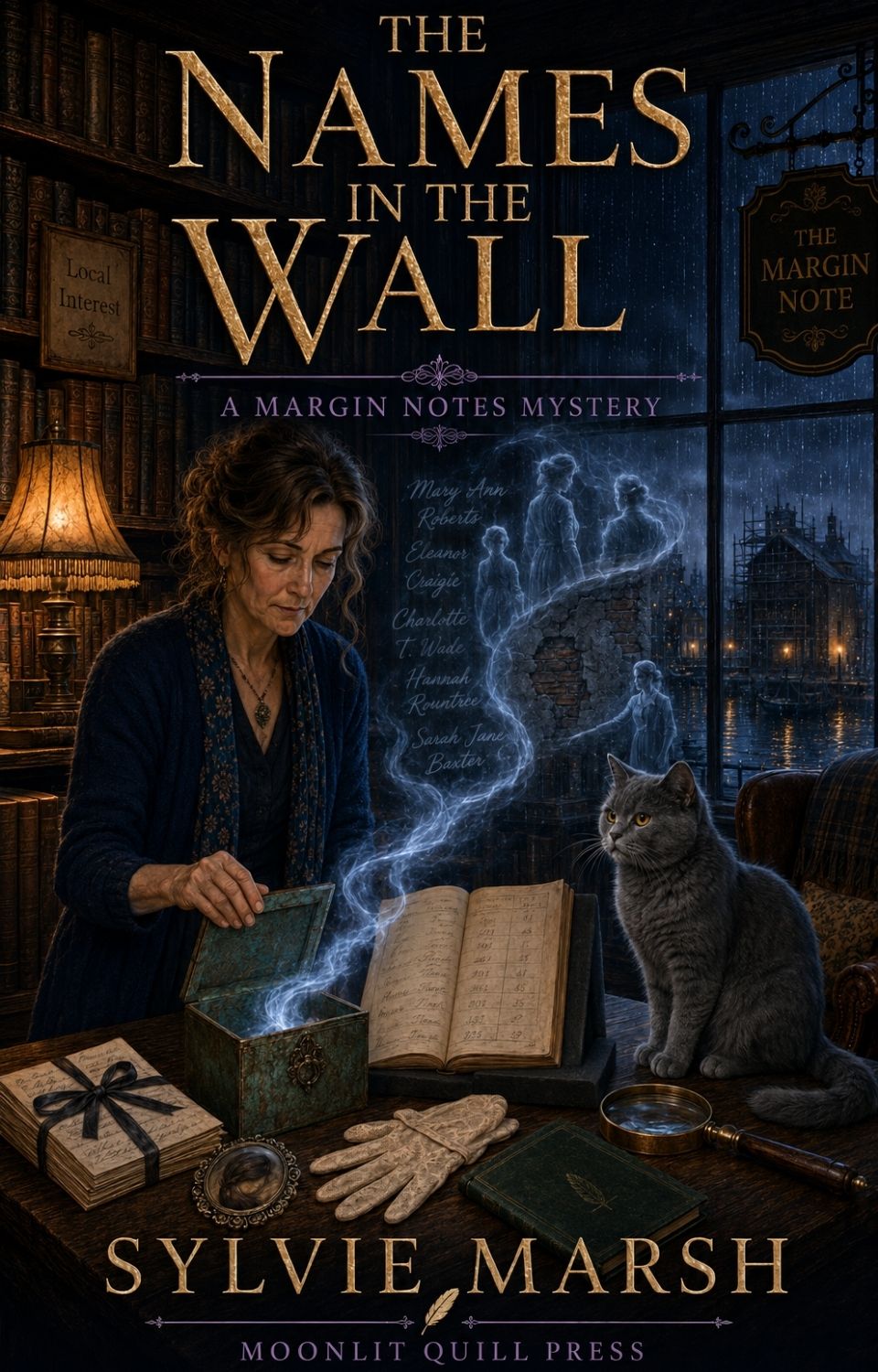
Chapter 1
The Copper Box
By half past nine, the rain had found every weak place in St. Petroc's.
It came through the torn sheeting over the east wall in thin, determined threads; it gathered on the scaffold boards and fell, one storey at a time, in irregular taps that made the empty rooms sound inhabited. The almshouses had been derelict for forty years, which was long enough for Bellhaven to stop seeing them as a building and begin treating them as scenery. A blackened gable. A sagging roofline above the upper lane. One more place the town meant to save when money, patience, and weather could be brought into rare alignment.
Now the money had arrived, the patience had been committee-approved, and the weather was doing what weather did on the English coast in November.
Cecily Mallory stood just inside the temporary hoarding with her cotton gloves folded in the pocket of her coat and watched rain slide down the plastic visor of a workman's hard hat.
"Behind the plaster?" she asked.
"Behind the brick behind the plaster," said Rowena Chalke, with the tone of a woman who had already corrected three people on this point and expected to correct several more before lunch.
Rowena stood at Cecily's shoulder in a terracotta cardigan quite unsuited to a building site and somehow immune to embarrassment. A lanyard hung round her neck, its plastic sleeve already fogged at the edges. Her tote bag, heavy with papers, pulled one shoulder lower than the other, and rain had darkened the copper in her silver-streaked hair.
"Which makes it deliberate," Cecily said.
"It makes it inconvenient," Rowena said. "Deliberate is what I am hoping you can help us establish."
The east room had been cleared just enough to permit access and not enough to pretend at order. Scaffolding pressed against the outer wall. Dust sheets lay over stacks of timber. The air held wet lime, old soot, and the mineral chill of a building opened after too many years of being left to think about itself.
On a folding table beneath a battery lamp sat the copper box.
It was smaller than Cecily had expected, no longer than her forearm, with a green bloom in the seams and a dent along one corner where some earlier hand had been impatient with history. The lid had already been lifted. Whoever had done it had at least had the sense to stop there.
"Who touched it?" Cecily asked.
Rowena's mouth compressed.
"Everyone who should not have done."
"That narrows it beautifully."
"The apprentice found it. Daniel Ferris took it from him. Then Aldridge from the trust decided to prove he knew how to open a box. I arrived in time to prevent anyone unfolding anything."
Cecily looked at the table again.
The contents had been laid out on a clean square of unbleached cotton. A bundle of letters, tied with black ribbon gone brown at the edges. A mourning brooch, oval, its glass dulled by dirt and time, with a lock of dark hair coiled inside like a question too intimate for public handling. Beside them lay a small leather-bound registry, the cover cracked, the corners rubbed pale, the whole thing swollen slightly with old damp.
Old paper had a way of holding itself apart from the room. Even there, under the raw white lamp, with rain ticking through scaffold and builders murmuring beyond the doorway, the registry seemed to have brought its own silence with it.
Cecily did not touch anything.
That was the first rule. It had been the first rule before she knew why it mattered, back when she had simply been a careful woman in a rare-book department who disliked fingerprints on eighteenth-century paper. Since Bellhaven, since the echo in London that had left her shaking on a tiled floor and unable to explain herself to anyone without sounding either dishonest or unwell, the rule had acquired teeth.
Bare skin woke things.
Cotton gave her a wall.
"The trust wants an assessment before the conservator arrives," Rowena said. "Preliminary only. Paper condition, handling risks, whether anything needs to be moved under supervision."
"And you want to know what it is."
"Naturally I want to know what it is. I am a historian, not a saint."
Cecily glanced at her.
Rowena was looking at the registry.
Not with professional impatience. Not even with curiosity, though both were there in the set of her shoulders and the little forward angle of her chin. Something had gone still underneath them. Rowena Chalke could make a roomful of councillors wish themselves elsewhere with one raised eyebrow, but now she was quiet in a way Cecily had never learned to trust.
"You've read it," Cecily said.
"Only the first page."
"And?"
Rowena reached into her tote and removed a folded sheet of acid-free paper as if it had offended her personally.
"I copied what was visible. I did not turn the pages."
She handed it over.
Cecily took the copy, not the book. Rowena's handwriting marched down the page in its usual precise columns.
Twenty-two names.
Dates beside them.
And, after each date, a single initial.
P.
S.
D.
The names themselves were ordinary in the way that made old records more brutal, not less. Mary Whitmore. Eliza Keddle. Sarah Prynne. Ruth Venn. Ordinary names, carefully entered, each made strange by the absence of any explanation for why she had been written down in a book and hidden in a wall.
"No heading?" Cecily asked.
"None visible on the first page."
"Institutional?"
"Possibly."
"Charitable roll?"
"Possibly," Rowena said again, and this time the word came out dry enough to scrape.
Cecily looked back at the registry. The leather had split near the spine. A small flake of it had lifted, showing paler material beneath, and she had the absurd impression that the book had been holding its breath.
That, she reminded herself, was not evidence.
It was barely even sense.
Across the room, a man in a navy waterproof came through the doorway, ducking under a loop of cable. He was in his late fifties, perhaps, with a rolled plan tube under one arm and the careful, distracted expression of someone keeping three versions of the same building in his head: what it had been, what it was, and what a committee had agreed it might become.
"Miss Mallory?" he said. "Daniel Ferris. Project architect."
Cecily shook his hand because he offered it, and because gloves would have made too much of a point. His palm was cold and dry. No echo came. Recent living hands rarely left her anything unless they were carrying some force too large for ordinary skin.
"Cecily, please."
"Thank you for coming in at short notice. Rowena said you were the person to ask."
"Rowena often says that in tones that make refusal feel bad for the town."
"That is because refusal usually is bad for the town," Rowena said.
Daniel Ferris smiled, but it passed quickly. His attention moved, as everyone's did, back to the box.
"We were taking down the late plaster," he said. "There's been water ingress along this wall for years. The brick pocket was behind a patch that didn't match the surrounding work."
"Victorian?" Cecily asked.
"The plaster, yes. The pocket could be later. Or earlier and covered then. I don't want to guess."
She liked him a little for that.
Guessing was one of Bellhaven's local industries. It kept the Anchor busy in winter and the Heritage Society incandescent year-round.
"May I see the wall?" she asked.
He led them across the room. The floorboards had been reinforced with temporary plates, but they still gave faintly underfoot. At the east wall, a ragged opening showed where plaster and brick had been removed. The cavity was at chest height, too neat to be accidental, too shallow to have held anything larger than the box itself.
Cecily leaned close without touching.
The smell was stronger there. Wet lime. Dust. Something metallic from the scaffold poles. Under it, faint but distinct, old soot.
"Was the box sealed?" she asked.
"Lid shut. No wax. No lock."
"No marking?"
"Not outside."
"And nothing else in the cavity?"
"Loose mortar. One nail. No paper."
Rowena had not followed them all the way. She remained by the table, looking at the copied list in Cecily's hand as though she could dislike it into changing.
Daniel noticed.
"Mrs Chalke?"
"I'm perfectly well."
This was so obviously untrue that Cecily let it pass.
Back at the table, she put on her cotton gloves before she lifted the letters. The ribbon was brittle, and she did not untie it. The upper sheet showed only the folded back of a letter, cream paper browned along the creases, no direction visible. She lowered it again.
The registry she opened only as far as Rowena had already read. The paper was softer than she liked and smelled faintly of mildew. The ink had browned, but the hand was still legible: precise, cramped, practised in economy. It belonged to someone accustomed to making records for people who would not thank her for detail.
Twenty-two women.
Dates.
Initials.
No title.
No explanation.
"This needs a conservator before anyone turns another page," Cecily said.
"One is coming from Bristol," Daniel said. "Josephine Carrick. Tomorrow, if the trains behave."
"Then until tomorrow, nobody turns anything."
Rowena made a small satisfied noise.
"And the brooch?" Daniel asked.
Cecily looked at it.
The sensible answer was the same. Wait. Let the conservator catalogue it. Let the object remain only an object for one more day.
The brooch lay on its square of cotton, dulled glass catching the battery lamp. The lock of hair inside had kept its colour, a dark coil against a backing that might once have been ivory silk. Mourning jewellery was meant to hold grief neatly. A locket, a name, a date. Private sorrow made portable.
This had no inscription visible.
Only hair.
Only the silence around Rowena's mouth.
"I can assess the setting," Cecily said. "Not the hair compartment. Not without proper tools."
She heard herself making the decision before she admitted she had made it.
Rowena turned her head.
Cecily removed her right glove.
The cold met her first. Not the room's ordinary damp, but a narrow cold, domestic and contained, like a hallway where no fire had been lit. Her fingers closed around the brooch before she could think better of it.
Coal smoke.
Carbolic.
Hands folded hard over something hidden in an apron, the knuckles pale, the nails short and scrubbed raw.
A door.
The scrape of a key outside it.
Not a slam. That would have been easier. This was careful. This was practised. The door drawn shut with the soft, final courtesy of someone doing a necessary thing and intending not to hear what came after.
Cecily set the brooch down.
For a moment the room was too bright. The battery lamp hummed. Rain ticked through the scaffold. Somewhere outside, a man laughed at something that had nothing to do with locked doors.
"Cecily?" Rowena said.
She put her glove back on because her hand had begun to shake, and because Daniel Ferris was watching her with the alert concern of a decent man who had seen someone go suddenly pale.
"The setting is fragile," Cecily said.
It was not a lie.
Rowena's eyes stayed on her.
"How fragile?"
"Enough that no one should handle it without a reason."
Daniel nodded at once, already practical, already grateful for a sentence he could use.
"I'll put that in the site note."
"Put everything in the site note," Cecily said. "Who found the box. Who opened it. Who touched what. Times, names, the order of it."
"You think it matters?"
She looked at the registry again.
Twenty-two women. Twenty-two dates. Twenty-two initials waiting under a lamp in a room that had kept its secrets longer than most people kept promises.
"I think," Cecily said, "that if a thing has been hidden in a wall for this long, the first day in the light is when people become careless."
Rowena folded the copied list with unnecessary precision.
"And are we people?"
Cecily picked up her notebook from the edge of the table. It was green, private, and already too full of things that could never appear in anyone's minutes.
"Unfortunately," she said, "yes."
Chapter 2
The Registry's Silence
The Margin Note was warmer than St. Petroc's, but only in the literal sense.
By noon the shop had gathered its usual winter smells: paper, dust, beeswax polish, damp wool from the coats of people who had come in to ask whether Cecily had heard about the almshouses and stayed to buy nothing. Rain blurred the front window. Chandler Street shone under it, every cobble holding a separate small version of the grey sky.
On the counter, beside the till, lay Rowena's copy of the first registry page.
Not the registry itself. Cecily had insisted on that with a firmness that had made Daniel Ferris look relieved and two members of the restoration committee look as if she had personally hidden their birthdays. The original book was back at St. Petroc's, sealed in a document box under temporary supervision until Josephine Carrick arrived from Bristol. No one was turning pages. No one was proving enthusiasm by putting their fingers where they did not belong.
It was astonishing, Cecily thought, how often preservation began with telling people not to touch things.
Rowena sat at the reading table in the Local Interest section, her terracotta cardigan steaming faintly from the radiator. She had taken off her lanyard but not her sense of office. Three parish register transcripts lay open in front of her, weighted at the corners with book snakes, while her tote slumped against the chair leg like a defeated committee member.
"Mary Whitmore," Rowena said.
Cecily turned from the shelf where the Bellhaven burial indexes lived between an 1898 harbour plan and a privately printed history of the lifeboat station.
"Which date?"
"March 1884."
"There are three Mary Whitmores in the town between 1870 and 1890."
"Naturally."
"One infant. One married to a sailmaker. One in service at Pemberton House."
Rowena did not look up.
Cecily took down the transcript volume and carried it to the table. She had put her gloves back on, though she was handling modern photocopies and twentieth-century bindings now, none of them likely to carry more than the ordinary impatience of researchers trying to make old handwriting behave. Habit mattered. Habits were what kept a person from improvising with the part of herself that should never be allowed near evidence.
Ptolemy watched from the low returns shelf by the door.
He had been there since Cecily came back from St. Petroc's. Not asleep. Not washing. Not pretending indifference with the theatrical commitment he usually brought to indifference. He sat squarely beside Rowena's folded copy of the registry page, a dense grey monument with copper eyes and one slightly torn left ear angled toward the room.
"He is being very pointed," Rowena said.
"He is often pointed."
"Usually at things that have already offended him."
"Then perhaps the registry has done that."
Ptolemy blinked once, slowly.
That, Cecily decided, was not evidence either.
She set the transcript beside Rowena and read down the column. The Mary Whitmore in service at Pemberton House appeared twice in the parish record: once as a witness to a wedding in 1881, once as godmother to a child in 1883. After that, nothing Cecily could see at a glance. No marriage under Whitmore in Bellhaven. No burial that matched the age. No neat ending.
Old records were full of women who vanished by becoming something else in ink. A married name. A workhouse number. A line in another parish. An absence no one had thought important enough to explain.
Still.
"Put a mark by her," Cecily said.
Rowena already had.
The connecting door to Salt & Thread opened without ceremony. Audrey Peel came through backwards, hip first, carrying a tray and making a face at whatever had just tried to follow her from the gift shop.
"If anyone asks," Audrey said, "I have gone to check whether Cecily is selling illegal antiquities."
"Are they asking?" Cecily said.
"Not yet, but Mrs. Vale has looked at my window display for seven minutes, and she has never taken seven minutes over anything that did not end in a question."
Audrey turned, saw Rowena, saw the papers, saw the way Cecily had one gloved hand resting on the back of a chair rather than sitting in it, and stopped making light work of the room.
She put the tray down.
"Oh," she said.
It was the thing Audrey did best. Not the tea, though the tea was reliable. Not the gossip, though Bellhaven moved through Salt & Thread with the efficiency of weather through a cracked sash. Audrey could enter a room and understand at once that something had shifted, and she had the mercy not to demand its name before offering warmth.
"Milk in both," she said. "No biscuits. I thought biscuits might be too cheerful."
"That has never stopped you before," Rowena said.
"No, but I am growing as a person."
Cecily took her cup. The china was one of Audrey's shop samples, white with a rim of blue waves that looked more determined than decorative. Audrey kept the chipped ones for them and sold the perfect ones to visitors who wanted the coast to behave in their kitchens.
"St. Petroc's?" Audrey asked.
Rowena slid the copied page toward her.
"First visible page of the registry."
Audrey did not touch it. She leaned over the table instead, reading from where she stood.
The longer she looked, the less expression her face kept.
"Those are women," she said.
"Yes," Rowena said.
"All women?"
"On this page."
"And the letters?"
"Unknown," Cecily said.
Audrey looked at her.
"Unknown, or not being said?"
"Unknown."
It was a useful distinction. Audrey nodded and accepted it.
Outside, the bell over the shop door gave a half-hearted jangle as wind worried it in its bracket. No one came in. Ptolemy turned his head toward the street, then back to the table.
Rowena picked up her pencil and laid it down again.
"Margaret Ainsworth," she said.
Cecily waited.
"She was my great-great-grandmother."
The rain filled the silence that followed. It ran down the glass in long, crooked lines, turning Chandler Street into a place seen through old varnish.
Audrey sat down.
"Rowena."
"She vanished in 1887." Rowena's voice had gone clean and formal, each word placed as if on archive foam. "That is the family phrase. Vanished. It does a great deal of work, that word. It avoids saying abandoned, because there was no proof of it. It avoids saying died, because no one had a body. It avoids saying sent away, because that would require asking by whom."
Cecily looked down at the copied list.
Margaret Ainsworth was there. The date beside her was October 1887. The initial was D.
Cecily did not say it aloud.
Audrey's hand had moved to the edge of the table. Not touching Rowena. Close enough to be noticed.
"You knew about St. Petroc's?" Cecily asked.
"I suspected." Rowena's mouth tightened. "My grandmother suspected more. She had a Bible with Margaret's name in it and a pressed fern between two pages. No letter. No death certificate. No grave. There was a story that Margaret had been difficult after her husband died."
"Difficult," Audrey said.
"Another useful word."
Cecily sat, finally. The chair gave its usual small complaint under her, the one she meant to fix every winter and forgot every spring. She pulled the copied page closer, but not too close. Distance helped. Distance made a list remain a list.
Ptolemy stepped down from the returns shelf.
He crossed the shop without hurry, paws silent on the worn boards, and sprang onto the second chair at the reading table. It was a heavy movement, undignified for any animal smaller than he was, but Ptolemy managed to make gravity seem like a servant who had briefly misunderstood him. He settled beside the copy, tail wrapped around his paws, copper eyes on Rowena.
"No," Cecily said mildly.
He did not move.
"He isn't on the paper," Audrey said.
"He is making a jurisdictional argument."
"Is he winning?"
"He usually assumes he has."
Rowena looked at him for a long moment. Then, very carefully, she put one hand on the back of his neck. Ptolemy allowed it. That was the only word for what he did. He did not lean in, did not purr, did not make a performance of comfort. He merely remained where he was, dense and warm and exact, while Rowena's fingers rested in the thick grey fur.
Cecily looked away first.
There were kinds of kindness one ought not watch too directly.
"We do not know that the initial means what it appears to suggest," Cecily said.
Rowena's laugh had no amusement in it.
"We do not know what it appears to suggest."
"No," Cecily said. "We don't."
It was important, and not only because of Rowena. Cecily had spent too many years learning that the mind liked patterns more than truth. An echo gave a room, not the room's owner. A record gave a mark, not its meaning. A family story gave a wound, not a verdict.
The copy on the table was only a copy of one visible page of a closed book.
It was also enough to alter the air.
Audrey rose and went behind the counter without asking. She knew the shop nearly as well as Cecily did, and better than some people who claimed to browse weekly. She found the biscuit tin after all, opened it, considered the contents, and brought it back.
"Emergency biscuits," she said.
"I thought they were too cheerful," Rowena said.
"I have reassessed the level of emergency."
This time Rowena's mouth moved almost into a smile.
Cecily wrote Margaret Ainsworth on a clean page in her green notebook. Beneath it she wrote: October 1887. D. Then, after a moment, she added three words from the echo and drew a line under none of them.
Coal smoke. Carbolic. Door.
She closed the notebook before Audrey could see more than the movement.
"What are we looking for first?" Audrey asked.
"Absences," Cecily said.
Rowena lifted her head.
"That is not a comforting answer."
"It wasn't meant as one."
She took the Bellhaven burial transcript and turned it so they could all see. The page edges were soft from years of local historians licking fingers they should not have licked. Cecily, gloved and faintly disapproving on behalf of paper everywhere, tapped the margin beside Mary Whitmore's last appearance.
"We look for women who enter the record and do not leave it properly. No marriage. No burial. No removal note. No service reference. Nothing tidy. Then we look for whether St. Petroc's touches their families."
"And if it does?" Audrey asked.
"Then the registry is not a curiosity."
Rowena's hand remained on Ptolemy's fur. Her fingers had stopped trembling, if they had ever trembled. Cecily could not be certain. She had learned, over seven years in Bellhaven and longer among books, that handling fragile things did not make them less fragile. It only improved the odds.
"I can bring the parish binders from the Heritage Society room," Rowena said.
"Not alone."
"Cecily."
"Not alone," Cecily repeated. "Not today."
Audrey reached for her coat from the back of the chair.
"I'll go with you."
"You have a shop."
"I have a sign that says back in ten minutes, which in Bellhaven means anything from eight minutes to a dental appointment."
Rowena looked as if she might object on principle, but the principle failed to present itself in time.
Ptolemy rose before she did.
He stepped onto the table, placed one careful paw just beside the copied registry page, and looked at Cecily.
Not at Rowena.
At Cecily.
His paw did not touch the paper. It was too precise for that. It rested on the bare wood, close enough that the meaning, if there was one, had to be about nearness rather than contact.
"No," Cecily said again, softer.
Ptolemy blinked.
Then he withdrew his paw, turned, and settled with his back to the copy as if he had said all that was necessary and found the room disappointingly slow.
Audrey watched him for a second.
"Does he often do that?"
"He often does things," Cecily said.
"That was not the question."
"No."
Rowena picked up the copied page and folded it along the crease she had made earlier. This time her hands were steadier.
"I will get the binders," she said. "Audrey may supervise my reckless crossing of the lane."
"Good."
"And you?"
Cecily looked at the notebook under her gloved hand, then at Ptolemy's broad grey back, then at the rain-silvered window and the reflection of the Local Interest shelves behind her.
"I'll make a list of the women who disappeared on paper," she said.
Rowena nodded once.
At the connecting door, Audrey paused with one hand on the frame.
"Cecily?"
"Yes?"
"When a town puts women in a list and hides the list in a wall, it usually means the town has been telling itself a nicer story."
Rowena's face changed at that. Not much. Enough.
Cecily looked down at the copied names.
"Then we had better find the first draft," she said.