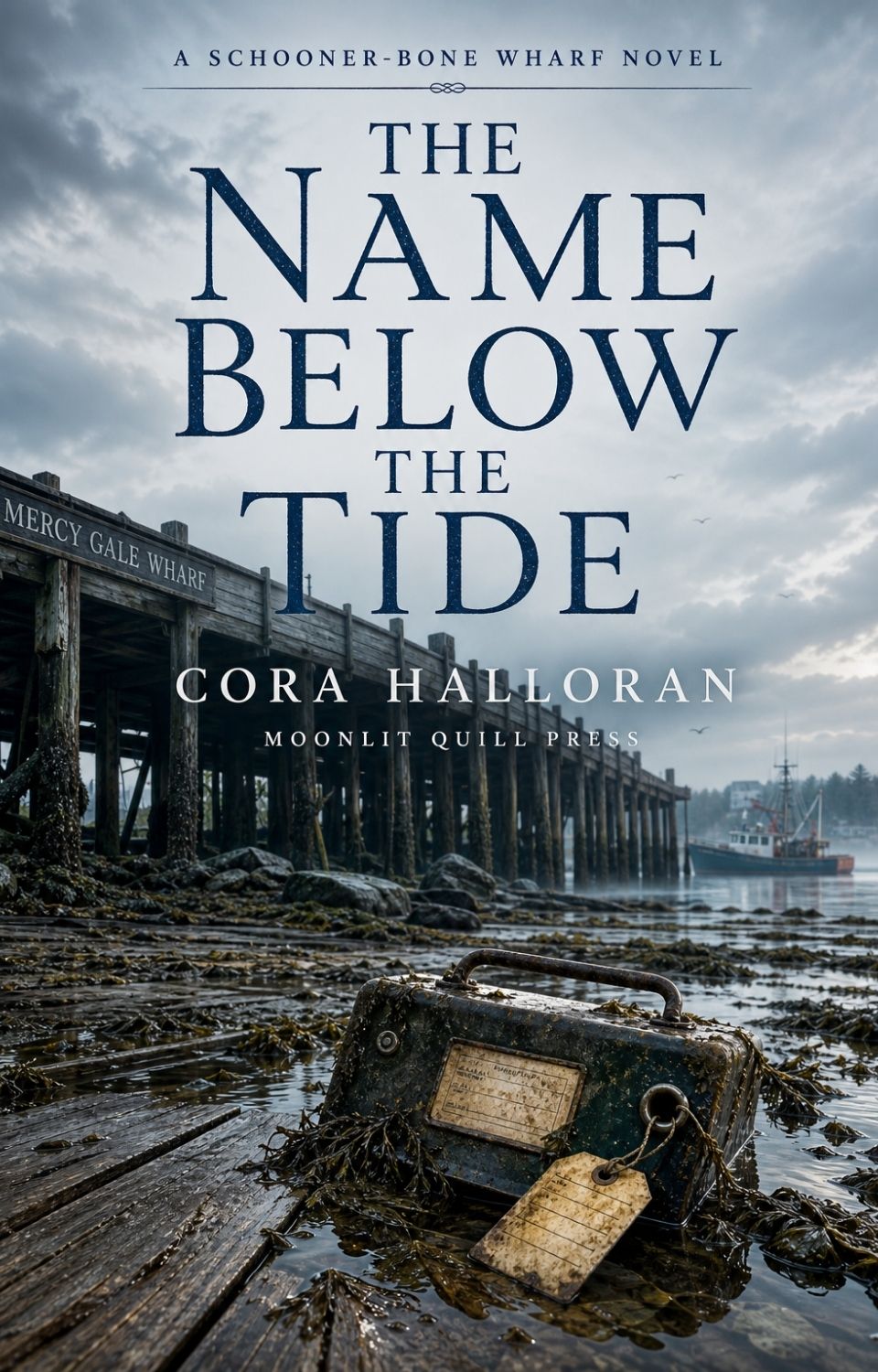
Chapter 1
The Letter Box on Malcolm's Table
Malcolm Deveraux had put the letter box in the center of the kitchen table as if it were a bill he meant to make his son pay.
The house smelled of old frying oil, cold coffee, and the faint iron tang of tools brought in from the shed and left near the stove. Fog pressed against the screen door, thick enough to turn the porch light into a yellow blur. Somewhere beyond the dark, a buoy bell worked its slow complaint in the channel, and the sound came through the cracked kitchen window with the damp breath of eelgrass, mud, and diesel from boats moored down the cove.
Finn stood just inside the door with rain drying on his jacket and sawdust still caught in the cuff of his jeans.
His father sat at the table.
Between Malcolm's hands rested a small wooden box, dull at the corners, dark where years of palms had worn oil into the grain. A blue ribbon held the lid shut. On top lay a packet of letters tied with brown twine. The twine had fuzzed where fingers had worried it, and the paper beneath had gone soft at the folds, the color of weak tea.
Finn did not take another step.
"You gave them blood," Malcolm said.
The sentence had been waiting. It had probably sat with Malcolm through the last hour, through the coffee going cold, through whatever version of the story he had built from harbor talk and his own oldest injuries. Malcolm had always been a man who could make a silence work as hard as a winch. He let it pull until someone else gave first.
Finn shut the door behind him. "I gave Dr. Patel a reference sample."
"You gave Barstows a piece of yourself."
"No."
"Don't pretty it."
"I am not."
Malcolm's hand moved over the letters. Not opening them. Guarding them. "You think the paper changes because you say it clean?"
"I think the paper matters."
"Paper." Malcolm gave a short laugh. It had no amusement in it. "They have paper. Deeds. notes. names on signs. You know what your people got? A box I was stupid enough to keep dry."
Finn looked at the blue ribbon. It had faded unevenly, darker under the knot, pale where light had touched it across decades. Annie Deveraux had tied it once, or someone who loved her had. The thought entered the room carefully and found no safe place to sit.
"Where did you get it?" Finn asked.
"My father."
"Thomas?"
"You got another?"
Finn let that pass. Humor, in Malcolm, was often a door with nails driven through it from the inside.
"He knew what was in it?"
Malcolm looked toward the window. Fog had blurred his reflection until he seemed older than sixty-six, a man made of stubborn bone and weathered angles, hair silvered at the temples, shirt sleeves rolled above forearms marked by old burns from ferry engines. "He knew enough late. Not early. Early, Annie kept her mouth locked and taught him to do the same. By the time she talked, he had a wife, a job, and too much pride to go beg a dead man's family for a name."
"Caleb's family."
His father's eyes came back to him.
The kitchen held.
Finn heard the refrigerator click on. Heard coffee shift inside the pot on the warming plate. Heard his own wet jacket sleeve drip once onto the linoleum.
"Say it," Malcolm said.
Finn did not want to give his father the satisfaction. He did not want the name pulled out of him like a tooth for Malcolm to inspect. But the name had already crossed the bait shed, the wharf, the room where Dr. Patel had said decades and Mara Barstow had stood very still beneath the weight of a dead person her family had not yet been allowed to name.
"Caleb Barstow," Finn said.
Malcolm closed his eyes.
Not long. Long enough that the room changed around him.
"That was the man Annie waited for," he said.
Finn came to the table then. The chair legs scraped louder than he meant them to when he pulled one out. He sat across from his father, leaving the letter box untouched between them.
"You could have told me before tonight."
"Could have."
"Why didn't you?"
"Because you were working for Alden Barstow's daughter."
"I was helping keep men from falling through a wharf."
"Same wharf."
"Same water too. You want me to stop drinking it?"
Malcolm's mouth twitched despite himself. It was not a smile, but it knew where one would have lived in another kind of father.
"You always did have your mother's sharp tongue when you were tired."
"You always did wait until a man was tired to start."
"Best time. Less waste."
The old rhythm sat between them for half a second, worn and familiar, and then Malcolm pushed the letters toward Finn.
"Read."
Finn looked at them. The twine knot was small and tight. Whoever had tied it had expected the packet to survive movement, hiding, perhaps a century of people almost brave enough to open it and then not. The paper smelled faintly of cedar, dust, and something sweet gone stale, maybe lavender soap from a drawer. When Finn touched the top letter, a line of dust clung to the ridge of his thumb.
"All of them?"
"Start with that one."
"Why that one?"
"Because I said."
Finn sat back. "No."
Malcolm's eyes narrowed.
"If you want me to read these," Finn said, "you tell me what I am holding."
"Truth."
"That's too big a word for a box."
"You always have to pick at things."
"A man should know whether he is opening a letter or a trap."
Malcolm's hand struck the table. The coffee cup jumped, and a brown ring spread beneath it.
"It is both."
There it was. The cost. The warning his father could not give gently because gentleness had been taken from him young and he distrusted it in himself.
Finn let the sound settle. Outside, the buoy bell swung again. A truck passed on the road above the house, tires whispering through wet gravel, then disappeared into fog.
"Then tell me where the teeth are," Finn said.
Malcolm stared at him. His anger did not drain, exactly. It rearranged. "Annie Deveraux worked sardines in Portland before she came up this way. Packed fish until her hands cracked. Caleb Barstow ran traps, patched boats, talked too much when men with money wanted quiet. They met through a cousin at a church supper in South Harpswell. He wrote her when he couldn't get down to Portland. She wrote him back more than was wise."
"How long?"
"Long enough."
"That's not an answer."
"A year. More. Maybe two. The letters don't all have envelopes. Some were folded into flour sacks. Some were carried by girls who should have been minding their own mothers."
Finn looked down at the packet. His thumb rested beside the twine knot but did not pull.
"And Thomas?"
Malcolm's jaw worked once. "Born in '31."
"Caleb's?"
"You tell me after you read."
"Dad."
"Don't Dad me like I owe you the conclusion without making you walk the road."
"You owe me something."
The sentence came out before Finn had decided to spend it.
Malcolm leaned back. The kitchen chair creaked under him. "Yes."
That single word, plain and unguarded, moved through Finn with more force than the table strike had. Malcolm did not apologize easily. He considered regret a private matter unless it could fix machinery or keep a boat from sinking. To admit debt aloud was as close as he came to kneeling.
"Then don't use this to point me," Finn said. "I will read it. But not if the price is hating on command."
Malcolm's nostrils flared. "You think I want command?"
"Yes."
"I want you to know what they did."
"You want me to know it your way."
"My way kept that box from a burn barrel."
"Your way also kept it from me."
For a moment, neither man moved. Finn could hear the house around them: the tired tick of baseboard heat, the faint ping of cooling metal in the stove, the window breathing fog along its frame. This was the room where Malcolm had taught him knots with a length of old clothesline. This was the table where Celia had once set blueberry pie straight from a chipped white plate, telling them both not to turn supper into a hearing. This was where Thomas Deveraux had sat near the end of his life, Finn remembered suddenly, one hand shaking around a mug, saying nothing while Malcolm said enough for two men.
Families had ways of making quiet look like peace.
Finn untied the twine.
The knot resisted. His fingers were too large for such careful work, nicked from the day's bracing and stiff from cold. Malcolm watched without helping. Good, Finn thought. Let him watch a man refuse to tear something just because it had been made hard to open.
The first letter unfolded with a dry whisper.
The handwriting was neat but not ornamental, each line slanting slightly upward as if hope had got under the paper and lifted it. The date at the top read March 23, 1931.
Finn's breath stopped for one count.
He had seen that week written nowhere and everywhere since the bones surfaced: in Bea's missing ledger pages, in the old strike song, in the way Mara's face had changed when the dead became older than Alden's sins. March. April. 1931. Dates that had sat in other people's books while his family ate around an absence.
"Read it out," Malcolm said.
Finn looked up.
"No."
"Finn."
"Not the first one."
His father opened his mouth, then shut it. He looked away, and that, too, was a concession.
Finn lowered his eyes to Annie's words.
Dear Caleb,
The name struck harder in ink than it had in any mouth. Ink did not posture. It did not argue. It only showed where a woman's hand had moved because a man mattered enough to be addressed.
Finn read slowly. Annie wrote of rain in Portland and the sardine floor running late, of her aunt's cough, of saving two dimes by walking home instead of taking the streetcar, of how her hands still smelled of fish even after lye soap. She teased Caleb for saying Harpswell fog had opinions and told him Portland fog had bills. She asked whether Nate had cooled off or only learned to speak lower. She said, in the middle of a paragraph about mended stockings and a landlady's cat, that she did not like him going under the wharf when men were angry enough to forget God could see in the dark.
Finn read that line three times.
Malcolm knew when he found it. "There."
"Don't."
"You see?"
"I see a woman worried."
"She had cause."
"Maybe."
"Maybe?" Malcolm shoved back from the table. "They find bones under the Barstow wharf, and you sit there with Annie telling him not to go under it, and you give me maybe?"
Finn kept his hand flat on the letter so the tremor in him would not lift the paper. "Cause of death has not been established."
"Listen to you."
"No. Listen to yourself. You hear a verdict because you've been waiting for one longer than I have been alive."
Malcolm stood. The chair hit the cabinet behind him. "I hear my grandmother."
"You never met Annie."
"My father did."
"And what did he hear? Her? Or everyone after her?"
Malcolm's face went red, then pale beneath it. For one unkind second, Finn thought his father might swing. Not because Malcolm had ever been a man to spend fists at home, but because pain sometimes reached for the oldest available tool.
He did not.
He walked to the counter, picked up the coffee pot, and poured half a cup with a hand that shook just enough to rattle glass against ceramic.
"Your mother would have hated this," Malcolm said.
The name not said was worse than if he had said Celia outright.
Finn folded the letter carefully along its old creases. "Mom hated anything that made you meaner than you had to be."
Malcolm barked a laugh. "That woman said things too soft for the size of them."
"She had range."
"She told me once I held a grudge like it was a newborn."
"She was right."
"She was usually right. Annoying habit."
Finn set the first letter aside and took up the second. The paper was thinner, torn at one corner. No envelope. No full date. Only Wednesday written at the top, with Annie's looping W bent back into itself.
This one was shorter. Caleb had apparently written of trap prices and Pike weights, of Nate telling him not to stir men who still owed bait money, of Silas keeping quiet in the way fathers did when they expected sons to mistake silence for wisdom. Annie answered with impatience plain enough to warm the paper.
If they are cheating you by the pound, she wrote, then they are stealing by the supper plate. A man can be proud and hungry at the same time, but pride will not put bread in any child's hand, not yours, not mine if God gives us one.
Finn looked up.
Malcolm watched him.
"She knew," Finn said.
"About Thomas?"
"Maybe. Or wanted."
"Read the next."
"You have read them?"
"Some."
"Some?"
"Enough."
Finn looked at the packet, then at the box. "What haven't you read?"
Malcolm did not answer quickly enough.
"Dad."
"There is a sealed envelope."
"Where?"
Malcolm's eyes moved to the box.
Finn reached for it.
His father's hand came down on the lid.
The old anger returned with new purpose. "Not that."
Finn's laugh came out low and incredulous. "You put it on the table."
"I put the box on the table."
"And now you are deciding which truth I am allowed to have?"
"I am deciding whether you are ready."
"Ready for what?"
"For what comes after."
Finn pulled his hand back, because if he did not, he would pry his father's fingers off the box, and that would make this night something neither of them could forgive cleanly.
"You brought this out because I gave a sample," he said.
"Yes."
"Because you thought I handed something to the Barstows."
"Yes."
"But the minute I ask for the whole of what you have, you turn into one of them."
Malcolm went still.
The words had landed. Finn knew it. He wished, too late, that he had chosen a duller blade.
His father lifted his hand from the box.
"Say that again," Malcolm said.
Finn swallowed. The kitchen tasted of coffee burnt down to bitterness. "No."
"Say it."
"No."
"You think I am like them?"
"I think hiding truth to control what someone does with it is not only a Barstow habit."
Malcolm's face changed in a way Finn had never seen. Not collapse. Malcolm Deveraux would have called collapse self-indulgent. But something in him lost its bracing.
He sat down.
"Annie took money," he said.
Finn had been ready for anger. He was not ready for that.
"What?"
"She took money after Caleb vanished. Sixty dollars, according to my father. Maybe to leave him off Thomas's birth record. Maybe to keep from naming him. Maybe because she had a baby and no husband and pride was not enough to buy milk. That is in the sealed envelope, or so Thomas told me. I never opened it."
"Why?"
"Because I was a coward," Malcolm said.
No fog, no bell, no house sound could cover that.
Finn looked at his father across the table. Malcolm's hands lay on either side of the box, scarred and broad, useless for once.
"I told myself I was saving it," Malcolm said. "For the right time. For proof if we ever needed it. For you, maybe. Then your mother got sick. Then Thomas died. Then the years did what years do when you let them. Made neglect look like patience."
Finn said nothing.
"You want a prettier answer, ask a prettier man."
"I don't."
"Good."
The box sat between them, no longer simply accusation, not yet offering. Finn thought of Mara standing at the bait-shed table with Dr. Patel's summary trembling under her palm, saying innocence in one era did not erase guilt in another. He had admired her for it then because the sentence cost her something. He disliked hearing its echo in his own kitchen.
"I need to call Mara," he said.
Malcolm's head snapped up. "No."
"I do."
"This is Deveraux business."
"It is Caleb business."
"Same thing."
"No. That is what you want it to be."
Malcolm pushed the coffee cup away. "You going to hand her Annie too?"
Finn touched the first letter. "No."
"Then what?"
"Tell her I have read enough to know the date matters."
"She will use it."
"She will protect it."
"You know that?"
Finn did not answer as quickly as he wanted to.
He saw Mara in pieces because that was how restraint allowed her into him: her hand steadying a roll of drawings, her hair damp under a work hood, her face when she looked at unsafe timber and heard family instead, the way she had said "the person" after June said claim must not come before name. He knew her professional language could cut. He knew her family name could wound him in ways she had not chosen. He knew she could leave. He knew she had not.
"I know enough to let her prove the rest," he said.
Malcolm stared at him. "That sounds like trust."
"Yes."
"Dangerous thing."
"Most useful things are if handled badly."
"You sound like an engineer."
"Do not insult me in my own childhood kitchen."
Malcolm huffed despite himself, and this time the humor had a little warmth in it, ragged but real.
Finn took out his phone. Mara's name sat near the top of recent calls, though he had not used it as often as he had wanted. He pressed it, then stopped before the call connected.
The first reading belongs to his own blood.
The thought did not come in Malcolm's voice. That mattered. It came from some quieter part of Finn that had sat at the bait-shed door all afternoon and understood dignity only counted if it applied in private too.
He ended the call before it rang.
Malcolm watched him. "Changed your mind?"
"For tonight."
"Good."
"Do not look pleased. It is unattractive."
"I am your father. I have no obligation to be attractive."
"You have been leaning hard on that."
Another almost-smile. Then it passed.
Finn opened the third letter.
This one carried a full date: March 28, 1931.
His fingers tightened on the paper.
Annie's writing was less neat here. The lines crowded each other, words rushing into margins.
Caleb,
Do not go to the wharf tonight because Nate says to meet there. If a man will not say a thing in daylight, he does not mean to say it fair. I know you think Silas can keep peace between his sons, but peace is not what they ask of you. They ask quiet. Those are different things.
Finn stopped.
The room had gone very small.
Malcolm leaned forward, all fury forgotten in the naked hunger of wanting the words to be enough.
Finn read on silently, though his father's breath had changed across the table.
Annie wrote that Pike weights had been wrong by enough to make wives count potatoes. That Caleb had promised to bring her the union pin after the meeting so she could laugh at him for polishing brass no one would see. That she would wait at the rooming house window until the last streetcar, and if he missed it he had better come first thing in the morning with an apology and not a story.
At the bottom, after the signature, in a line so small Finn almost missed it, Annie had added:
If they make you choose between blood and right, choose the thing you can bear to tell our child.
Our child.
Finn set the letter down.
His hand had gone numb.
Malcolm saw the place where the words had struck. "You see now."
Finn could not speak.
His father reached across the table and, with a caution so sudden it seemed borrowed from another man, turned the letter enough to read the final line again. Malcolm's lips moved without sound.
"Thomas never saw that one," Malcolm said.
"How do you know?"
"Because he would have told me."
"Maybe he couldn't."
Malcolm looked at the box. "Maybe none of us could."
The sentence sat with them. It was not forgiveness. It was not enough. It was a beginning shaped like shame.
Finn stood because sitting had become impossible. He crossed to the sink and turned on the tap. The water ran cold over his fingers, carrying dust and old paper grit into the drain. Through the window, fog made a blank wall of the yard. His truck was a dark shape beside Malcolm's, both vehicles salt-streaked, both brought home from work that never ended when men walked through doors.
Mara would be at the Barstow house now, or still at the wharf, or sitting somewhere with a ledger and a problem no one should have asked her to carry. Finn's body wanted the phone in his hand. Wanted her voice because she would not make the letter smaller than it was and would not make it only his father's anger either.
He dried his hands on a towel stiff with line grease.
Not yet.
He returned to the table.
"I will read them all," he said.
Malcolm nodded.
"But I decide what kind of man I become after."
"You think you decide that alone?"
"No."
"Good. Because family will decide some of it for you whether you sign or not."
"Then I decide what to do with what family hands me."
Malcolm studied him. Outside, the buoy bell sounded again, slower now beneath fog and distance.
"You are softer than I wanted," his father said.
Finn gathered the letters into careful order. "You raised me badly, then."
"Maybe your mother interfered."
"Thank God."
Malcolm's mouth bent. Grief moved under the expression and did not break it.
Finn reached for the next letter. The paper had no date at the top, only a pressed smear where a thumb had once dragged damp ink. Before he unfolded it, he looked at the box.
"The sealed envelope stays sealed tonight," he said.
Malcolm's face tightened. "Why?"
"Because I am not opening every wound just because you finally brought out the knife."
His father flinched. Finn let him. Some truths did not become less true because they hurt.
"Tomorrow," Finn said. "Maybe."
"You will sleep after this?"
"No."
"Then why wait?"
Finn looked down at Annie's March 28 letter, at Caleb's name and the child no one had been allowed to claim in daylight. "Because if I open that tonight, I will do it angry. And if I call Mara angry, you win."
Malcolm did not deny it.
That was answer enough.
Finn sat again.
They read until the coffee went undrinkable and the fog erased even the porch steps. They read of sardine shifts, trap prices, a man named Nate spoken of with worry first and anger later, Pike weights, Silas's silence, Annie's hunger, Annie's humor, Caleb's stubbornness, the child not yet born and already living inside choices made by people who thought secrecy could be a kind of shelter. Once, near midnight, Malcolm got up and fried two eggs without asking. One yolk broke in the pan, and he cursed softly, as if breakfast had wronged him personally.
Finn ate because his mother had raised him to understand food as one of the ways the living stayed in rooms with each other after words had made staying hard.
At the end of the packet, beneath the last loose letter, lay a smaller folded sheet. Not sealed. Not addressed. Only a date written on the outside in Annie's hand.
March 31, 1931.
Finn looked at Malcolm.
His father shook his head once. "I have not read that."
"Why?"
"It was under the others."
"You never got that far?"
Malcolm's shame answered before his mouth did. "No."
Finn unfolded it.
There were only three lines.
Caleb did not come.
No one will say where he is.
Nate came to the door with mud on his cuffs and told me to stop asking at Mercy Gale.
The old house made its ordinary night noises. The refrigerator hummed. Fog leaned on the glass. Somewhere down the cove, a chain knocked once against a mast.
Finn read the lines again.
Then he slid the paper across the table to his father.
Malcolm took it with both hands.
For once, he had nothing ready.
Finn looked at the date. March 31. Last week of March. The week Caleb vanished. The week Bea's missing pages began.
He set his phone on the table beside Annie's letters but did not touch it.
Not yet.
Chapter 2
Evidence Tide
By seven in the morning, the tide had turned under Mercy Gale Wharf, and so had everyone's patience.
Water slapped the granite cribwork with a flat, irritated sound. It pushed green-black through the gaps beneath the old deck, lifted strings of eelgrass against the temporary braces, and retreated with little sucking noises that made the protected pocket seem to breathe. Fog sat low over Harpswell Reach, not thick enough to hide the boats, only enough to soften their edges and make every stern light look farther away than it was. The wharf smelled of wet oak, salt, bait, diesel, and the clean rubber bite of new hazard tape.
Mara stood below the main deck with one boot braced against a cross-timber and one shoulder almost touching the temporary shore Finn had helped set two nights before. Her hard hat knocked softly against the underside of a joist when she looked up.
"Again," Etta said from behind her.
"You are enjoying that word too much."
"It is a municipal word. We get few pleasures."
Mara shifted the clipboard against her hip and pointed the beam of her headlamp across the restricted bay. "No load above this line. No equipment storage. No foot traffic except authorized evidence personnel and engineering review. Landing crews stay to the marked east lane. Bait transfer happens by hand truck only, no pallet jack, no forklift, no creative cousin with a good idea."
Deputy Rourke, crouched on the plank bridge the sheriff's office had grudgingly accepted after Mara rejected the first version as a lawsuit with hinges, made a note. "Creative cousin. That legal?"
"It will be when I am done," Etta said.
Dr. Patel did not smile. She stood just outside the oldest crib bay in a Tyvek suit unzipped at the throat, nitrile gloves clean and pale against her clipboard. Nothing about her posture was dramatic. That was one of the reasons Mara trusted her. She made the dead less theatrical, not less human.
"And below?" Dr. Patel asked.
Mara angled the light toward the damaged pocket. The concealed board sat behind the marked Mercy Gale timber, partly visible through the opened void, protected now by a temporary shield of breathable mesh and standoff framing. It looked too ordinary for what it had done. A board. Old fasteners. Tidal stain. The kind of thing generations of men had walked above while charging bait, mending traps, lying to daughters, and teaching sons the names of boats.
"No further probing," Mara said. "No widening the void. No removal of loose stone unless cleared by you and documented. If tidal action exposes new material, all operations stop. If bracing shifts by more than the tolerance markers, all operations stop. If Alden moves one cone because he has feelings, all operations stop."
Alden, above them somewhere near the bait shed door, heard his name through the deck and said, "I heard that."
"It was designed to carry," Mara called up.
Etta made a noise that might have been a laugh if she had been off duty. Deputy Rourke wrote something down and wisely did not read it aloud.
Mara tasted metal at the back of her throat. She had slept, technically. Three hours in the Barstow house, on top of the quilt, boots beside the bed, Tessa's photo envelope on the chair where it could accuse her in the dark. Sleep had not cleared the images: pale bone in tidewater, Alden's shaking signature, Finn near the bait-shed door not touching her, the public statement spreading through town faster than rain through old decking.
And under all of it, the old sentence.
The missing pages begin in the week Caleb Barstow vanished.
"You have the updated load map?" Dr. Patel asked.
Mara passed it over in a plastic sleeve. "This version reflects the safe landing test, the widened closure after the second fragment, and the evidence boundary you requested."
"Requested," Etta said. "That is one word."
"Required," Dr. Patel said.
"Better."
The doctor's gloved thumb rested beside the red-shaded exclusion zone. "The protected pocket remains vulnerable to vibration."
"Yes."
"How vulnerable?"
"Enough that any heavy rolling load above the old bay risks dislodging material before it can be documented. Enough that if a crew decides the shortest path is worth ten minutes, we lose both safety and evidence integrity."
Rourke looked up. "And people will decide that."
"People have already decided worse," Mara said.
Alden's boots appeared at the edge of the access opening overhead. "If you mean me, say me."
Mara looked up into the rectangle of gray morning behind him. "You."
"There. Cleaner."
"Not safer."
His silence came through the boards more heavily than his voice had.
Dr. Patel turned one page on her clipboard. "I understand the economic pressure. I do. But chain of custody is not flexible because the tide is inconvenient or because a boat is carrying live catch."
From above, Royce Bunker said, "Live catch goes bad faster than paperwork."
"Royce," Etta called, "I can hear you discovering the point and walking away from it."
Mara closed her eyes for one breath. The wharf had reopened by a thread, and every person standing on it had begun tugging that thread toward their own necessity. Royce needed boats moving. Alden needed cash before Cal's debt became an axe. Etta needed enforceable language. Dr. Patel needed the dead preserved from carelessness. Mara needed the structure to hold while truth gathered itself into something harder to deny.
The wharf needed all of them and trusted none of them.
She climbed out first, taking the ladder slowly because the lower rung was slick with tide breath. Above deck, the morning widened. Yellow tape snapped between weighted stanchions. Fresh orange paint marked the restricted path to the east lane. The bait shed door stood open, spilling coffee smell and men's voices into the fog.
Alden waited near the tape line with his arms folded. He had shaved badly. A strip beneath his jaw was missed, and the small human failure made Mara look away before tenderness could confuse her.
"You got enough people under there to start a town meeting," he said.
"Good. Then I only have to say it once."
"You have said it more than once."
"Evidence rules work best as repetition."
"So do prayers," Reverend June said, coming from the bait shed with two paper cups of coffee and a stack of folded napkins. "Nobody likes those either when they are inconvenient."
Etta took one of the cups. "I like a well-aimed prayer."
"That is because you think God respects documentation."
"He should."
June gave the second cup to Mara, who accepted it even though her stomach objected. The coffee had been on too long. It tasted scorched, bitter, and necessary.
"Finn coming?" June asked.
Mara kept her eyes on the load map. "I do not know."
That was true in the narrowest sense. She had not heard from him since dusk, when Etta had interrupted them on purpose and turned almost-tenderness into public-statement edits. Finn had gone home to Malcolm. To the letter box. To Caleb Barstow in Annie Deveraux's hand.
She had woken twice with her phone in her palm.
No message.
No missed call.
Not yet, she had thought, hating that she understood.
Royce crossed from the east lane carrying a coil of blue line over one shoulder. "If Deveraux isn't here, who's checking the tide window for the Elsie May?"
"I can read a tide chart," Alden said.
Royce's face did nothing. That was impressive, given history.
Mara looked at the handwritten schedule clipped to the temporary railing. "Elsie May lands only if she arrives before nine-ten. Danny's boat after that. No overlap. No stacking crates at the turn. No one waits on the closed side."
"And if they are late?" Royce asked.
"They go around."
"To Pike?"
Alden's jaw tightened.
Mara did not soften it. "If they miss the safe window, they do not land here."
"That costs them."
"So does falling through."
"Danny says his sternman won't wait."
"Danny's sternman can buy a calendar and a sense of self-preservation."
Royce snorted. "You been away long enough to think those are sold local?"
June's mouth twitched. Even Alden looked almost amused before remembering himself.
Then a truck rolled slowly down the wharf road.
Finn's truck.
Mara turned before she could stop herself.
He parked crooked near the bait shed, as if he had aimed at a space and lost interest in the last six feet. He got out wearing yesterday's work pants and a clean flannel that had not been buttoned evenly. His hair was damp from fog or a sink splash. He carried no coffee. That, more than anything, made June glance at Mara.
Finn closed the truck door and stood for half a second with one hand still on it.
He had not slept.
The knowledge arrived in Mara's body before her mind finished gathering evidence. It was in the set of his mouth, the careful steadiness of his walk, the faint crease at the bridge of his nose that deepened when he was doing arithmetic under stress. He looked toward her, and something passed between them with no room in it for anyone else: apology, warning, trust not yet ready to speak.
Then he looked away first and came to the table.
"Sorry," he said. "Truck did not want to start."
Royce looked at the truck. "Truck was fine last week."
"So was the wharf."
"Fair."
Alden watched him with a new hostility, not sharper than before, but altered by curiosity. "Your father keep you up?"
Finn picked up the tide sheet. "Yes."
The direct answer made Alden blink.
Mara looked down at her clipboard.
Etta, who missed little and filed the rest, tapped the map. "We are reviewing evidence-preservation limits and restricted landing conditions. You are late enough to have missed the first lecture and early enough to suffer the second."
"Lucky me."
"That is the spirit."
Finn leaned over the map beside Mara but did not crowd her. His sleeve brushed the edge of her clipboard, no more than cloth against paper, and her hand tightened around the coffee cup before she could stop it.
He saw the revised brace layout.
Tired as he was, his eyes changed. The sleepless son disappeared for the length of a calculation, replaced by the lobsterman who knew tide, timber, load, habit, and the places men would cut across if the shortest path saved two minutes and their pride.
"This cone line won't hold," he said.
Royce groaned. "We just got those placed."
"The cones are fine. The men are the problem."
"Thank you," Etta said. "I feel seen."
Finn pointed. "At low tide, they'll come off the east lane here and step through the old gear path because it looks open. It has always looked open. Paint won't change what their feet remember."
Mara leaned closer despite herself. "What would?"
"Stack empty bait tubs here. Two high. Not pretty. Enough to make walking around easier than climbing over."
"Tubs shift."
"Not if we fill the bottom row with old chain."
Alden frowned. "I need those tubs."
"You need men alive more," Finn said.
The sentence landed without heat. That made Alden's answer harder to find.
Mara sketched the change in pencil. "What about hand-truck clearance?"
"Still enough."
"With crates?"
"If Royce stops pretending he can turn like a twenty-year-old."
Royce put a hand to his chest. "That was tender."
"You will survive."
"Not according to my knees."
"Your knees have been filing complaints since 2008," Alden said.
"And no one from municipal ever responds," Royce said, looking at Etta.
"Put it in writing," Etta said.
There. A sliver of working humor, salt-stained and practical. It moved through the group the way sun sometimes moved through fog, not clearing anything, but proving the world had more than one weather at a time.
Dr. Patel came up from below and studied the revised barrier idea. "Does this reduce vibration risk?"
"It reduces unauthorized foot traffic," Mara said. "Vibration risk remains governed by the no-load zone."
"Then add it."
Etta wrote. "Barrier modification: weighted bait tub line, bottom row filled with chain, no storage function, no removal without approval."
"You make everything sound punishable," Royce said.
"That is how you know I love it."
Mara took the pencil back from Finn. Their fingers almost touched. Did not. She was grateful and irritated by the precision of that almost.
"Thank you," she said.
He nodded. "Check the diagonal shore at the southeast corner."
"I did."
"Again."
She looked at him.
His eyes held hers for one second too long, and she understood what he was really saying: not that she had missed something, but that something in the plan bothered him and he was too tired to trust the shape of it until she walked him through.
"Come on," she said.
They went below together.
No one followed at first. That was either mercy or fatigue. The access ladder dropped them into the dim understructure where the world became beam, water, stone, tape, and breath. Mara moved ahead, ducking under the joist. Finn stayed behind her, close enough to catch a slip, far enough to make it professional. Saltwater tapped the old granite. Somewhere above, Royce dragged bait tubs into place with a theatrical complaint.
"You read them," Mara said.
Finn did not answer immediately.
Her headlamp cut across the diagonal shore. The timber still held firm against the load plate. The chalk line was unbroken. Moisture beaded along the lower edge but had not opened new movement.
"Some," he said.
The word entered the low space like a second tide.
Mara kept her light on the timber. "Do you want to tell me?"
"Yes."
She waited.
"Not here."
"All right."
"I almost called you."
"I know."
He made a small sound. "That confidence is annoying."
"I am told I have gifts."
"You do."
The words were simple. Too simple for the room they were in. Mara's face warmed in the damp cold, and she resented every old board around them for witnessing it.
She tapped the diagonal shore with the end of her pencil. "This is what bothered you?"
Finn shifted, grateful for the work and honest enough not to hide it. "Maybe. The load path is right, but look where the tide throws debris on the ebb."
He crouched and pointed beneath the brace, where strands of eelgrass had gathered against a rough stone edge. Mixed in were flakes of rust, a strip of blue plastic bait bag, and one pale splinter of old wood no longer than her finger. The water moved through and around it, patient, repetitive, making small work of everything humans called temporary.
"If debris builds here," he said, "the lower end stays wet longer. Not enough to fail today. Enough to make your marker lie in a week."
Mara crouched beside him. Her knee brushed damp stone. The air under the wharf tasted of salt, old iron, and the stale mineral breath of wet granite. "We need a debris check after each tide cycle."
"And after every landing."
"That often?"
"Men drop things. Tide keeps receipts."
She wrote it down on the sleeve of the map. "Post-landing debris sweep at southeast diagonal shore. Assigned to?"
"Not Alden."
She looked at him.
"He will do it if he says he will," Finn said. "Then the first day he is angry, tired, ashamed, or convinced he knows better, he will skip it because it is small."
Mara thought of her father moving barriers in the dark. "Royce?"
"Royce will complain and do it."
"Good."
Finn did not stand. His gaze had gone past the brace toward the protected pocket.
The Mercy Gale timber sat in shadow, its old mark faint beneath salt stain and the mesh standoff. Mara had looked at it so often in the last days that she had begun to know its surface the way she knew a face: notch, crack, swelling, iron bloom. It was beautiful. It was evidence. It was rotten in places. It had held.
It had hidden.
"Annie wrote March thirty-first," Finn said.
Mara went still.
Above them, something heavy thumped on deck, followed by Royce saying, "That was on purpose," in a tone that proved it had not been.
Finn kept his voice low. "Caleb did not come. No one would say where he was. Nate came to her door with mud on his cuffs and told her to stop asking at Mercy Gale."
The sentence seemed to change the temperature under the wharf.
Mara looked at the old timber. March 31. Mud on cuffs. Stop asking at Mercy Gale. Missing pages. Strike song. Caleb's name living in a woman's hand while a body waited under a family business.
"Finn."
"I know."
"That does not identify the remains."
"I know."
"It matters."
"I know that too."
She turned toward him. In the headlamp wash, his face looked carved down to what the night had left: exhaustion, restraint, a grief that had not yet decided whether it was allowed to be his.
"Do you have the letter with you?"
"No."
"Good."
His eyebrows lifted.
"Not because I do not want it," she said. "Because if it comes here in your jacket pocket, this place will eat it before we have a process."
"That sounds like something you say when you want a thing very badly."
"It is."
His mouth changed, not quite a smile. "I did not bring it because my father would have followed me with a tire iron."
"Also valid."
"He has strong feelings about chain of custody."
"Does he know those words?"
"No. He expresses them mostly through suspicion and kitchen furniture."
Mara laughed once, too softly for the deck above to hear. The sound surprised her. Finn looked at her as if he had been given something and did not intend to spend it foolishly.
Then Dr. Patel called down, "Mara?"
The moment closed, but not badly. It folded itself and waited.
"Coming," Mara called.
They climbed out together. This time, when Finn reached the top first, he offered a hand. The gesture was practical. The ladder was slick. Everyone could see them. Mara took it.
His palm was warm, work-rough, steady.
He let go before the warmth could become a statement.
On deck, the bait-tub barrier had been built. Royce stood beside it, offended and proud. Alden watched Finn and Mara emerge with an expression that gathered several old family failures and did not choose among them.
Dr. Patel held out a sealed evidence-protocol packet. "I need signatures acknowledging the expanded restrictions."
"From whom?" Alden asked.
"Property owner. Engineering lead. Municipal witness. Operational representative."
"Operational representative?" Royce said. "That sounds like somebody with no raise."
"That is you," Etta said.
"Naturally."
Alden took the clipboard first. He read the first page, then the second. His face darkened at "owner violation" and "immediate suspension." He looked at Mara.
"You wrote this."
"Etta wrote it."
"You supplied the venom."
"Accuracy is not venom."
"Depends who has to swallow it."
June, who had come to stand near the barrier, said, "Alden."
He signed.
Not easily. The pen gouged the paper once. But he signed in the place marked property owner, and when he handed the clipboard to Mara, his fingers did not brush hers.
She signed as engineering lead.
Etta signed as municipal witness with such satisfaction that Royce muttered, "Careful, you'll pull a muscle."
Then Royce signed as operational representative after asking whether that meant he could boss Danny Hadlock. Etta said only within approved scope. Royce said approved scope had never had much ambition.
Dr. Patel took the packet back. "One more point. We may need additional voluntary kinship reference material."
The deck quieted.
Mara felt Alden go still beside her.
Finn stood near the bait-tub barrier, eyes on the protected tape.
"From whom?" Alden asked.
"Potential living descendants or relatives relevant to the historical period. We are not at a formal request list yet. But given the possible age and the family references already circulating, it is likely."
"Circulating," Alden said.
"Yes."
"You mean Caleb."
Dr. Patel's face did not change. "I mean historical names should be handled carefully until evidence supports them."
"People are already saying it."
"People are not evidence."
Bea would have liked that, Mara thought. She wished Bea were here and was glad she was not.
Alden looked at Finn. "You planning to bring your father down here with his box?"
Finn held his gaze. "No."
"No?"
"Not without a process."
The words were Mara's, borrowed or chosen, and she had to look down at the map so her face would not betray how much that steadied her.
Alden made a rough sound. "Process. Everybody has found religion."
"Some of us had it before," June said.
"I was not talking to you."
"That has never stopped me."
Deputy Rourke stepped closer to the table, not intervening yet, only reminding everyone that a uniform could become relevant. "Dr. Patel is saying no one needs to make a decision this minute."
"That is not what she is saying," Alden said. "She is saying sooner or later they will ask me again."
Mara kept her voice even. "Yes."
"And if I still say no?"
"Then that becomes part of the record."
"Everything becomes part of the record with you."
"That is how we stop people from using silence."
Alden's eyes moved toward Finn again. "Silence is not always what you think it is."
Finn answered quietly. "No. Sometimes it is inheritance."
The words did more damage because he did not raise them.
Alden looked away first.
For a moment the wharf held all of them in a balance too fragile to name: the living owner who had not caused a recent death but had endangered living men; the possible descendant of the dead who refused to turn grief into spectacle; the engineer-daughter trying to make rules strong enough to hold history; the municipal cousin sharpening language into rails; the doctor insisting that bones were neither property nor rumor; the minister guarding the person under the structure from every appetite above.
Then a white pickup turned down the wharf road.
Not Cal's truck. Smaller. Newer. Pike Bait & Fuel logo on the door, red letters bright through fog. A young man Mara did not know climbed out with a clipboard tucked beneath one arm and a plastic envelope in his hand.
Alden saw it and went pale with fury before the messenger reached the deck.
"No," he said.
The young man stopped at the first cone. He had the miserable posture of someone paid by the hour to carry trouble for men who did not appear in person. "Alden Barstow?"
"You know who I am."
"I have a delivery requiring acknowledgment."
Etta's pen appeared in her hand as if summoned.
Mara stepped forward. "No one crosses the restricted line."
The young man looked at the tape, then at the cluster of people, then back at Alden. "I can hand it from here."
"What is it?" Alden asked.
The messenger swallowed. "Notice of formal cure period under private note. Twenty days from service."
The fog seemed to thicken.
Cal had not responded publicly because he had been preparing paper.
Alden did not move.
Mara took one step toward him, then stopped. He would not thank her for receiving the blow in his place. He might need her anyway.
Finn stood very still near the bait tubs, one hand resting on the weighted chain, eyes on Alden and not on the messenger.
"Twenty days," Etta said, her voice flat enough to be dangerous.
Dr. Patel looked from the envelope to the protected pocket beneath the oldest bay, as if adjusting the shape of the investigation around a new clock.
Alden walked to the cone line.
He did not cross it.
That mattered. Not enough. But it mattered.
The messenger extended the envelope. Alden took it between two fingers as though paper could rot skin. He signed the acknowledgment on the clipboard without reading anything except the place where his name had been printed by someone else's office.
When the pickup backed out, its tires cracked over crushed shell and damp gravel. No one spoke until it turned toward the main road.
Royce was the first.
"Well," he said. "That improves the morning."
No one laughed.
Alden looked at the envelope, then at the wharf around him: tape, tubs, braces, old timber, family, not family, town, law, tide.
Mara knew, with a clarity that made her hands cold, that Chapter 2 of the wharf's survival had just been written by Cal Pike in certified delivery language.
Dr. Patel gathered her protocol packet. "We still hold the evidence boundary."
"And the landing schedule," Etta said.
"And the brace checks," Mara said.
Finn looked toward the old Mercy Gale timber below deck. "And the hard part."
The tide slapped once beneath them, impatient as a hand against a closed door.