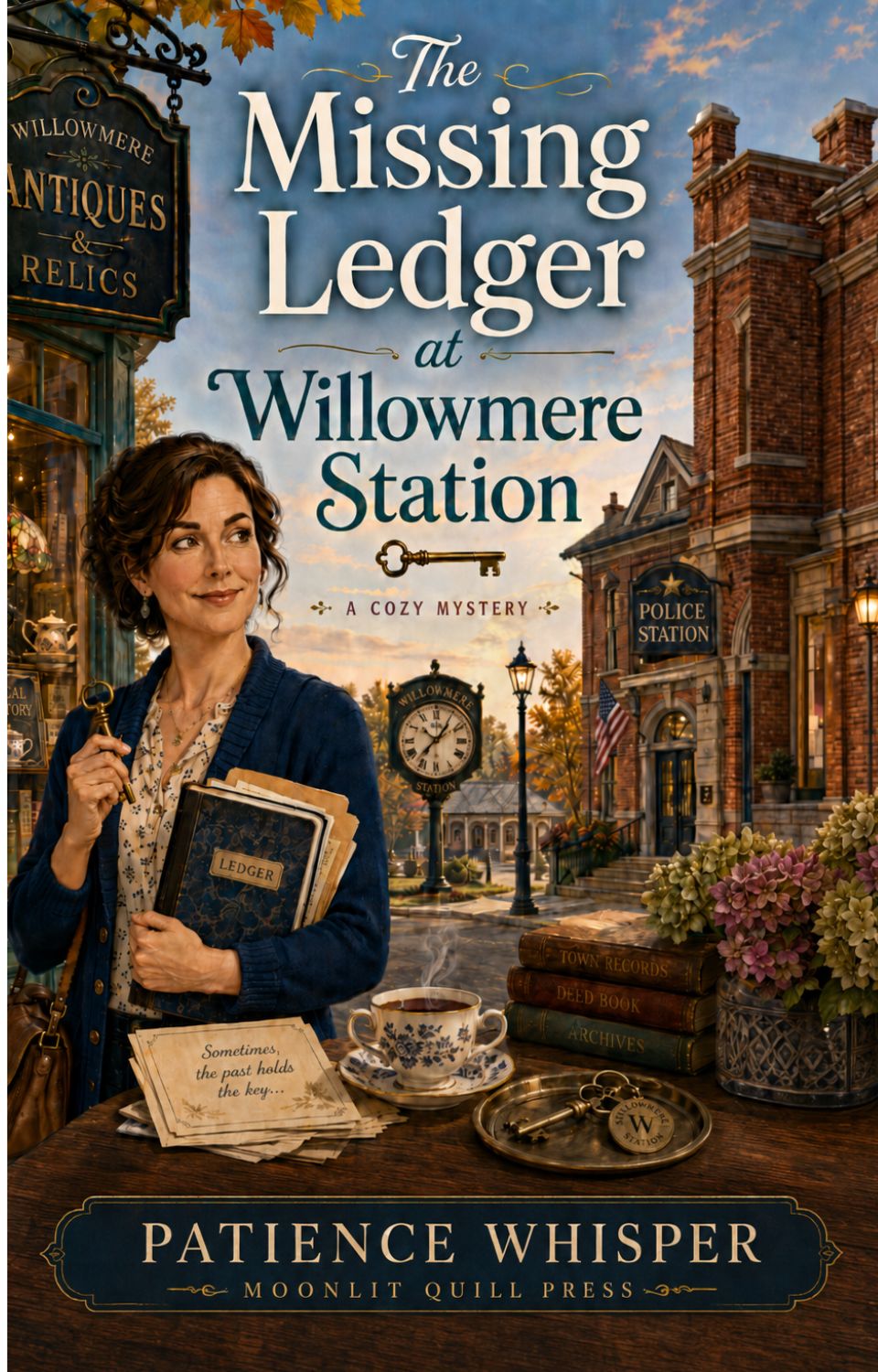
Chapter 1
The Trouble with Quiet Drawers
The evidence room at Willowmere Police Station smelled faintly of cardboard, floor wax, and secrets alphabetized by people who believed order could tame anything. Nora Bellamy had always found comfort in that smell. It meant every bracelet, broken window latch, muddy shoe, chipped teacup, and ill-advised garden gnome had a place, a number, and a signed chain of custody form tucked neatly into the station’s records.
On Tuesday morning, however, the comfort had gone rather thin.
Nora stood alone between the tall gray shelving units, her sensible navy cardigan buttoned wrong by one hole and her reading glasses sliding toward the end of her nose. She held a checkout ledger in one hand and a paper evidence request in the other. The two were supposed to agree with each other. In Nora’s experience, paper usually did agree with paper, provided humans hadn’t interfered.
This morning, humans had interfered quite a lot.
She looked again at the entry near the bottom of page 147, though she had already read it four times. Case 04-117. Millhouse Road Fire. One sealed envelope: photographs, scene sketches, original interview cassette. One cloth pouch: recovered brass key. One folded inventory supplement, blue carbon copy. Checked out three weeks ago.
Not logged back in.
Nora pressed her lips together until they were nearly invisible. Twenty years ago, Millhouse Road had been whispered over every pie counter and church basement folding table in Willowmere. A small carriage house had burned on the edge of town, and Ezra Vale, an antiques dealer with too many locked cabinets and too few friends, had been found dead after the flames were out. The case had gone cold before Nora was old enough to understand why adults lowered their voices when they spoke of it.
Now pieces of that cold case were missing.
And the person who had checked them out was someone she saw every day.
“Talking to the shelves again, Nora?”
She nearly dropped the ledger. Sergeant Miles Finch stood at the end of the aisle, one shoulder propped against the shelving as if he had been casually manufactured there. He had a paper coffee cup in one hand, a maple-glazed doughnut in the other, and the expression of a man who believed every room in the station brightened when he entered it. Unfortunately, he was often right.
“I talk to the shelves because they listen better than most people,” Nora said, closing the ledger with one finger, still marking the page.
Miles grinned. “Fair. But the shelves don’t bring you coffee.”
“They also don’t leave powdered sugar on active case files.”
“That happened once.”
“Three times.”
“Two and a half, if we’re being generous.”
Nora gave him the look she reserved for mislabeled evidence boxes, unsigned forms, and officers who returned borrowed pens without caps. Miles stepped into the aisle, peered at the ledger in her hand, and immediately lost half his grin.
“You found something?”
The question was too quick. Nora noticed because noticing was her job. She was not sworn. She did not carry a badge or a weapon. She did not chase suspects, interview witnesses, or tell people they had the right to remain silent. But she knew the weight of a stapled report by feel, knew when an evidence seal had been pressed by a careful thumb instead of a hurried one, and knew how people sounded when they were hoping a question would have a harmless answer.
“Inventory discrepancy,” she said.
Miles winced. “Those words make Captain Brandt’s eye twitch.”
“Then we must protect his eye.”
“Anything serious?”
Nora slid the request form beneath the ledger. “I’m not sure yet.”
Miles watched her for a heartbeat too long. The station hummed beyond him, with phones ringing, keyboards tapping, and Officer Janine Patel laughing at something near dispatch. It was the ordinary music of a small police department where everyone knew the coffee maker’s moods and whose turn it was to buy dish soap. Nora had worked there for eight years. She could tell from across the room when the copier was about to jam and when Captain Brandt was about to say, “Let’s keep this tidy,” which was usually a sign that nothing was tidy at all.
Miles lowered his voice. “Need help?”
That was the problem with Miles. He was helpful in a way that made people trust him, even though they remembered that trust ought to be earned slowly, like a sourdough starter. Nora had trusted him with birthday cake orders, printer emergencies, and the time she had backed her car into a snowbank behind Town Hall. But the ledger page had his name on it.
Sergeant M. Finch.
Checked out three weeks ago. No return.
“I’ll let you know,” she said lightly.
His gaze flicked to her finger holding the ledger page, then back to her face. Something unreadable crossed his features and was gone. “All right. But if it turns out to be one of Patrol’s famous spelling disasters, don’t blame me. Last week, Calder logged a crowbar as a ‘crow bard.’ I’m still hoping it writes sonnets.”
Despite herself, Nora smiled. “If it does, I’ll assign it shelf space under poetry.”
Miles lifted his coffee in salute and disappeared toward the front office.
Nora waited until his footsteps faded before she opened the ledger again.
There it was, written in blue ink in Miles’s tidy, slanted hand. Not forged. Nora handled enough paperwork to know the loops of his letters, the quick slash of his F, the way he crossed a t slightly too high. The signature looked authentic. The time notation, however, made her pause.
5:42 p.m.
Three weeks ago, on a Friday.
The evidence room was normally locked at five. Nora had left early that day to bring lemon bars to her aunt Hattie’s bridge club after Mrs. Barstow sprained her ankle attempting what she later described as “a graceful pivot.” Access after hours required a supervisor’s keycard and a manual ledger entry. Miles had both the authority and, apparently, the ink.
That did not mean he had done anything wrong.
Nora repeated this to herself firmly as she pulled the Millhouse Road master index from the cold case cabinet. Repeating sensible things did not always make them true, but it helped keep panic from throwing confetti in one’s brain.
The file box was on the lower shelf, gray cardboard with a faded white label. Case 04-117. Arson. Suspicious death. Unsolved. The box had been sealed with red evidence tape long ago, then resealed several times over the years for reviews that never led anywhere. The most recent seal had been cleanly sliced open.
Inside, the folders were arranged in proper order: initial report, fire marshal summary, autopsy correspondence, witness statements, property records, tip sheets, and press clippings. Nora exhaled with relief, then immediately regretted relaxing. Three empty spaces sat at the back where supplemental items should have been.
The envelope, the pouch, and the blue carbon copy were gone.
Not misplaced within the box. Gone.
Nora set the ledger down on a clean metal worktable and reached for the access log binder. This was separate from the checkout ledger, a modern addition after a long-ago debate involving missing bicycle parts, a prosecutor’s headache, and two months of training videos no one wished to remember. The keycard system recorded who opened the evidence room door and when, but the printed summary was only generated weekly. Nora kept copies because machines had confidence, but paper had humility.
She flipped to the Friday in question.
5:39 p.m. Sergeant Miles Finch. Access granted.
Then, a second entry.
5:51 p.m. Captain Elaine Brandt. Access granted.
Nora blinked.
Captain Brandt had entered the evidence room nine minutes after Miles checked out the missing items. The captain’s name did not appear in the checkout ledger. Neither did anyone else’s. If Brandt had come in after Miles, she should have seen him. Or she had come in because of him. Or she had come in for something else entirely and had not noticed that three items from a twenty-year-old case had just left the building.
Nora rubbed her temple.
The trouble with evidence was that it liked to make one thing clear while leaving six others foggy.
A burst of laughter drifted through the cracked door. Nora could see the bullpen through the narrow wire-glass window. Officer Calder was demonstrating something with a stapler, Janine Patel had one eyebrow raised in deep skepticism, and Miles was at his desk, now doughnutless, speaking to Captain Brandt. Brandt was in her usual charcoal blazer, her silver hair cut sharply at the jaw. She listened with her arms folded, face calm and unreadable.
Nora had never known Captain Brandt to be ruffled. Even during the Great Raccoon Incident, when a masked intruder had fallen through the break room ceiling and escaped with half a tuna sandwich, Brandt had simply said, “Let’s contain the narrative,” and shut the door.
Now she glanced toward the evidence room.
Nora stepped back from the window as though caught doing something improper, which was absurd. She was allowed to be there. She was the evidence clerk. She had keys, passwords, laminated procedural charts, and a drawer full of color-coded tabs that nobody appreciated enough.
Still, she closed the file box halfway.
“Think, Nora,” she whispered.
The safest thing was to report the discrepancy immediately. That was policy. A missing evidence item, even from an old cold case, required documentation, notification, and possibly a review by county officials. Nora could already imagine the forms piling up on her desk.
But the policy assumed the missing items were missing due to error, negligence, or an external actor. The policy did not account for the name of a respected sergeant appearing beside items from a famously unsolved death. Policy certainly did not account for the captain entering minutes later and never mentioning it.
If Nora reported it openly, Miles would know at once. So would Captain Brandt. If one of them had a harmless explanation, wonderful. If one of them did not, the missing envelope, pouch, and supplement might become more missing than they already were.
Nora had spent eight years making sure evidence could speak in court. Now it seemed to be whispering in the one place no one expected to listen.
She opened the file again.
The Millhouse Road carriage house had belonged to Ezra Vale, owner of Vale & Vellum Antiques, a narrow shop downtown that sold walnut writing desks, silver teaspoons, and the occasional porcelain shepherdess with an expression of deep disapproval. Ezra had lived alone in the main house and used the carriage house for restoration work. According to the initial report, the fire had started late on an October night. Neighbors smelled smoke. Firefighters arrived to find the rear structure burning hot and fast.
Ezra was found inside after the flames were brought under control.
The official cause of death was smoke inhalation, with the manner undetermined pending further investigation. The fire marshal suspected the presence of accelerant near the workbench. The police suspected someone had locked Ezra inside. The town suspected everyone.
Nora remembered fragments from childhood. Her mother lowered the radio in the kitchen. Her aunt Hattie whispered that Ezra had “known things about people’s heirlooms that were not strictly heirlooms.” Mr. Vale’s antiques shop sat dark for months with a wilted wreath on the door. The way grown-ups had stopped talking whenever Nora entered a room.
She turned to the witness statements.
There were plenty of names she knew. That was the hazard of a small town and an old case. Twenty years did not erase people; it merely changed their hairstyles and blood pressure medication.
Miriam Vale, Ezra’s younger sister, had found his shop records in disorder the next morning. She now ran the antique store under the more cheerful name The Velvet Teacup, though in Nora’s opinion, no teacup ought to be velvet. Harold Peavey, then a volunteer firefighter, reported seeing tire tracks near the back lane. He now fixed bicycles and gave unsolicited advice at the farmers’ market. Vivienne March, the bakery owner next door at the time, had argued with Ezra earlier that week over a missing family brooch. She now owned half the storefronts on Juniper Street and wore pearls even to committee meetings.
And there, tucked into a typed report, was a name Nora did not expect.
Elaine Brandt.
Not captain then, of course. Officer Elaine Brandt had been one of the first responders on scene. Nora knew Brandt had served in Willowmere for years, but somehow the connection had never settled in her mind. Brandt had walked through the aftermath while ash still clung to the air. Brandt had interviewed the neighbors. Brandt had logged the first recovered items, including the brass key now missing from the box.
Nora sat down slowly on the stool.
The brass key.
She searched the inventory list. The key had been found under Ezra Vale’s right hand, blackened but intact, attached to no ring. The report noted that it did not match the carriage house door, the main house, the shop, or any of the cabinets examined during the original investigation. Unknown key, retained for future identification.
A key that opened nothing was annoying.
A key that vanished twenty years later was interesting.
Nora copied the item number onto a sticky note, then stopped. Sticky notes were not evidence-room approved for case handling because they could fall off and cause confusion. She scowled at herself, peeled it away, and wrote the number in her personal notebook instead, which had a cover printed with tiny foxes wearing scarves. It had been a gift from Aunt Hattie, who believed all office supplies should have personality.
She added three columns beneath the case number.
Who accessed it?
What was removed?
Why now?
The last question felt the heaviest.
Three weeks ago, nothing obvious had happened in Willowmere. The mayor’s tulip luncheon had been postponed because of hail. The high school marching band had hosted a car wash. Someone had placed a ceramic goose in the town fountain wearing a rain bonnet, but that was not unusual enough to connect to a cold case. Nora tried to remember whether any anniversary had passed, any article had run, any outsider had asked questions.
The station phone rang twice and stopped.
Then Nora heard Captain Brandt’s voice.
“Ms. Bellamy? A word when you have a moment.”
Nora froze with her pen hovering over the fox notebook.
Brandt stood just outside the evidence room door. She had not opened it. She never entered without Nora logging her in properly, which Nora respected and, at this precise moment, found inconveniently intimidating.
Nora slid the notebook beneath a folder and closed the Millhouse box. “Of course, Captain.”
She stepped out, locking the evidence room behind her with fingers that only trembled slightly. Brandt’s gaze traveled from Nora’s face to the door, then back again.
“Inventory morning?” Brandt asked.
“Yes.”
“Anything unexpected?”
The question was mild. Too mild, perhaps. Or perhaps Nora had spent too long alone with old paper and had begun assigning motives to punctuation.
“There are always surprises,” Nora said. “Last month, I found three fishing lures filed under kitchen utensils.”
“That would explain Officer Calder’s report writing.”
Nora almost laughed. Captain Brandt did not often make jokes. When she did, everyone treated them like rare birds landing on a windowsill.
Brandt gestured toward her office. “Come in.”
Nora followed, feeling absurdly like a schoolgirl summoned for drawing spectacles on a portrait of President Millard Fillmore, which she had done once in fifth grade and still considered an artistic improvement. Brandt’s office was small, tidy, and severe, softened only by a spider plant on the windowsill and a framed photograph of the station’s charity softball team from twelve years ago. Nora immediately noticed Miles in the picture, younger, grinning, one arm slung around a teammate.
Brandt closed the door.
“I wanted to ask whether you’ve had any unusual records requests recently,” she said.
Nora clasped her hands in her lap. “Unusual how?”
“Old cases. Retired files. Anything that required digging.”
Nora’s pulse ticked once at the base of her throat. “We get occasional requests. Insurance, genealogy, journalists who think the right font makes them investigative reporters.”
Brandt did not smile. “Anyone asking about Millhouse Road?”
There it was.
The room seemed to shrink by one tidy inch.
Nora adjusted her glasses. “Not that I recall.”
Brandt watched her. “You would recall.”
“Yes,” Nora said. “I would.”
The captain moved behind her desk and picked up a slim folder. She did not open it. “A woman came by yesterday while you were at lunch. She asked dispatch about old fire reports from the Vale property.”
Nora’s mind began arranging facts as if they were beads on a string. Yesterday. Old fire reports. Vale property. Brandt asking before Nora had reported anything.
“What woman?”
“She gave her name as Cora Dane.”
Nora knew most people in Willowmere by sight, by library card disputes, or by evidence receipt signatures. Cora Dane was not among them. “From town?”
“Claims her grandmother lived here.”
“That narrows it down to everyone over seventy with a casserole dish.”
This time Brandt’s mouth twitched. “She was directed to submit a formal records request. She didn’t.”
“Maybe she will.”
“Maybe.” Brandt set the folder down. “If she contacts you, let me know before pulling anything.”
It was a reasonable instruction. Perfectly reasonable. The sort of instruction a captain would give if an outsider had begun sniffing around a sensitive cold case. Nora could have nodded, agreed, and gone back to her desk.
Instead, she made the mistake of asking, “Sensitive for legal reasons?”
Brandt’s eyes sharpened. “For departmental reasons.”
There was no harshness in her voice, only finality. Nora felt the way she did when a drawer slid shut with her fingers nearly inside.
“Of course,” Nora said.
Brandt softened by a fraction. “Nora, old cases stir old grief. People remember things incorrectly or too vividly. Sometimes they go looking for answers that won’t comfort anyone.”
“And sometimes answers are needed anyway.”
The words escaped before Nora could starch them properly. She expected Brandt to reprimand her. Instead, the captain looked suddenly tired.
“Yes,” Brandt said quietly. “Sometimes they are.”
Nora left the office with more questions than when she had entered, which hardly seemed efficient. At her desk outside records, she pretended to sort mail while watching the station through the benign camouflage of routine. Miles was on the phone, leaning back in his chair. Janine was typing. Calder was trying to repair the stapler, which appeared to have lost a spring and possibly its will to live.
Captain Brandt remained in her office with the door half closed.
Nora opened the evidence database and searched Case 04-117. Digital records were added years after the case began, which meant they were incomplete in the charming way of old municipal software: confident, clunky, and occasionally wrong, all in capital letters. Still, the system showed the same checkout entry from three weeks ago.
Requested by: Sgt. M. Finch.
Purpose: Review.
Approved by: Capt. E. Brandt.
Items: 04-117-E12, E13, E14.
Return date: Pending.
Approved by Captain Brandt.
Nora sat very still.
That had not been in the paper ledger. Approval sometimes happened verbally, then was entered later into the database. Miles had not acted alone, at least officially. Brandt had approved the removal. But why had neither of them returned the items? Why had Brandt just asked Nora about records requests as if she did not already know Millhouse Road materials were out?
Unless Brandt had approved one thing and Miles had taken another.
Or unless the database entry had been edited.
Nora clicked the audit history. The little spinning wheel appeared, spun with theatrical reluctance, and produced a list of changes.
Original entry created: Sgt. M. Finch, Friday, 5:46 p.m.
Approval added: Capt. E. Brandt, Monday, 8:12 a.m.
Return date changed from 30 days to Pending: user admin, Monday, 8:14 a.m.
Nora’s skin prickled.
An evidence checkout for cold case materials should have had a specific return date. Changing it to Pending was not necessarily improper, but it was not casual either. It stretched the string so no one would notice when the kite disappeared into the clouds.
She printed the audit history, then immediately regretted the sound of the printer. The machine behind her coughed, whirred, and produced the page with the delicacy of a gossip clearing her throat.
Miles looked over.
Nora snatched the paper from the tray and slid it into a folder labeled Vendor Invoices. Her heart thumped with such guilty vigor that she felt she ought to apologize to it for making assumptions.
Miles put down the phone and walked toward her desk.
“Everything behaving?” he asked.
“Never,” Nora said. “The printer has opinions.”
“That it does.” He rested one hand on the counter. “Nora.”
She looked up.
For once, he was not smiling.
“If you come across anything odd,” he said, “anything from an old case, bring it to me before it turns into a station-wide circus.”
Nora heard the words beneath the words. Not Captain Brandt. Not official channels. Me.
“That sounds very specific,” she said.
His jaw tightened. “It’s a small town. Specific comes with the plumbing.”
“Does this have to do with Millhouse Road?”
The question landed between them like a dropped teacup.
Miles glanced toward Brandt’s office, then at the hallway behind him. When he spoke, his voice was low enough that Nora had to lean in.
“It has to do with someone asking questions who shouldn’t be.”
“Cora Dane?”
His eyes changed. Not much, but enough. “You’ve heard from her?”
“No.”
“Good. Don’t.”
“Miles.”
“Please.” The word was so unlike him that it silenced her more than any order could have. “Some old stories are old because people survived by leaving them that way.”
Before she could answer, Officer Patel called his name from the bullpen. Miles stepped back, his everyday grin reappearing as though he had pulled it from a pocket.
“Duty,” he said, and walked away.
Nora remained at her desk with the Vendor Invoices folder beneath her hand.
By noon, the station had settled into its usual lunchtime rhythm. Calder had given up on the stapler and begun eating soup from a mug that said World’s Okayest Fisherman. Janine was explaining to dispatch why her mother’s book club had banned true crime podcasts after Mrs. Larkin accused three husbands of suspicious gardening. Miles had gone out on a call. Captain Brandt’s office was empty.
Nora took her lunch break ten minutes early.
She did not go to the break room. She did not go to the little bench outside where people from the courthouse smoked, despite claiming they were “just holding cigarettes for friends.” Instead, she walked two blocks to Juniper Street, past the florist, the hardware store, and the statue of town founder Abel Willowmere, whose bronze expression suggested he had disapproved of the future and been proven correct.
The Velvet Teacup sat between a yarn shop and a bakery that smelled strongly of cinnamon. Its front window displayed antique teapots, lace gloves, and a walnut writing box with brass corners. The bell above the door gave a delicate chime as Nora entered.
Miriam Vale looked up from behind the counter.
She was in her early seventies now, small and precise, with white hair pinned into a twist and eyes as bright as polished spoons. Nora had seen her at charity auctions and town meetings, always wearing soft lavender and a brooch shaped like a bird. She smiled warmly.
“Nora Bellamy. What a pleasure. Are you hunting for something particular?”
Nora took in the shop: the glass cases, the old cabinets, the faint smell of lemon oil and dried roses. Twenty years ago, Miriam’s brother had died in a fire behind a property full of locked drawers and family quarrels. Now his sister sold delicate things to tourists who wanted history without dust.
“I’m not sure,” Nora said. “Perhaps a key.”
Miriam’s smile did not vanish. It simply became still.
“A key?”
“For an old writing box,” Nora improvised, nodding toward the display. “Something brass. Unusual.”
Miriam stepped from behind the counter. “Old keys are troublesome creatures. They look important even when they open nothing.”
“That’s exactly what I was thinking.”
Miriam studied her for a moment. “Most customers want teacups.”
“I’m not most customers.”
“No,” Miriam said softly. “You work at the police station.”
The shop seemed to quiet around them. Outside, someone laughed on the sidewalk, and a delivery truck rumbled past. Inside, Miriam’s bird brooch caught the light.
Nora chose her next words carefully. “I came across a reference to your brother’s case.”
Miriam turned toward the display window, her profile sharp against the afternoon brightness. “Ezra has been dead twenty years, and still his name has a way of entering rooms before anyone invites it.”
“I’m sorry.”
“So was everyone.” Miriam adjusted a porcelain creamer by a quarter inch. “At the time.”
“Did he own a brass key? One that didn’t match the house, shop, or carriage house?”
Miriam’s hand stopped on the creamer.
There it was. A small thing, barely a pause, but Nora felt it as surely as if a drawer had opened by itself.
“Why do you ask?” Miriam said.
“Curiosity.”
“My dear, curiosity wears many hats. Yours has a badge tucked under the ribbon.”
“I’m not an officer.”
“No,” Miriam said, turning back. “That may be why I’m inclined to answer.”
Nora waited.
Miriam walked to a tall cabinet near the rear of the shop. From a drawer, she removed a small velvet tray containing keys: iron, brass, nickel, some ornate, some plain. She set it on the counter between them.
“Ezra collected keys. Not valuable ones. Sentimental ones, or so he claimed. Keys to houses torn down, trunks lost in attics, diaries without pages. He said every key was a promise someone forgot.”
“That sounds poetic.”
“It sounded like nonsense when he said it over breakfast.” Miriam touched one brass key on the tray, then another. “But there was one he kept apart. He wore it on a black cord under his shirt for several months before the fire.”
Nora’s breath caught. “Do you know what it opened?”
“No.”
“Did he tell anyone?”
Miriam’s face grew pinched. “Ezra enjoyed knowing what others didn’t. It made him careless. It also made people angry.”
“Who?”
A bell chimed behind Nora as the shop door opened.
“Nora Bellamy,” said a woman’s voice, low and amused. “I was told you were the person who knows where Willowmere keeps its ghosts.”
Nora turned.
The newcomer was perhaps forty, with dark curls tucked beneath a green cloche hat and a raincoat far too stylish for the mild spring weather. She carried no purse, only a leather satchel worn at the corners. Her smile was pleasant, but her eyes went straight to the velvet tray of keys, then to Miriam Vale.
Miriam’s face had gone pale.
“You,” Miriam whispered.
The woman inclined her head. “Hello, Miss Vale.”
Nora knew before anyone said it.
Cora Dane had found her.
And judging by Miriam Vale’s trembling hand on the counter, Cora was not merely asking questions about the past.
She had brought part of it with her.