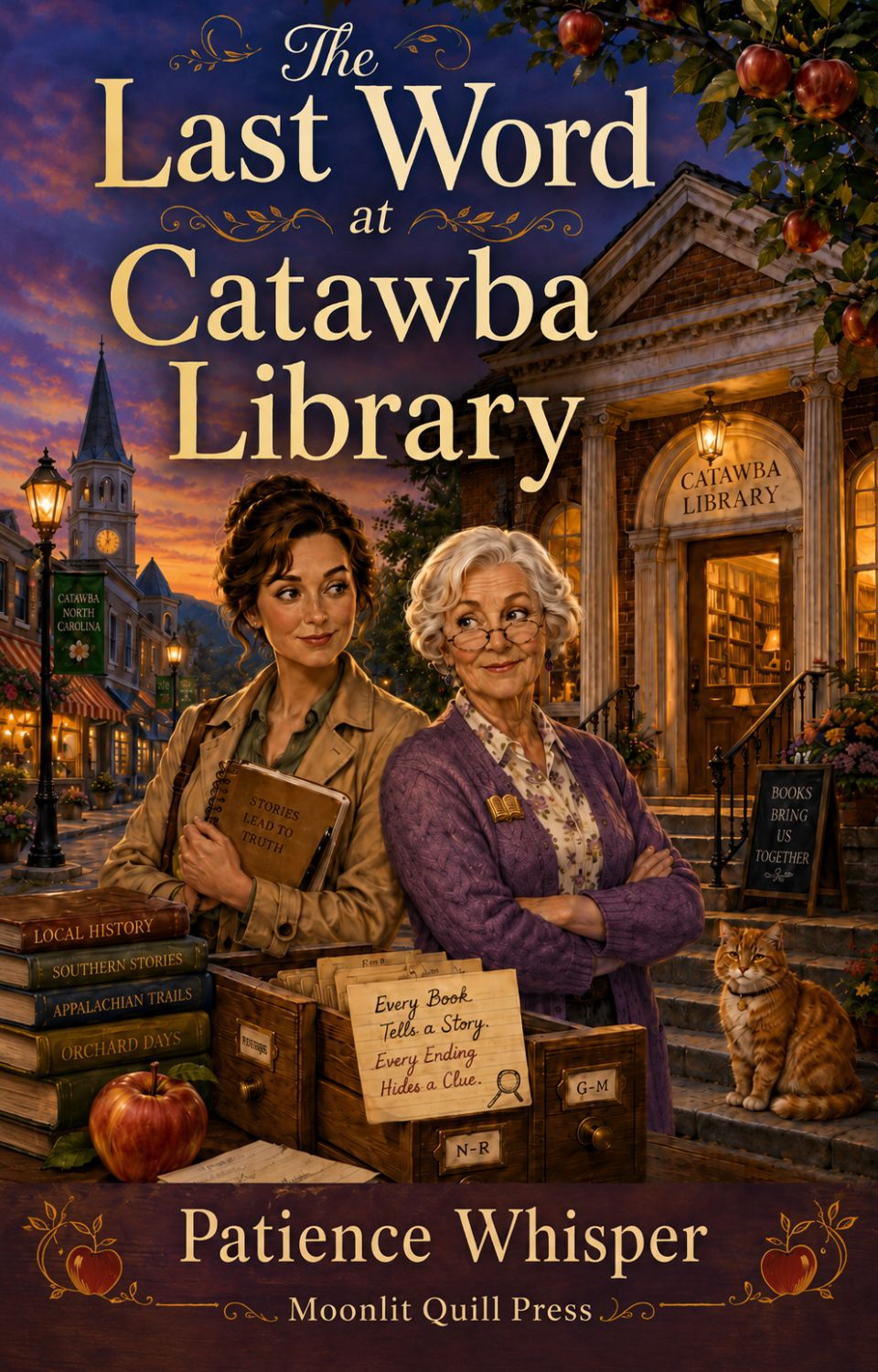
Chapter 1
A Whisper Between the Stacks
By six o’clock, the rain had softened Catawba Falls into a watercolor of porch lights, slick sidewalks, and red-brick storefronts shining like polished apples. The kind of evening, Willa Vale thought, when sensible people stayed indoors with soup, slippers, and no mysterious appointments arranged by anonymous sources.
Unfortunately, Willa had never built a career by being sensible.
She sat in her little blue hatchback at the edge of Briarlock Mill, where the old textile building leaned against the river as if exhausted from keeping too many secrets. The mill had been closed for thirty years, though someone had recently bought it under a company name so dull it seemed designed to put people to sleep: Regional Renewal Holdings. Willa had written that name in her notebook eight times in the past month, circling it twice, underlining it once, and finally drawing a question mark so aggressive it had nearly torn the paper.
Her phone screen glowed in the cup holder.
Tonight. 6:15. Briarlock Mill. Come alone.
Then, beneath it, the sentence that had made her leave her apartment without finishing dinner.
They know what I gave you was only the ribbon around the box.
The message had come from Finch, her anonymous source of two years. Not his real name, of course. Willa had never heard his voice without distortion, never seen his face without shadow, never known whether Finch was old or young, polished or shabby, afraid or simply talented at sounding so. He had fed her documents, photographs, meeting places, financial trails, all tying a polished regional charity network to something far uglier beneath: illegal gambling, intimidation, laundering through shell donors, and a tidy little constellation of respectable names.
It had been the story of her career.
Or so she had thought.
Willa rubbed her thumb over the edge of her press badge, dangling from the rearview mirror like a talisman that had lost some of its magic. She had told her editor she was following a weather-related lead about flooding at the old mill. She had not told him about Finch’s message. She had not told her younger sister, who would have driven over with pepper spray and a lecture. And she had certainly not told Miss Ruthie Knobblebrush, head librarian of the Catawba County Library, because Ruthie would have said something like, “My dear, when a stranger writes come alone, one ought to bring either a policeman or a casserole. Preferably both.”
Willa almost smiled at the thought.
Then she saw the side door of the mill standing open.
It was not wide open. Just ajar, a slim black line cutting through rusted metal. Rain ticked on the roof of her car, quick and nervous. The river beyond the mill moved in the dark with a wet, whispering force.
Willa turned off the engine.
Her boots splashed in the gravel as she crossed the lot, her umbrella immediately flipping inside out in a rude gust of wind. She wrestled it closed and tucked it beneath her arm. The mill smelled of rain, old cotton dust, machine oil, and that peculiar mineral scent of buildings that had been empty long enough to stop pretending otherwise.
“Finch?” she called.
Her voice came back thinner.
She stepped inside.
The entry corridor opened into a cavernous floor where rows of silent machines stood beneath broken windows. Water dripped somewhere steadily, like a clock with no hands. Her phone flashlight cut a pale path over concrete, columns, and faded safety signs.
At first, she saw only the chair.
It sat in the middle of the floor, turned slightly toward the old loading doors. A folded newspaper rested on the seat. On the newspaper sat a small brass library card catalog drawer.
Willa stopped.
She knew that drawer.
Not personally, perhaps, but she had seen its siblings in the Catawba County Library’s local history room, where Miss Ruthie Knobblebrush guarded the old wooden card catalog as if it were an elderly relative with scandalous memories. A little brass pull. A cream label browned at the edges. Inside, cards typed decades ago with careful black letters and the occasional handwritten correction.
“Finch?” Willa said again, softer now.
A shape lay beyond the chair, half in shadow beside a stack of rotting pallets.
For one long second, her mind refused to understand it. The human brain was strange that way. It would rather name objects than admit calamity. Coat. Bundle. Tarp.
Then her light caught a hand.
Willa did not scream. She inhaled once, so sharply her chest hurt, and stumbled back into the chair. The brass drawer clattered to the concrete, spilling index cards in a pale flutter around her boots.
The man on the floor did not move.
His face was turned away, his body curled slightly as though he had lain down to listen to the rain. Beside his hand was a phone, dark and cracked. Near his shoulder, a damp envelope had been weighted down with a small river stone.
Willa forced herself not to touch him. She had written enough crime stories to know how much damage panic could do. Her fingers trembled so badly she nearly dropped her own phone as she called 911.
“There’s a man,” she said when the dispatcher answered. “Briarlock Mill. He’s not moving. I think—” Her throat tightened. “I think he’s dead.”
The dispatcher’s voice became calm, precise, and far away.
Willa stayed where she was, rainwater dripping from her coat onto the concrete, while the old mill held its breath around her.
Only when she heard sirens in the distance did she look down at the scattered cards.
Most were ordinary catalog entries. County tax rolls. Church directories. High school annuals. Oral histories. But one card, lying faceup near her left boot, had a phrase handwritten in red ink across the top.
Ask Ruthie what was never filed.
Willa stared at it until blue lights flashed against the broken windows.
By seven-thirty, Briarlock Mill had bloomed with police cruisers, rain jackets, flashlights, and the grim choreography of people trained to step carefully around tragedy. Willa sat in the back of an ambulance with a foil blanket around her shoulders, though she kept insisting she was not cold.
She was cold, of course. Cold had settled into her bones the moment she saw the hand.
Detective Amos Pruitt stood a few feet away under the sagging lip of the loading dock, talking to an officer with a notepad. Pruitt was compact, silver-haired, and wore the expression of a man who distrusted both coincidences and journalists on principle. He had questioned Willa for twenty minutes already, during which he had managed to say “Miss Vale” in at least nine different tones of disapproval.
“You received a message from an anonymous source,” he had said.
“Yes.”
“Who asked you to come alone.”
“Yes.”
“And you came alone.”
“Yes.”
“Without notifying law enforcement.”
Willa had pulled the blanket tighter. “He was my source. He trusted me.”
Detective Pruitt’s eyes had softened for half a second, but only half. “Did he?”
That question had followed her ever since, slipping beneath the blanket, beneath her skin.
A white sedan pulled up beyond the police tape, its windshield wipers flapping with frantic determination. The driver’s door opened, and out stepped Miss Ruthie Knobblebrush in a yellow raincoat, green rubber boots printed with tiny foxes, and a knitted hat shaped, unmistakably, like an acorn.
Willa closed her eyes.
“Oh no.”
Ruthie marched toward the tape with a covered thermos in one hand and a tote bag in the other. She was seventy-two, five feet tall if her hair had volume, and possessed of the rare authority that made grown adults obey her before understanding why. The officer at the tape began to say something official, but Ruthie had already fixed him with her librarian’s gaze.
“Young man, I have brought hot tea for a witness who is likely in shock, and I know your mother, who still has not returned the Bundt pan she borrowed after the Harvest Fair of 2019.”
The officer blinked. “Miss Ruthie?”
“Yes, Trevor. Now be useful and hold this bag while I duck under, unless you intend to explain to your mother why you left Willa Vale shivering like a porch geranium in February.”
Trevor held the tape.
Ruthie ducked under.
Detective Pruitt saw her and pinched the bridge of his nose.
“Ruthie,” he said.
“Amos,” she replied, as though they had met in the produce aisle. “You look as if you’ve been chewing gravel.”
“This is an active scene.”
“And this is chamomile with honey. We all have our burdens.”
Willa almost laughed, and because she almost laughed, her eyes filled with tears instead.
Ruthie reached the ambulance and set the thermos beside her. “There now, duck. No need to be brave in weather like this. Bravery gets damp and starts smelling like wool.”
“I didn’t call you,” Willa said.
“No, but you called 911, and Trevor’s mother called me, and Amos’s sister called the library to ask whether I knew you were mixed up with Briarlock Mill, and then Mrs. Dobbins at the pharmacy said she saw your car pass Maple Street like the hounds of old sin were after it.” Ruthie unscrewed the thermos cap. “Small towns are inefficient in many ways, but never in the movement of alarming information.”
Detective Pruitt approached. “Ruthie, I’m going to need you to step back.”
“In a moment. Has Willa had anything warm?”
“This is not a tea party.”
“Few of life’s most important gatherings are,” Ruthie said, handing Willa the cap full of tea. “Drink.”
Willa drank. It tasted of honey, flowers, and being eight years old with a fever and someone kind nearby.
Pruitt lowered his voice. “Ruthie, I mean it. You cannot interfere.”
“I am not interfering. I am comforting.” Her eyes flicked toward the mill, then back to Willa. “Though I do wonder why one of my catalog drawers is being photographed by your evidence technician.”
Willa’s fingers tightened around the cup.
Detective Pruitt went still. “Your catalog drawer?”
“It is from the old oak cabinet in the local history room. Second section, surnames L through R, if memory serves, though it may be M through S if someone has rearranged things after I specifically asked them not to breathe too close to it.” Ruthie’s voice remained light, but her face had changed. The bright, busy kindness had sharpened into something keen.
Pruitt studied her. “How can you tell from here?”
“My dear Amos, if you had spent thirty-one years caring for those drawers, you would know them at twenty paces in a thunderstorm. That one has a scratch on the brass pull from when Councilman Dale’s cufflink caught on it during the bicentennial exhibit. He blamed the hinge. It was the cufflink.”
Willa looked from Ruthie to the open mill doors. “There was a card,” she said. “One of the cards said to ask you something.”
Pruitt’s gaze snapped to her. “What did it say?”
Willa swallowed. “Ask Ruthie what was never filed.”
The rain seemed to hush.
Ruthie’s gloved hand settled on the edge of the ambulance door. For the first time since she had arrived, she did not have a ready answer.
Detective Pruitt noticed. “Do you know what that means?”
Ruthie looked toward the mill, where the dead man had been taken from shadow into official light. “I know many things that were never filed,” she said quietly. “That is the trouble with libraries. Everyone assumes we only keep what is on the shelves.”
Willa’s reporter’s instincts stirred beneath the shock. A question formed. Then three more.
“Miss Ruthie,” she said, “did you know Finch?”
“I don’t know anyone named Finch,” Ruthie replied. “But I suspect you don’t either.”
Detective Pruitt folded his arms. “You two are going to make my evening worse, aren’t you?”
“Almost certainly,” Ruthie said.
Willa looked down at the tea. The surface trembled with the faint shaking of her hands.
Two years. Two years of messages, drops, warnings, documents. Two years of believing Finch was helping her expose criminals who hid behind charity galas and redevelopment speeches. And now he was dead in a mill with a library drawer, a handwritten card, and evidence that the story he had given her might have been arranged like a window display.
Not false, perhaps.
Worse than false.
Selected.
Detective Pruitt turned to Willa. “You said there was an envelope near the body.”
“I didn’t touch it.”
“No one said you did.”
“But you were going to wonder.”
“I wonder professionally.”
Ruthie made a small approving noise. “That was almost witty, Amos. Grief does improve you.”
Pruitt ignored her. “The envelope had your name on it.”
Willa felt the tea turn heavy in her hand. “My name?”
“Willa Vale, printed in block letters.” Pruitt’s expression gave nothing away. “We’ll process it before opening.”
Ruthie inhaled through her nose, the way she did when discovering someone had dog-eared a rare book.
“What?” Willa asked.
“Block letters,” Ruthie said. “Not typed?”
“That’s what I saw,” Willa said. “Before I called.”
Ruthie looked at Pruitt. “May I ask whether the ink was blue?”
“No,” Pruitt said.
“Because you don’t know or because you won’t tell me?”
“Yes.”
Willa frowned. “Why would blue ink matter?”
Ruthie adjusted the cuff of her raincoat. “It may not. But when someone wishes to disguise handwriting, they often think in terms of slant and shape. They forget pressure, spacing, habits. They forget whether they prefer black ink or blue. They forget that a person who writes notes all day begins to recognize the manners of ink.”
Pruitt stared at her. “The manners of ink?”
“Pens have personalities.”
“Of course they do.”
Willa turned the phrase over in her mind: ask Ruthie what was never filed. “There’s something at the library, isn’t there?”
Ruthie did not answer quickly enough.
A gust of rain swept beneath the ambulance’s open doors. Beyond the police tape, a cluster of onlookers had gathered under umbrellas: Mayor Lyle Haskett in his camel coat, pretending not to be there; Bixby Thorne, the redevelopment consultant, speaking urgently into his phone; Fern Alvarez from the bakery, one hand pressed to her mouth; and Cyrus Bell, Willa’s editor, hair plastered to his forehead, looking both worried and furious.
Willa’s eyes stopped on Bixby.
Regional Renewal Holdings. Briarlock Mill. The charity network. The anonymous documents. The story Finch had been feeding her.
Bixby looked up suddenly, as if he sensed her watching.
For one heartbeat, his face was blank.
Then he smiled.
It was not a nervous smile, not an embarrassed one, not the smile of a man caught rubbernecking at a crime scene. It was polite and composed and somehow colder than the rain.
Willa looked away first.
Ruthie noticed.
“Bixby Thorne,” Ruthie murmured. “That man irons his jeans, which is rarely a good sign.”
Detective Pruitt sighed. “Ruthie.”
“What? I didn’t say it was evidence.”
“No, you implied it was moral failure.”
“Sometimes the cardigan knows before the court does.”
Despite herself, Willa gave a short, shaky laugh. It loosened something in her chest, but only a little.
Pruitt’s phone buzzed. He checked the screen, frowned, and stepped aside to answer. Ruthie waited until he was out of earshot before leaning closer.
“Willa,” she said softly, “I want you to listen very carefully. When Amos lets you go, you are coming to my house. Not your apartment. Not the newsroom. My house.”
“I can’t hide.”
“I didn’t say hide. I said come to my house. There is a difference. Hiding involves fear and poor curtains. Coming to my house involves biscuits, locks that work, and my late husband’s unfortunate but effective collection of walking sticks.”
“Miss Ruthie—”
“Someone lured you here. Someone wanted you to find that poor soul. Someone used a drawer from my library and a message meant to pull me into it.” Ruthie’s eyes, usually merry as polished chestnuts, were dark with worry. “That means whoever arranged this knows both your habits and mine.”
Willa’s mouth went dry. “You think Finch wasn’t working alone.”
“I think Finch may not have been Finch in the way you believed.” Ruthie glanced toward the mill. “And I think the story you’ve been chasing has been wearing a very clever hat.”
Detective Pruitt returned, his expression grave.
“Willa,” he said, “we opened the envelope.”
She stood before she realized she had moved. The blanket slipped from her shoulders.
“What was inside?”
Pruitt hesitated, just long enough for dread to step forward.
“A photograph,” he said. “Old. Black and white. It appears to show five people standing in front of this mill, maybe forty years ago.”
Willa waited.
“And on the back?” Ruthie asked.
Pruitt looked at her then. Not like a nuisance. Not like an old friend. Like a detective suddenly realizing that the smallest person at the scene might be standing nearest the fuse.
“On the back,” he said, “someone wrote, ‘The first story was buried in the library.’”
Ruthie’s face lost every scrap of color.
The rain kept falling. The river kept moving. And somewhere inside the old mill, Willa’s carefully built story collapsed into something far older, stranger, and much closer to home.