Prologue
Six weeks after the Concordance House had been divided into safer pieces, Angela Lark discovered that a road could vanish without moving an inch. She was standing in the unfinished Garden Map Room at Primrose Bend, holding one end of a measuring string while Jonas Thorne crouched beside the old stone distance post beneath the lifted floorboards. Outside, early-autumn rain whispered through the rosemary and thyme, and the room smelled pleasantly of damp plaster, lamp oil, and the cinnamon buns Tobin had insisted were appropriate equipment for municipal archaeology. Nothing about the morning felt urgent, which Angela had learned was not the same as nothing being wrong.
The Garden Map Room had survived its first review four days earlier without becoming a residence, household, annex, romantic declaration, or civic emergency. Angela considered this an excellent record, particularly because the room now contained one broad map table, two sets of private drawers, an ordinary garden door, a side door toward the lane, and absolutely no bed despite Tobin’s persistent claim that a narrow daybed would improve both scholarship and lunch. Jonas still lived at Bellweather Steps, Angela still lived in Primrose Bend, and both of them had chosen to continue using the room until its three-month review. The arrangement felt important precisely because neither of them had been required to make it mean more.
“Twenty-seven,” Jonas said from the floor. He read it out the way he read any measurement he had already taken twice.
Angela checked the measuring string. “The stone still says twenty-seven.”
“I was hoping six weeks of being ignored might have persuaded it to become less mysterious.” He brushed grey dust from the carved letters with a soft restoration brush, leaving another streak of dirt across his knuckles. “Most objects respond well to neglect.”
“That principle has not performed reliably in Alderwren.” Angela set down the string and opened her small ledger.
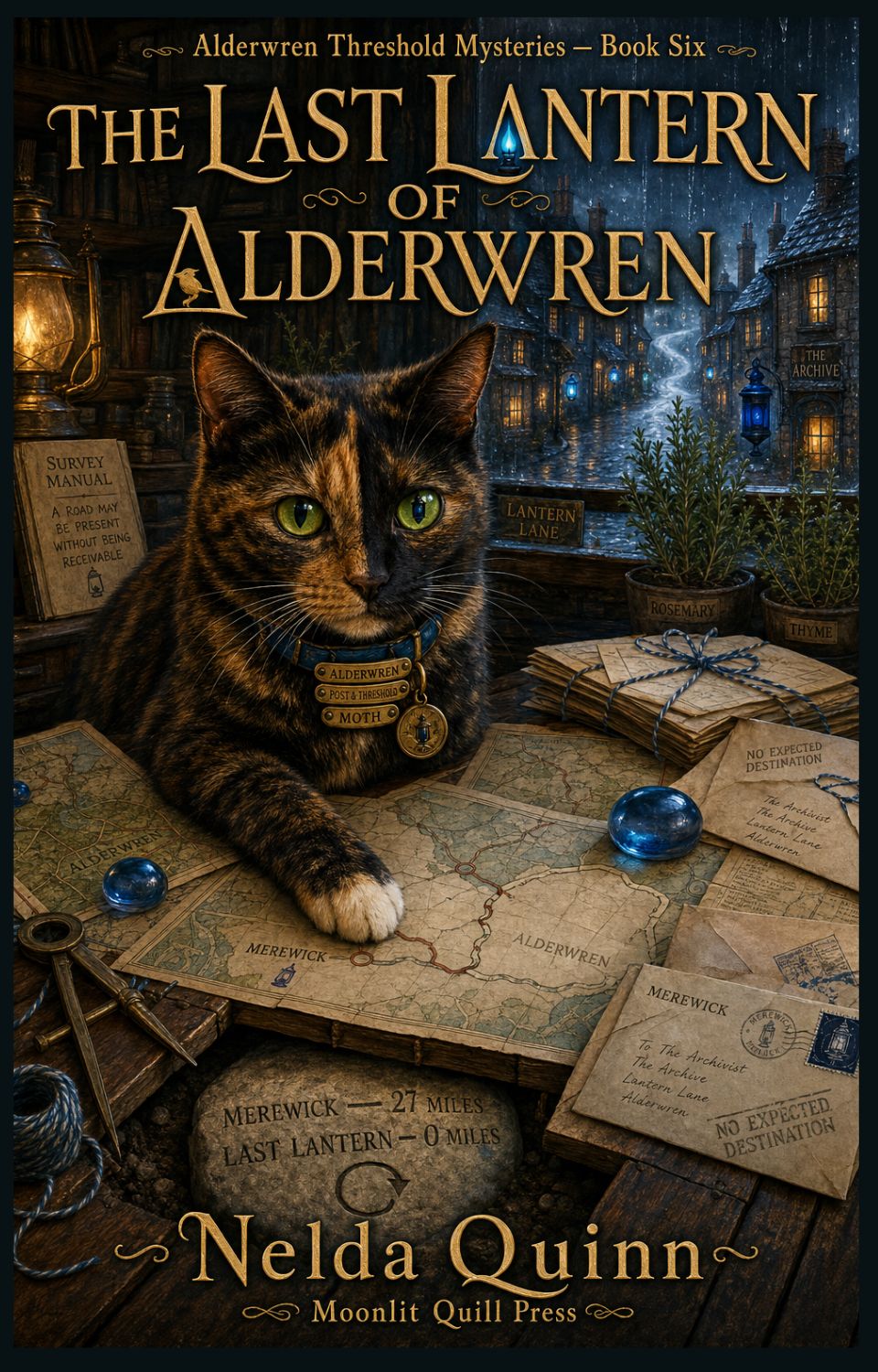
The exposed portion of the post carried several weathered place names beneath a carved arrow. MEREWICK — 27 MILES remained clear enough to read, while CANDLEFEN and RAINMARKET occupied lower lines where old soil had stained the stone. One destination had been crossed out so thoroughly that the original letters could not yet be distinguished, and the final inscription remained the least cooperative of all. LAST LANTERN — 0 MILES sat beneath an arrow curled into a complete circle, pointing nowhere beyond itself.
Moth had spent the first half of the morning sitting upon that inscription. The broad-faced tortoiseshell now occupied the windowsill instead, one white-tipped paw tucked beneath her chest and her green eyes narrowed at the rain. Her blue collar showed all five familiar addresses in their proper places, bright brass lettering undisturbed, while the dry seed husk she had chosen to keep still rested beneath the band. Angela had checked the collar twice since breakfast and had not written either inspection down, because there were limits to what even she was willing to classify as routine.
Jonas rose and stretched carefully beneath the rafters. “A distance of zero usually means we are already there.”
“We are in my garden.” Angela did not look up from the ledger.
“Yes.” He allowed the word to stand on its own for a moment.
Angela crouched at the edge of the opened boards. “Last Lantern is not currently recognized as part of my garden.”
“No.” He looked toward the post, then toward Angela with the patient expression he used when allowing a map to remain unfinished. “Which may mean the number is measuring something other than geography.”
Angela disliked conclusions that arrived before evidence, though she disliked plausible conclusions slightly less. She closed her ledger and crossed to the map table, where Jonas had left several older road sheets beneath blue glass weights. Alderwren appeared in every one of them: the old fountain, Lantern Lane, Clover Row, Wren Court, Bellweather Steps, the Shared Edge, and dozens of lanes that shifted just enough between surveys to make map restoration a profession rather than a hobby.
A knock sounded from the side door, and Angela looked toward it. The side door opened onto the lane and had been included specifically so workroom visitors would not need to cross through Primrose Bend, which meant the knock was ordinary, welcome, and almost disappointingly sensible. Moth jumped from the windowsill before Angela reached the latch.
Clem Sedge stood outside beneath a dark umbrella, holding a canvas postbag against his chest. Rain had silvered his brown coat at the shoulders, and his expression possessed the cautious misery of a man whose morning paperwork had begun behaving like philosophy. “Archive delivery,” he said. “Except it was delivered to us first.”
Angela looked at the bag. “From where?”
“That is part of the difficulty.” Clem stepped inside only after she moved aside and explicitly invited him into the workroom. “These were all sent from Alderwren yesterday.”
Jonas stopped beside the table. “Returned?”
“Every one.” Clem set the bag on the bare corner of the map table rather than upon Jonas’s working sheets. “No stamps missing, no envelopes opened, no weather damage, no route tears. They simply came back on the first Merewick coach this morning.”
Angela loosened the leather strap. Twelve letters lay inside, neatly bundled with blue postal twine. She recognized archive correspondence, a bakery supplier order in Tobin’s handwriting, one envelope from Mrs. Della Rusk, and a narrow green note whose return address belonged to Open-Form Writing Support. Each carried the same pale grey mark across the front.
NO EXPECTED DESTINATION.
Angela read the words twice. “Merewick exists.”
“So I was told by the coachman,” Clem said. “Rather emphatically.”
Jonas reached for the oldest road map and stopped before touching it. “Were the letters addressed correctly?”
“I checked three. Then Willa checked all twelve.” Clem swallowed. “The addresses outside Alderwren are valid.”
Rain tapped against the glass. Somewhere in Primrose Bend, a pipe began singing one soft note beneath the floor, then stopped as though it had reconsidered asking for attention. Angela became aware of how quiet the house had been all week, how few unfamiliar requests had reached the Listening House, and how grateful she had been for the rest.
Moth stepped onto the map table while Jonas pulled a current Merewick road sheet from beneath the glass weights. The paper showed Merewick clearly, with its market square, western road, postal yard, and the long route that should have continued twenty-seven miles toward Alderwren. Instead, the road reached the edge of the sheet and ended in clean, untouched paper. Moth lowered one white-tipped paw onto the blank place where Alderwren ought to have been.
The map did not remember them.
Chapter 1
The Letters That Came Home
The Alderwren Archive had developed procedures for damaged correspondence, disputed correspondence, correspondence addressed to people who no longer used the name on the envelope, and one memorable parcel whose recipient insisted the box contained a winter Tuesday rather than six jars of marmalade. It had no procedure for twelve perfectly intact letters that had travelled outward and returned because the world beyond Alderwren no longer expected their destination to exist. By nine the following morning, Mr. Pell had produced three provisional forms to correct this deficiency, Willa Dane had rejected two of them as prematurely categorical, and Moth had fallen asleep across the remaining one.
Angela stood at the long household-intake table with Clem Sedge’s canvas postbag open beside her and the first returned envelope held beneath a blue evidence weight. The pale grey mark across its face remained unchanged: NO EXPECTED DESTINATION. Someone had underlined the phrase overnight in pencil, and Willa had already established that the mark belonged to Mrs. Della Rusk, who considered postal terminology improved by visible skepticism.
“It is not technically a returned-address failure,” Mr. Pell said. He had placed the morning’s sharpened pencils in a ceramic cup at his elbow, longest to shortest, although Willa had rotated the cup so that this arrangement could not be mistaken for institutional policy. “The destination is outside Alderwren and remains valid.”
“Then why does the letter say the destination was not expected?” Angela asked. She knew the answer was not yet available, but questions became more useful when stated precisely enough to embarrass bad assumptions.
Mr. Pell looked at the envelope. “Because the postal route is wrong.”
Clem Sedge, who had been sorting ordinary incoming mail at the neighboring table, lifted his head. “The Merewick coachman disagrees.” He was a mild man in a brown waistcoat with the permanent crease of a sorting strap across one shoulder, and he had spent enough years carrying other people’s news to distrust confident explanations of journeys he had not witnessed. “He says the route is exactly where it has always been.”
“That does not make the route correct,” Mr. Pell replied.
“No,” Willa said, turning a provisional record toward him. “It makes the disagreement worth preserving.” She had created four fields beneath the heading RETURNED CORRESPONDENCE — EXTERNAL ROUTE ANOMALY. CURRENT ADDRESS VALIDATION occupied the first. DELIVERY ATTEMPT RESULT filled the second, while the third and fourth read RETURN ROUTE PRESERVED and EXTERNAL EXPECTATION STATUS. Angela approved the form because it described what they knew without pretending to know what the phrase expectation meant.
Nera sat at the east consultation table beneath the small sign for Open-Form Writing Support. Six weeks earlier, the Turning Cottage had taken up residence at the edge of Gloaming Row under its own reviewable agreement, and three days ago Nera had completed the first formal review without surrendering either its wheels or her right to leave. The cottage had remained where it was because she wanted it there, which had caused enough civic satisfaction that Mr. Pell had written STAYING DOES NOT ESTABLISH PERMANENCE across two separate ledgers before breakfast.
Her current client had not arrived, because the appointment concerned an outside form sent from Candlefen. Nera held the returned envelope at arm’s length. “This one was addressed to an office that wrote back to me last month.”
“Current external address?” Willa asked.
“Confirmed six days ago through ordinary correspondence.” Nera turned the envelope over, and no seal had been broken. “If Candlefen still exists and this office still exists, then the destination did not disappear.”
Angela looked toward the pale grey mark. “The expected destination did.”
Moth opened one green eye without lifting her head from Willa’s abandoned draft form. Her collar showed all five permanent addresses with ordinary clarity in the archive lamps: Clover Row, Wren Court, Bellweather Steps, Larkspur Threshold, and the Shared Edge. Nothing about the cat suggested concern, although Moth had always possessed strong opinions about when human alarm deserved reinforcement.
Tobin Reed arrived through the public doors carrying two baskets and the expression of a man who had correctly predicted that municipal investigation would interfere with breakfast. The bakery had opened at eight as usual, and Flora was managing the first counter shift while Kit handled deliveries. Tobin placed one basket six feet from the evidence table without being reminded, which Mr. Pell acknowledged by not mentioning crumbs.
“Seed rolls, apple buns, ordinary oat bread, and one loaf Flora made without me touching it,” Tobin announced. He removed his coat but kept his apron on, flour marking one side of his dark shirt. “I mention the final point because she instructed me to state it in rooms where people still confuse delegation with absence.”
Mr. Pell looked toward him. “No one here has made that confusion.”
“Excellent. Then the warning is preventative.” Tobin began distributing plates.
Angela accepted a seed roll and returned to the mail. The twelve letters formed an unremarkable collection once their destinations were ignored: supplier orders, personal notes, an archive request, two civic notices, Nera’s form, Mrs. Rusk’s Merewick inquiry, and one envelope addressed in Tobin’s handwriting to a cinnamon importer whose invoices contained unnecessary compliments. Nothing linked the senders except that every letter had left Alderwren on the same afternoon.
“Were these all sent through the same postbag?” Angela asked Clem.
“Yes.” Clem tied a label onto a separate stack of normal incoming mail. “Yesterday’s western bag. Ordinary coach transfer at the lower road.”
Angela set her cup down on the counting table. “Did anything from outside arrive yesterday?”
“Seven letters, two catalogues, one bill, and a postcard from a coastal place I had to look up.” He frowned at the sorted stacks. “Nothing this morning.”
Angela stopped writing. “Nothing at all?”
“Nothing external.” Clem checked the table as though an overlooked envelope might materialize beneath his elbow. “Local post only.”
Tobin handed Mr. Pell a plate. “Perhaps everyone outside Alderwren has become unusually considerate.”
“Statistically unsupported,” Mr. Pell replied.
“Most good manners are.” Tobin said it while cutting the oat bread, and the archive’s public doors opened before Mr. Pell could improve the argument.
Jonas Thorne entered with a leather map case beneath one arm and early-autumn rain darkening the shoulders of his coat. He had come directly from Bellweather Steps rather than Primrose Bend, which mattered to Angela for reasons both municipal and personal; their Garden Map Room could be shared without becoming the only place either of them did useful work.
Jonas set the map case beside the evidence table. “Merewick sent a reply.”
Clem stared at him. “Nothing came through the post.”
“It did not.” Jonas opened the case and removed a sheet sealed beneath clear map cloth. “Marta Greaves used a Direction exchange mark on an existing survey. It reached Bellweather Steps because the map relationship already existed.”
Angela leaned over the sheet. Merewick occupied the left half in clean black lines: market square, postal yard, west bridge, outer road. The road toward Alderwren extended eastward for twenty-seven miles according to the distance marks, then ended three inches from the paper’s edge. There was no Alderwren. Tobin stopped chewing, and even Moth sat up.
Jonas placed a second map beside the first. “This is my copy from six months ago.” Alderwren stood exactly where it should have been, lantern symbol near the old fountain, roads branching toward Merewick, Candlefen, and several smaller places. “Same Merewick survey office. Same plate series.”
Willa touched neither sheet. “Has the old map been altered?”
“No.” Jonas pointed toward the earlier copy. “But Marta says their current public edition omits Alderwren completely.”
“Why?” Mr. Pell asked.
“She does not know.” Jonas looked toward Angela. “She thought we had requested removal.”
The truth-sensitive chandelier lowered two inches above them. It had no jurisdiction over Merewick’s assumption, but Angela appreciated its mood. “We did not,” she said.
“No.” Jonas had already expected the answer.
Mr. Pell opened a new ledger. “Then the map office made an unauthorized alteration.”
Jonas shook his head. “Marta says no editor removed Alderwren. The current plate simply stopped holding the route.”
“That is not how printing works,” Mr. Pell said.
“No,” Jonas agreed. “It is how relational mapping sometimes works.”
Nera left her east table and approached the map from the public side of the evidence boundary. “Meaning?”
“A map can record more than geography.” Jonas rested both palms against the table edge without touching the sheets. “Direction magic has always responded to whether a route can be used, remembered, recognized, or safely followed. I have maps of doors that physically exist but do not appear unless they are currently available.”
Angela thought of the stone post beneath the Garden Map Room. MEREWICK — 27 MILES. LAST LANTERN — 0 MILES. “Could Alderwren remain physically present while an outside map stops recognizing the route?”
“Yes.” Jonas paused over the blank paper. “The harder question is why every route would do it at once.”
Moth jumped onto the chair beside him and sniffed the newer map. She placed one white-tipped paw where Alderwren should have been, then looked toward the archive windows.
“Does she see something?” Tobin asked.
“Ask her,” Angela said. She did not look up from the blank half of the sheet.
Tobin considered the cat. “Moth, does the blank map offend you professionally?” Moth jumped down without answering. “That seems ambiguous.”
“Your question was poorly designed,” Mr. Pell said.
Angela took the newer Merewick map and carried it to the reading window. Rain silvered the glass, blurring Lantern Lane beyond. Alderwren itself looked entirely normal: Tobin’s blue-painted bakery sign across the street, a courier bicycling past with one trouser cuff clipped, a woman shaking water from an umbrella beneath the archive awning, and two blue welcome lanterns glowing faintly despite the grey morning. The town had not gone anywhere. A letter had simply failed to find the assumption that it could leave.
By eleven, the archive had collected twenty-one returned letters. The second batch came from yesterday’s northern post, followed by three parcels delivered back to the exact shelves from which they had been packed. One contained new brass hinges ordered by Hettie Brass for a lamp repair in Candlefen, although the hinges had never reached Candlefen. Another held Tobin’s spice order and a terse note from the supplier stating that Alderwren’s outgoing request had arrived, while the supplier’s reply could not discover the return route.
“That is worse,” Tobin said. He had returned briefly to the bakery for the lunch preparation and come back under Flora’s insistence that he stop hovering near the ovens during her assigned work. “My cinnamon can get out, but cinnamon cannot get in.”
“It suggests asymmetry,” Jonas said. Tobin told him it suggested catastrophe instead, and Jonas observed that his definition of catastrophe was unusually spice-dependent.
“You have not eaten my winter buns without cardamom.” He said it with real feeling, and Angela ignored them both with practice.
She had begun charting the returned items by destination, departure time, and route. Merewick dominated the first group, Candlefen appeared four times, and Rainmarket twice, despite its seasonal address requiring separate verification. One letter had gone to a private recipient outside every threshold-aware municipality they knew, and all had returned unopened.
Willa approached carrying an envelope with no grey mark. “This one is different.”
Angela took it. The address read:
ALDERWREN MUNICIPAL ARCHIVE
LANTERN LANE
ALDERWREN
The return address belonged to a records office in Merewick. “This arrived?” Angela asked.
Willa said it had been sitting in the returned-outgoing pile. Angela told her that was impossible.
“Noted.” Willa sounded almost pleased to be able to say it.
Angela turned the envelope over. The seal was Merewick civic blue, unbroken, and the postmark showed that the letter had originated there two days ago. Yet Clem’s sorting mark on the lower corner showed that Alderwren had sent it outward yesterday afternoon.
Clem came over when called, and his face changed as soon as he saw the envelope. “I remember that one.”
Angela turned the envelope over in both hands. “You sent a letter addressed to this archive out of Alderwren?”
“I did not know it was addressed here.” He looked genuinely unsettled. “It arrived inside a sealed route pouch from Merewick. External transit mail sometimes continues through us toward the Shared Edge roads, and the outer manifest listed onward civic transfer.”
Jonas leaned closer. “Merewick sent a letter to Alderwren, but the route treated Alderwren as an intermediate point rather than the destination.”
“Yes.” Clem swallowed. “So we sent it away again.”
“Then it came back,” Willa said. Nobody in the sorting room answered her.
Mr. Pell removed his spectacles and polished them, a sign Angela associated with procedural distress. “Open it under ordinary correspondence authority.”
The envelope was addressed to the archive, carried no private classification, and contained only one folded sheet. Angela opened it with the civic letter knife, and Marta Greaves’s handwriting filled the page.
To the Alderwren Archive,
Our office is attempting to confirm whether your western postal road remains in service. Three scheduled travelers have reported that the Alderwren turn now returns them to the Merewick milestone after approximately forty minutes of travel. One courier attempted the road twice and arrived back at the same milestone from opposite directions.
No accident, closure notice, weather event, or municipal diversion has been recorded.
Please confirm receipt and current approach conditions.
Angela read the final line twice. Below Marta’s signature, another hand had added a postal notation in grey pencil.
DELIVERY CANNOT COMPLETE. DESTINATION NOT EXPECTED.
No one spoke for several breaths. Outside the reading windows, Alderwren’s lanes shone dark with rain, roofs smoked pleasantly beneath the low clouds, and the two blue welcome lanterns beside the archive steps continued to glow.
Then the lantern on the left went out. Hettie Brass happened to be passing beneath it with a coil of copper wire over one shoulder. She stopped, looked up, and struck the glass lightly with one knuckle, and the flame did not return.
Angela was already reaching for her coat when Moth moved. The cat jumped from the accession table, crossed the reading hall, and placed both front paws against the public door. Angela opened it, and Moth slipped outside into the rain.
She did not approach the dark lantern. Instead, she sat beneath the one that remained lit and looked toward the western road.
Angela followed her gaze past Lantern Lane, past the fountain, past every familiar roof that still knew exactly where it belonged. Somewhere twenty-seven miles away, Merewick was looking down a road that no longer believed Alderwren waited at the other end.
Behind Angela, Willa read Marta’s letter one more time. “Three travelers,” she said quietly. “Not letters.”
Jonas stepped beneath the awning beside Angela, rain beading in his dark hair. “The post was only the first thing we noticed.”
Moth’s brass collar caught the blue lantern light, and all five addresses remained visible for now. One road beyond the fountain had already begun forgetting where it led.
Chapter 2
Twenty-Seven Miles
The Garden Map Room had acquired the respectable appearance of a place that had survived one formal review and therefore believed itself entitled to better shelves. Jonas had spent the previous afternoon fitting narrow oak ledges along the north wall, while Angela had labeled the two private drawer banks in lettering sufficiently plain that no future magical object could claim misunderstanding. Between them stood the broad shared map table, currently occupied by three internal Alderwren surveys, two sheets from Merewick, Marta Greaves’s impossible letter, a compass, a pot of sharpened pencils, and a plate containing the final cinnamon bun from breakfast.
Moth occupied the cinnamon bun’s former paper wrapper. She had investigated the stone distance post twice since dawn, found it unchanged, and apparently concluded that municipal archaeology could proceed without her direct supervision.
Angela stood beside the western window with Marta’s current Merewick map held against the light. Early-autumn sun had replaced yesterday’s rain, making Primrose Bend’s garden shine with wet leaves and silvered rosemary. The map remained less cooperative. Merewick’s western road extended cleanly toward the edge of the paper, travelled twenty-seven measured miles, and ended in blank cream space where Alderwren should have been.
Jonas looked over her shoulder. “Still missing?”
“I had hoped daylight might improve it,” Angela said. Jonas told her that maps rarely responded to optimism.
“Neither do archives. We continue operating them.”
“That explains your professional compatibility.” He said it to the window rather than to her.
Angela lowered the sheet and looked at him. Jonas had arrived from Bellweather Steps shortly after eight carrying the map case, two mugs, and a loaf from Tobin’s bakery that Flora had wrapped with a note stating TO BE EATEN BEFORE ANYONE CONCLUDES THE TOWN HAS CEASED TO EXIST. The loaf had been excellent, and the town continued existing, so Angela considered the intervention successful.
They had finished the Garden Map Room’s first formal review four days earlier. The review had required twenty-three minutes, six written questions, two practical tests of the separate doors, and one discussion about whether Jonas’s habit of leaving rolled maps in the shared umbrella stand constituted inappropriate territorial expansion. They had chosen to continue the original three-month agreement without changing the room’s classification.
SHARED SPACE WITHOUT SHARED RESIDENCE remained in the archive, and CURRENT USE ONLY. NO HOUSEHOLD MERGER IMPLIED remained beneath it. Angela had been unexpectedly pleased when nothing attempted to rewrite either line.
She placed Marta’s map on the central table. “We need to decide whether the external-route investigation belongs here.”
Jonas raised one eyebrow. “We are standing in a map room.”
Angela did not move. “That does not answer the question.”
“No.” He set his mug near his side of the table but not inside the blue line marking the map-restoration area. “It belongs here if we want it to.”
“That is closer.” Moth opened one eye at the change in tone.
Angela pulled the workroom agreement from the shallow shared drawer built into the center of the table. Unlike the private banks on opposite walls, the central drawer contained only documents both Angela and Jonas had agreed could remain mutually accessible: the room terms, tool inventory, current projects list, cleaning rota, one restaurant menu Tobin had declared insufficiently legible to qualify as a document, and a narrow blue card labeled QUESTIONS THAT MAY WAIT. The card had been Jonas’s idea, and Angela had used it more often than she expected.
She read the current-use section. “Shared work may include maps, records, correspondence, route analysis, and threshold questions jointly accepted for review.” She tapped the line. “The boundary issue qualifies.”
Jonas nodded. “Agreed.”
“Private notes remain private even when relevant,” she went on, and Jonas agreed. “No external-boundary document goes into either private drawer without its owner choosing that.” He said yes to that as well.
“If one of us is working here alone, the other does not gain automatic access to materials left closed or covered.” Jonas gave each answer without impatience.
Angela looked up. “You do understand I am reading terms we both wrote.”
“I do. I also understand you are checking whether the room remains what we chose when the work becomes important.” That stopped her.
Jonas did not smile as though he had caught her doing something emotional. He turned instead toward the table and moved one of the blue glass weights half an inch to prevent Marta’s map curling in the morning warmth.
Angela closed the agreement. “Important work has a history of making bad arguments for expanded access.”
“So do frightened people,” Jonas said. Angela agreed.
“And frightened towns, probably.” She looked toward the western window rather than answering.
The old fountain was not visible from the Garden Map Room, but the road beyond Primrose Bend eventually curved toward it. Somewhere farther west, past lanes Angela could name without thinking and intersections that Jonas could draw from memory, the road to Merewick had begun returning travelers to where they started.
“We do not yet know the town is frightened,” she said. The sentence sounded thinner aloud than it had in her head.
“No.” Jonas unfolded another map. “But something is behaving cautiously.”
The stone distance post lay beneath a lifted section of floor near the room’s southern wall. They had resisted the temptation to remove it. Anwen had inspected the surrounding foundation and confirmed that the post supported nothing structural, but moving an unexplained civic marker merely because it interfered with convenient flooring had seemed like the sort of decision future investigators complained about in historical records. Instead, Jonas had built a shallow hinged cover over the opening, and Angela had written DO NOT CONCEAL PERMANENTLY on the underside.
The post looked older in full morning light, and yesterday’s rain had darkened the grooves of its lettering. Jonas knelt on one cushion beside the opening while Angela sat on the floorboards with her ledger balanced against one knee. Moth abandoned the paper wrapper and came to sit between them, tail curled neatly around her paws.
“Merewick first,” Angela said, and Jonas brushed the upper line. He read it aloud: “MEREWICK — 27 MILES.”
“Which agrees with the current external map,” Angela said, and Jonas confirmed that it did. “Does the road physically measure twenty-seven?”
“From the old fountain milestone to Merewick’s eastern post, approximately. Depends which seasonal bend the road is using.”
Angela wrote: DISTANCE GEOGRAPHICALLY PLAUSIBLE. Below Merewick, another line emerged beneath the remaining soil. CANDLEFEN had become readable after careful brushing, though its mileage stayed obscured by a dark mineral stain. RAINMARKET appeared below that, followed by the crossed-out destination and the final circular arrow.
Jonas touched none of the damaged lettering. “This was not a local decorative marker.”
Angela wrote the line into her ledger. “No one decorates foundations with mileage.”
“You have lived in Alderwren long enough to know that sentence lacks adequate support.” Angela conceded the point without saying so.
Moth leaned forward and sniffed the crossed-out line. The marks were deliberate. Someone had not merely scratched through the destination once; the name had been carved over repeatedly until only several shallow curves remained beneath the damage. The stone around it had not cracked, which meant whoever erased the word had taken considerable care.
“Can you restore it?” Angela asked.
“Probably.” Jonas sat back on his heels. “Not today.”
Angela looked up from the ledger. “Why?”
“Because I would need to lift the staining without lifting the original cuts, and the garden humidity is high.” He pointed toward the lower groove. “If I rush, I may preserve my guess instead of the word.”
Angela approved strongly enough that she wrote nothing. They moved instead to the final inscription, LAST LANTERN — 0 MILES. The circular arrow beside it had no obvious beginning. Its carved line looped around itself with a narrow opening at the bottom, though from several angles the opening disappeared entirely.
Angela measured the depth. “Different hand?”
Jonas examined the cut through a brass lens. “Possibly different tool. Same period, or near enough that weathering will not separate them reliably.”
“What does a distance post normally do with zero?” Angela asked. Jonas said it marked the current place.
“So Last Lantern was here,” she said. Jonas answered that the thing measured as Last Lantern had been here, which was not quite the same claim.
Angela frowned. “You are making a distinction without evidence.”
“Yes.” Jonas looked pleased rather than chastened. “It is a useful distinction.”
Moth stood, stepped into the floor opening, and placed one paw directly on the zero. Nothing happened. Tobin had suggested the previous evening that everyone would find this reassuring if they stopped expecting cats to activate municipal infrastructure, and Angela had not argued.
Jonas looked toward the shared map table. “What if the post measures roads differently from our current maps?”
Angela waited for the rest. “Meaning?”
“Merewick is twenty-seven miles because it is geographically away.” He pointed toward the zero. “Last Lantern may be zero because it is not.”
“Not what?” Angela asked. She already suspected the shape of the answer.
“Not away.” Angela considered the words. A place that was not away could mean here, internal, conceptual, folded, relational, historical, or simply badly labeled, and Alderwren had produced examples of all six categories during the past few years.
Angela set down her pen. “Do you know of any map convention where a circular arrow marks non-geographic distance?”
“Not exactly.” Jonas rose and returned to the table. “But Direction has always measured relationship as well as roads. Bellweather maps react differently to a route someone may use than to one that merely exists.”
Angela joined him. “Yesterday you said external maps may stop recognizing a physically present destination.”
He said yes, and Angela pushed the thought one step further. “Could a distance post measure whether a relationship exists rather than how far a place is?”
Jonas went still for a moment. Then he pulled the older Merewick survey toward him, and it showed Alderwren clearly. The western road entered beside the old fountain. A small blue lantern symbol stood near the town name, and three tiny route marks extended outward toward Merewick, Candlefen, and Rainmarket. Jonas traced them without touching the ink.
“Old route maps sometimes recorded reciprocity,” he said. “A road drawn from one settlement did not always mean the other settlement accepted the same approach. Some survey systems used paired marks.”
Angela leaned over the older survey. “Does this one?”
“I assumed these were printing artifacts.” Angela leaned closer.
Beside the Merewick road stood two tiny strokes, nearly parallel. Candlefen had the same, and Rainmarket’s were slightly offset. The crossed-out destination was not represented on the current map at all.
“What do they mean?” Angela asked. Jonas said he needed references.
“Archive?” She was already reaching for her coat.
“Bellweather Steps first.” Angela looked toward him, and he noticed. “My private technical references are at my home.”
“I know,” Angela said. Jonas went on anyway, saying that he was allowed to return there during a shared investigation and that this room had not swallowed his studio, and to each of them she answered that she was aware.
Jonas smiled slightly. “Good.” She disliked that he could make the obvious sound tender.
Moth walked across the old map, carefully missing the roads until she reached the lantern symbol marking Alderwren, and sat on it. Angela looked at Jonas. “She has developed an opinion.”
“Her opinions remain procedurally flexible,” Jonas said. Angela told him he had been spending too much time with Tobin, and he agreed that this was almost certainly true.
They did not go to Bellweather Steps immediately. At half past ten, Willa arrived through the side door carrying copies of the returned-letter records and one narrow archive box. She knocked despite the door standing open, waited for Angela to invite her into the workroom, and placed the box only on the shared table after both Angela and Jonas confirmed it belonged to the current investigation.
“I brought every surviving external-route form from the last twelve months,” she said. Her blue scarf was tied in a compact knot at her throat, and three pencil marks crossed the side of her hand. “Mr. Pell objects to the phrase surviving because no records are known to have been destroyed.”
“Why did you use it?” Angela asked.
“Because some expected records are absent.” Jonas moved the cinnamon-bun plate to make room.
Willa opened the box. “We compared outgoing correspondence against incoming acknowledgment records. Alderwren has been receiving fewer external confirmations for approximately five months.”
Angela frowned. “How much fewer?”
“Not enough to become conspicuous immediately. Eleven percent in the first month. Fourteen the second. Then twenty-one, thirty-two, and forty-six.” Jonas stopped moving.
“Why did no one flag it?” Angela asked.
“Because the missing acknowledgments were distributed across unrelated categories.” Willa removed several sheets. “Supplier notices. Household inquiries. Route confirmations. Visitor registrations. Research requests. Private letters where no response was required.”
Angela sat back from the table. “No single system saw the pattern.”
“No.” Willa looked annoyed by the fact rather than defensive. “Also, some absences were reasonable. People do not always answer letters.” Angela thought of the thousand small ways a dangerous pattern could hide inside legitimate choices.
Willa produced another sheet. “External visitor entries also declined.”
“How much?” Angela asked. Willa turned the sheet so she could see the columns.
“Less clearly. Alderwren does not require universal visitor registration, so the figures are incomplete by design.”
Angela said what Nera would have said in her place. “Incomplete by design is not a failure.”
“No.” Willa nodded. “But the records we do have show fewer first-time outside visitors and roughly normal numbers of known returning visitors.”
Jonas looked toward Marta’s blank map. “Known routes still work better than unknown ones,” he said.
“Possibly,” Willa replied. “The archive does not support a stronger conclusion yet.” Angela approved.
Willa removed the final item from the box, and it was a blue welcome-lantern maintenance card. “Yesterday’s extinguished archive lantern,” Angela said.
“Hettie Brass inspected it this morning.” Willa turned the card toward them. “Glass intact. Fuel intact. Wick intact. No weather damage. No charm break. No threshold scorch. No unauthorized alteration.”
“Then why is it dark?” Angela asked. Willa read Hettie’s own wording off the card: “Lamp declines to signify current condition.”
Jonas read the sentence twice. “That sounds like Hettie.”
Willa nodded. “She added three exclamation marks and then crossed out two.”
Angela took the card. “What condition is a welcome lantern supposed to signify?”
“Historically?” Willa asked, and Angela nodded. “Public threshold potentially receptive to approach.”
Angela looked up. “Not entry,” Jonas said.
“No,” Willa replied. “Approach.” The difference moved through the room quietly.
A blue welcome lantern did not promise that a stranger could enter the archive. It indicated that a person could arrive at the threshold and be considered. Entry could still be refused. Records could still be requested where necessary. Private rooms could remain closed.
Angela thought of the dark lamp. “What if it is not refusing entry?” she asked.
Jonas understood first. “What if it is refusing approach?” Moth’s ears turned toward the western wall.
Bellweather Steps smelled of paper, rain-damp stone, lampblack, and the smoky tea Jonas forgot to finish whenever a map became difficult. Angela had not used Jonas’s limited Primrose Bend key to enter his home, because no equivalent arrangement existed in the opposite direction. Jonas opened his own door, invited Angela and Willa into the lower map studio, and Moth slipped past everyone without waiting for paperwork.
“She continues to undermine access theory,” Willa said. Jonas replied that Moth had existing Bellweather standing, and Willa pointed out that standing was not residence.
“No.” Moth jumped onto a cabinet as though the distinction bored her.
Jonas retrieved three old survey manuals from a locked glass case. He opened the first on his worktable, found nothing useful, and passed it to Angela. The second contained conventions for shifting lanes, guest roads, seasonal bridges, and civic routes that existed only at particular hours. The third was older, and its cover read MUTUAL ROAD AND LANTERN MARKS FOR THRESHOLD MUNICIPALITIES.
Jonas sat down. Angela leaned beside him while Willa opened a clean notebook, and the paired marks appeared on page forty-three.
A public approach road required two recognitions. One mark meant the originating place recognized the road outward, while the second meant the receiving place recognized that an approach could arrive. Neither mark meant entry was guaranteed. Below the diagram, an old annotation stated:
A ROAD MAY BE PRESENT WITHOUT BEING RECEIVABLE.
A RECEIVABLE ROAD MAY STILL BE REFUSED AT ITS PROPER THRESHOLD.
Angela read it again. “So the second mark means the destination agrees to be approached.”
“Yes,” Jonas said. Angela asked whether the current Merewick map had paired marks.
He unrolled Marta’s new survey beside the manual. The road leaving Merewick had one mark, and the second was gone. Jonas reached for the six-month-old copy, which carried two.
Willa drew a comparison. “When does the second disappear?”
“We need intermediate editions.” Jonas moved toward another cabinet, then stopped. His gaze had caught on a narrow map tube stored behind several current survey rolls.
“What?” Angela asked.
“I did not put that there.” He removed the tube, and a Merewick seal marked the cap. The paper inside was not new; the survey date placed it nearly four months earlier, between Jonas’s old correct map and Marta’s current blank one.
They unrolled it together. Merewick appeared normally. The road westward carried one clear originating mark and a second faded mark near its end, and Alderwren still appeared on the sheet, but its name was pale enough that the paper grain showed through the letters.
More troubling was the road itself. It reached Alderwren’s outer boundary and stopped, with no line entering the town. Instead, the final quarter inch had faded into blank paper immediately beneath a tiny blue lantern symbol whose flame had gone grey.
Angela put one finger beside the mark without touching it. “The road knew where Alderwren was,” she said, and Jonas nodded. “It simply no longer expected to be received.”
Moth jumped from the cabinet and landed beside the map. For a moment, all five addresses on her collar shone brightly beneath the studio lamp. Then the map’s grey lantern symbol flickered, and Jonas looked toward the window, westward beyond Bellweather Steps, beyond the fountain, beyond every familiar lane.
On the four-month-old Merewick map, Alderwren had not yet disappeared. It had already begun saying no before anyone reached the door.