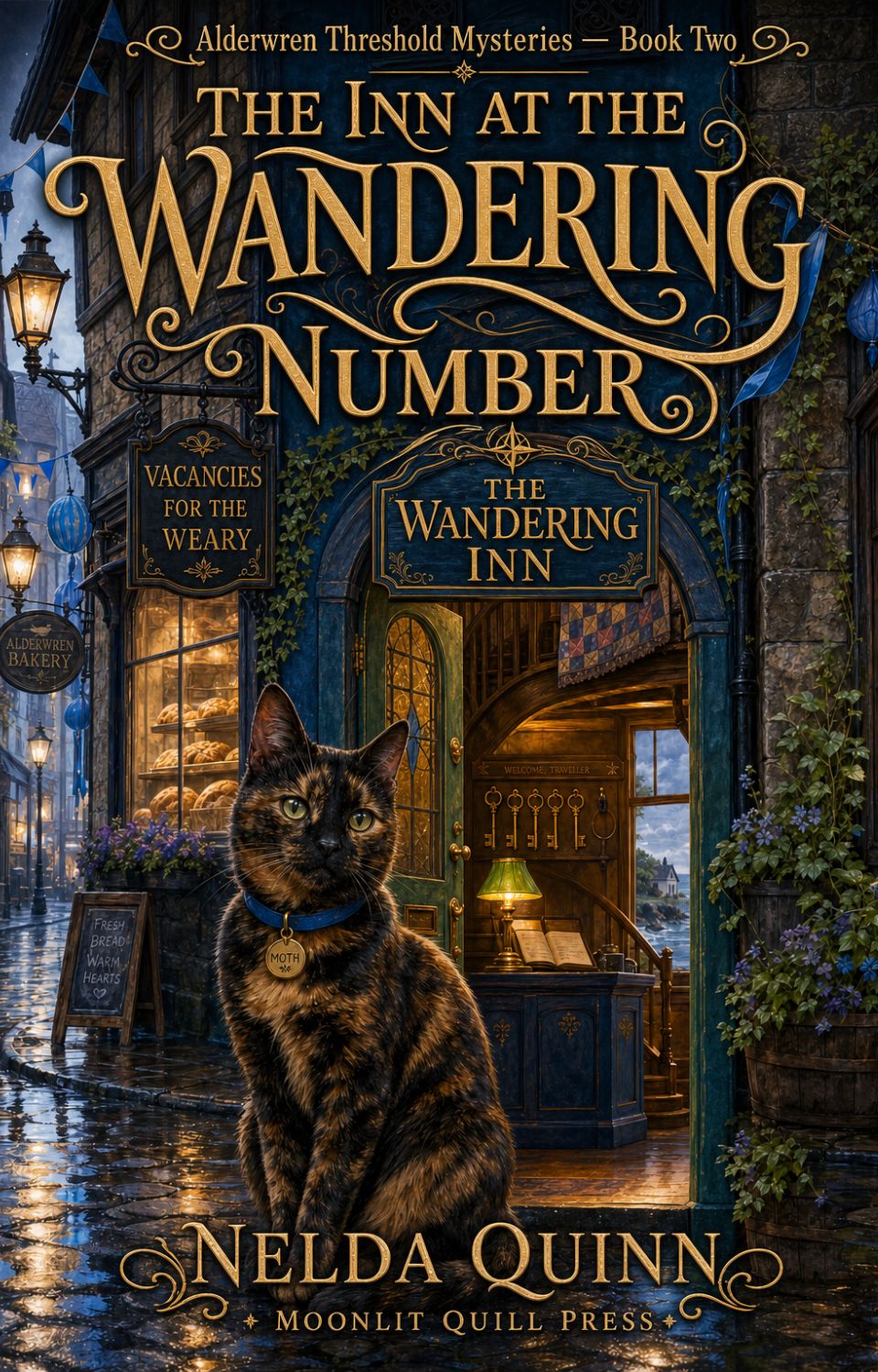
Prologue
The woman at the reception desk had been awake long enough to forget what morning felt like. She knew morning as an administrative fact because the brass clock above the pigeonholes had chimed eight several times. She knew it from the smell of toast drifting through the blue inn and from the soft footsteps of guests descending toward breakfast. Yet the windows continued to show a silver night, and the green-shaded lamp beside the guest ledger had burned so long that its glass had faded to the color of weak tea.
Elspeth Harrow closed the ledger carefully. Its pages gave a drowsy sigh, then opened themselves again to the same unfinished line: ROOM SEVEN. No guest name followed it.
She dipped the pen and tried once more. “Elspeth Harrow,” she said aloud, because spoken names sometimes behaved better than written ones inside the inn. “Temporary custodian. Seven-night term.” The ink formed beneath the room number: ELSPETH HARROW —
Before she could finish, the letters yawned themselves into a grey blur. The line smoothed over, leaving the page blank except for the room number and a small blue stain where the nib had rested. Elspeth set down the pen. Her fingers were trembling, although the inn had removed the ache from them three nights earlier.
It had also removed the tightness in her back, the headache behind her eyes, and the anxious pressure that appeared whenever two guests rang their bells at once. She was grateful for the relief. She was beginning to fear what gratitude had cost her.
A bell chimed near the staircase. Elspeth rose automatically, smoothing the front of her dark dress before remembering that no guest had appeared on the landing. Instead, a pair of embroidered slippers descended without feet inside them, crossed the lobby, and stopped before the green front door.
“Someone wishes to leave?” she asked. The slippers turned around, crossed the lobby again, and began climbing toward the guest rooms.
Elspeth followed them past the reading parlor, where the lamps had dimmed themselves around a man pretending not to sleep, and past the narrow conservatory, where rain tapped the glass despite the cloudless night beyond the windows. At the end of the first corridor, the slippers paused before a blue-painted door marked with a brass six.
“That is not your room,” Elspeth said. The slippers tapped their toes impatiently, and she opened the door.
Beyond it lay the lobby. Elspeth saw the reception desk, the faded lamp, and the guest ledger waiting beneath the clock. On the opposite side of the impossible room, another Elspeth stood at the base of the staircase with one hand on the banister.
For one breath, the two women stared at one another. Then the distant Elspeth turned away and disappeared into the breakfast room. The door closed by itself.
Elspeth leaned against the corridor wall. She wanted to be alarmed, but the inn had taken most of that feeling during her last bath. The water had smelled of lavender and clean linen, and when she stepped out, she no longer remembered why locked doors troubled her.
She could remember that they once had. That was not the same thing.
A soft chirping sound came from inside the wall. Elspeth straightened. “Hello?”
Something scratched twice behind the blue wallpaper. She pressed her ear against it and heard a low purr, followed by the faint chime of metal striking plaster. No cat stayed at the inn. Elspeth was almost certain of that, although the thought became slippery when she tried to hold it.
The scratching moved toward the end of the corridor. She followed until she reached the blank stretch of wall beyond Room Six. The wallpaper there had no seam, frame, or handle, but the air smelled faintly of rain-wet stone and crushed mint.
A number appeared beneath the paper: seven. Elspeth touched it, and the wall opened just wide enough to reveal a narrow room containing a neatly made bed, a wooden chair, and a small round window. It looked peaceful in the way an empty cup looked peaceful after someone else had finished drinking from it.
On the bed lay her travelling coat. Elspeth had not seen it in years. Or perhaps only since yesterday.
She entered and lifted the coat. One pocket contained a railway ticket with the destination rubbed away. The other held the small brass key she had used when she first agreed to care for the inn. The tag attached to it read: TEMPORARY RELIEF — SEVEN NIGHTS
Elspeth closed her eyes. “I was meant to stay seven nights.” The room warmed around her.
The bedcovers folded back in invitation, and the lamp beside the chair lit with a soft amber glow. A cup of tea appeared on the little table. It smelled of chamomile, honey, and the evenings before anyone had depended upon her.
Elspeth did not drink. She returned to the corridor and walked toward the stairs. The inn stretched gently beneath her feet, adding another length of carpet between every two steps. The lobby remained visible ahead, but it never came closer.
“I am leaving,” she said. The walls settled around the words.
No lock clicked. No hand restrained her. The inn merely softened the lamps, warmed the air, and sent the smell of fresh bread drifting through the corridor.
Elspeth tried again. “I resign as custodian.” A door opened beside her, and it led into Room Seven.
The travelling coat now hung over the chair, and the tea still steamed beside the lamp. The guest ledger rested on the turned-down bed, open to the unfinished line. Elspeth seized the attached pen.
“I did not agree to this.” The ink moved without her: INNKEEPER RESTING
Elspeth struck through the words. The paper absorbed every mark. “Resting is not consent.”
The room dimmed as though saddened. Beyond the round window, rooftops moved through darkness. The inn was travelling again, slipping from one unremembered address toward another. Somewhere inside the wall, the unseen cat scratched three times.
Elspeth placed both hands upon the ledger. “My name is Elspeth Harrow,” she said. “I am still here.” The book hesitated.
Then the blank line beneath Room Seven filled itself: WAITING.
Chapter 1
An Extra Line on the Collar
Angela Lark had learned that a quiet house was not necessarily an idle one. Primrose Bend had remained silent through breakfast, which was encouraging. The pipes had hummed only once when the kettle boiled, none of the cupboard doors had opened without permission, and the blue lamp upstairs had not lit itself in response to any request more urgent than a neighbor seeking advice about an argumentative garden gate. The Listening House was learning restraint, and Angela had begun to suspect that restraint required more practice than magic.
She sat at the kitchen table with her ledger open, sorting the morning’s requests into three columns. The first was labeled MAGICAL RESPONSE REQUIRED. The second was labeled ORDINARY RESPONSE PREFERRED. The third, newly added after several weeks of experience, read NOT ACTUALLY A REQUEST.
A complaint from Mrs. Rusk’s westernmost clock had entered the third category. The clock claimed that noon had become repetitive and wished to skip directly to tea. Angela had written a note advising Mrs. Rusk to adjust the minute hand and ignore its rhetoric.
Across the table, Moth sat beside a shallow saucer of cream with the composed attention of someone reviewing Angela’s administrative decisions. Her broad tortoiseshell face remained perfectly still, though the faint blue ring around one bright green eye gave her expression an air of permanent skepticism. The brass tag on her blue collar rested against her white chest, displaying the three central addresses that connected her to Alderwren’s threshold network. Fourteen Clover Row. Three Wren Court. Twenty-nine Bellweather Steps.
Around the edge, in smaller letters, were Larkspur Threshold and the Shared Edge. The restored clasp still carried the words Angela had read so many times that they had begun to feel less like an inscription and more like a principle by which the town measured itself. HOME IS NOT THE PLACE THAT KEEPS YOU. On the reverse: HOME IS THE PLACE THAT LETS YOU RETURN.
Moth lowered her head and drank. Angela finished recording the garden-gate complaint. “You agree with the classification?” Moth continued drinking. “That is not the same as agreement.” The cat lifted one paw and placed it neatly over the corner of Angela’s ledger.
Angela interpreted this as either approval or a demand that paperwork cease before cream did. She closed the book, tied its blue ribbon, and turned toward the kitchen window. Alderwren’s first Festival of Open Doors had begun decorating itself three days ahead of schedule. Blue lanterns hung from wires across Primrose Bend, though no one had yet lit them. Ribbons looped between railings, garden walls, and lampposts, changing shade whenever the breeze shifted. Farther down the hill, two festival volunteers argued beneath a wooden sign that read WELCOME, WITH PERMISSION, while the sign painter attempted to fit a smaller line beneath it explaining that private thresholds remained closed unless marked otherwise.
The festival had been proposed after the new threshold agreement settled into daily use. Its official purpose was to teach residents how voluntary magical hospitality worked. Its unofficial purpose, according to Tobin Reed, was to encourage people to eat pastries while visiting public courtyards they normally ignored. Angela suspected Tobin had influenced the planning committee more than the minutes admitted.
A knock came from the front door. Three ordinary taps. The house did not open it. Angela considered this progress.
She rose, followed by Moth, and crossed the narrow hallway. Sunlight from the upper landing touched the paired brass plates beside the green door: PRIMROSE BEND and THE LISTENING HOUSE. The house had accepted both names without attempting to decide which mattered more. Angela opened the door. Pippa Vale stood on the step beneath a tower of folded quilts. Only the upper half of her face was visible above them. Her spectacles had slipped down her nose, and several strands of dark hair had escaped the knot beneath her green felt hat. Small charms hung from every pocket of her moss-colored coat, clicking together whenever she shifted her weight.
“Good morning,” Pippa said. “I have made an error of proportion.” Angela looked at the quilts. “How many?”
“Twelve.” “How many were requested?”
“Four.” “That is not an error of proportion. That is an error of arithmetic.”
Pippa adjusted the stack, which leaned toward the flower bed. “I thought the public rest station might become busy.” “The festival lasts one day.” “People may become tired in groups.”
Angela stepped aside. “Come in before the top quilt becomes a public hazard.” Pippa entered carefully. Moth wound between her ankles, forcing her to stop in the hallway while the uppermost quilt slid forward. Angela caught it before it struck the floor.
The quilt was pale blue, stitched with tiny green doors and gold paths. Its border contained words embroidered in Pippa’s compact hand: REST OFFERED. DEPARTURE UNOBSTRUCTED.
Angela examined the wording. “This is improved.” “I added departure after the yellow blanket refused to release Mr. Pell during testing.”
Angela looked over the stack. “Is the yellow one here?” “No. Mr. Pell confiscated it as evidence.”
“Of what?” “Overenthusiastic comfort.”
Moth sniffed the blue quilt, then sneezed. Pippa’s face tightened. “That is not encouraging.”
“It may be dust.” “The quilts were stored in sealed cedar boxes.” “Moth may object to cedar.”
Moth stepped onto the lowest folded blanket and sat. Pippa relaxed by a degree. “Perhaps she approves.” Angela did not mention that Moth had once sat on a threatening municipal notice for nearly half an hour.
They carried the quilts into the parlor and stacked them beside the wall. Primrose Bend warmed around the new arrivals, but none of its doors opened. A brass hook appeared near the fireplace, followed by a handwritten label reading TEMPORARY FESTIVAL TEXTILES. Pippa read it twice. “The house is becoming precise.”
“It has been spending time near Mr. Pell.” “That explains the lettering.” The label used the archive’s preferred narrow capitals.
Angela returned to the kitchen, where the kettle had prepared a second cup without being asked. It contained lavender tea with honey, which meant the Listening House had recognized Pippa as a guest without attempting to infer a need from her presence. Angela poured ordinary black tea for herself. Pippa sat at the table and removed three charms from her pockets. One resembled a miniature pillow, another a brass slipper, and the third a small blue key wrapped in wool thread.
“These are for the festival rest station,” she said. “The pillow signals when someone is too tired to make a clear magical agreement. The slipper leads them toward an ordinary exit, and the key closes any temporary threshold that begins behaving possessively.”
Angela picked up the pillow charm. Its embroidered eyes were open. “How does it determine whether someone is too tired?” “It listens to hesitation.” “Hesitation is not the same as incapacity.”
“I know.” Pippa turned her cup between both hands. “I am still adjusting it.” The pillow charm gave a tiny yawn.
Angela placed it on the table. “It should signal uncertainty, not decide what uncertainty means.” “Yes.”
Pippa’s answer came quickly, but worry remained in the way she pressed her thumb against the cup handle. Since inheriting the full responsibilities of Shelter, she had become better at asking whether protection had been invited. She had not become less afraid of what might happen after she allowed someone to leave. Angela understood the distinction. “Test it on me,” she said.
Pippa looked surprised. “Now?” “You require evidence.”
“You are not especially tired.” “I reviewed fourteen unresolved gutter claims yesterday.”
“That may qualify.” Pippa placed the pillow charm between them. Its tiny eyes closed, then opened again. A thread of gold light moved around Angela’s wrist, warm but not restrictive.
“Would you like to rest?” Pippa asked. “No.” The light faded at once.
Pippa exhaled. “Good.” “Again.”
Angela looked toward the window and allowed herself to notice the weight behind her eyes. She had slept, but lightly. The Listening House no longer answered every request, yet Angela still woke when it heard them, much as a person might wake when rain began even if the roof did not leak. Pippa asked again. “Would you like to rest?”
Angela hesitated. The pillow charm’s eyes widened. A soft blue light appeared around the edge of the table, but it did not touch Angela. Pippa waited.
Angela considered the question rather than the work awaiting her. “For twenty minutes.” The miniature pillow unfolded into a square of blue fabric no larger than a handkerchief.
“Accepted,” Pippa said. “And the rest station would record the limit.” “Good.” The charm stitched the number twenty into one corner.
Angela touched the embroidered figures. “What happens when the time ends?” “The charm offers the choice again.” “Offers.” “Only offers.” Pippa’s smile was small but genuine.
A second knock sounded at the front door. This one was followed by the scrape of something large against the step and a muffled complaint about municipal signage.
Angela opened the door to find Tobin Reed holding two baskets and a wooden festival placard. Flour covered the sleeves of his blue shirt, and a streak of pear glaze shone along one cuff. Behind him stood Jonas Thorne, carrying a rolled map beneath one arm and the other end of the placard. The sign read FESTIVAL REST STATION Beneath it, in smaller letters, NO PURCHASE NECESSARY. PASTRIES LIKELY.
Angela looked at Tobin. “The second line is not official.” “It is accurate.”
Jonas shifted his grip on the sign. Dark hair fell across his forehead, and blue ink marked one side of his hand. “The festival committee rejected his first version.” “What did it say?” “Rest responsibly. Eat irresponsibly.”
Tobin looked offended. “It had balance.” Angela stepped aside. “Bring it in.” The kitchen filled quickly.
Tobin placed the baskets on the table and began unpacking small pear tarts, savory buns, and rounds of seed cake dusted with sugar. Jonas leaned the sign beside the parlor quilts, where Primrose Bend added a second label reading TEMPORARY FESTIVAL PROPAGANDA. Tobin read it and nodded. “Fair.”
Jonas removed his coat and hung it on the hook beside Angela’s. The ordinary familiarity of the movement warmed her more than the house did. Their relationship had changed little in public shape since the fountain hearing three months earlier, yet small permissions had accumulated between them: supper invitations, keys used only when expected, a shelf at Bellweather Steps where Angela kept two books, and a drawer at Primrose Bend containing a spare map cloth and nothing else they had formally discussed. He joined her near the kitchen window. “The house on Marigold Court is available for inspection tomorrow.”
“The one with the north-facing workroom?” “It claims the room faces south.”
“The municipal plan says north.” “The house believes windows should follow optimism rather than direction.”
“That sounds expensive.” “It is.”
Angela glanced at him. “You still wish to inspect it?” “I wish to understand how badly it disagrees with itself.”
“That is a professional interest.” “Entirely.” His grey eyes suggested otherwise.
Angela allowed the corner of her mouth to lift. “Tomorrow after the festival meeting.” Jonas nodded, neither pressing nor disguising his pleasure. “Tomorrow.”
Across the kitchen, Tobin rang a small silver bell over the pastries. Pippa looked alarmed. “Is that the honesty bell?”
“No. The honesty bell refuses outdoor events. This is an ordinary serving bell.” The bell gave an offended little clang. “Mostly ordinary,” Tobin amended.
Moth leapt onto the windowsill. Her movement was sudden enough that everyone turned. She stared down the hill toward Lantern Lane. The blue ring around her eye brightened, and the brass tag at her throat began tapping softly against the glass. Once. Twice. Three times.
Angela crossed to her. “What do you hear?” Moth’s ears angled forward. No one spoke.
Through the open kitchen window came the ordinary sounds of festival preparation: hammers striking temporary stalls, laughter from the ribbon crew, a cart squeaking beneath crates of lantern oil, and somewhere farther away, Mrs. Rusk’s clock protesting that it had already experienced this morning. Then another sound joined them. A bell chimed.
Not Tobin’s serving bell, the archive chandelier, or the silver fountain. This bell was softer, muffled by walls and distance. It rang once, paused, then rang six more times in an uneven sequence. Jonas unrolled his map across the table. Alderwren appeared in fine brown lines, with public festival thresholds marked in blue. Primrose Bend, the archive, the bakery, and the fountain square remained in their proper locations. No new route appeared.
The bell rang again. Moth turned from the window and pawed at her collar. Angela crouched. “May I?” Moth lifted her chin.
Angela touched the brass tag. It was warmer than it should have been. The three central addresses remained unchanged. So did Larkspur Threshold and the Shared Edge around the edge. But beneath the known engraving, a sixth line was pressing itself slowly through the brass.
Pippa came nearer. “There is no space.” The tag stretched by the width of a fingernail. Letters formed: ROOM SEVEN, NO FIXED ADDRESS
No one moved. Tobin was the first to speak. “That is not an address.”
Jonas touched the edge of the tag without lifting it from Moth’s collar. “The network disagrees.” Angela opened her ledger. She recorded the time, weather, witnesses, exact wording, and Moth’s behavior. The cat remained focused on Lantern Lane, her tail moving once across the windowsill.
“Has the festival registered a Room Seven?” Angela asked. Pippa shook her head. “The public rest station has no rooms.”
“Temporary lodgings?” Jonas asked. “None approved near the municipal center,” Angela said.
Tobin looked toward the baskets. “The bakery has an upstairs room, but it is number two and contains sacks of flour.” The bell rang again. This time, the sound came from much closer.
Moth jumped from the sill and ran through the kitchen, down the hallway, and out the still-open front door. Angela snatched up her coat and ledger. Jonas retrieved the map, while Pippa swept the pillow, slipper, and key charms into her pockets. Tobin looked at the unpacked pastries. The Listening House opened a cupboard and displayed a cool shelf.
“Thank you,” he said, placing the baskets inside. “You are an excellent civic building.” The cupboard label changed to FOOD, TEMPORARILY UNSUPERVISED.
They followed Moth down Primrose Bend. The cat moved quickly but did not disappear, pausing at each corner until the others caught up. Blue festival ribbons lifted in her wake. Volunteers carrying lanterns stepped aside, and a woman arranging potted herbs asked whether the cat had joined the opening procession.
“She has not completed the required form,” Mr. Pell would have said. Angela merely continued.
They crossed the fountain square, where workers were assembling public tables around the Shared Edge. Elsie stood beneath the striped awning reviewing witness tokens with Maud Cresset, the festival coordinator. She looked up as Moth passed. “What happened?” Elsie called. “Unknown threshold address,” Angela replied. Elsie took her silver whistle and followed.
By the time they reached Lantern Lane, the bell had stopped. Tobin’s bakery stood beside the archive exactly where it belonged. Its windows shone with morning light, and the repaired silver line in the front pane glinted above a display of festival buns.
Beside the bakery stood a small blue inn. The previous evening, the space had been a narrow delivery passage containing three empty flour crates and a drainpipe. Now a two-story building occupied it.
Deep blue timber framed cream-painted walls. Seven narrow windows lined the upper floor, though the inn was scarcely wide enough for four. Green and silver plants filled flower boxes beneath the glass, their leaves folded as if asleep. A brass rain chain hung beside the front step despite the clear sky, and a green door waited beneath a swinging sign shaped like a folded blanket. Warm amber light glowed behind the lower windows. The sign creaked. Gold letters painted themselves across its surface: THE WANDERING INN Below the name appeared a smaller line: VACANCIES FOR THE WEARY
Tobin stared at the building. “That passage belongs to the bakery.” Angela measured the width with her eyes. “The inn is larger than the available plot.”
“My flour crates were there.” “They are no longer visible.” “I had planned to reuse them.”
Moth climbed the stone step. The step lowered itself to meet her paws. Pippa drew the tiny brass key from her pocket. Its wool thread tightened toward the inn. “This place believes it is offering shelter.”
Jonas opened his compass. The needle spun, pointed toward the inn, then bent upward as if trying to indicate a direction the instrument did not possess. “It has no stable route,” he said.
The green door opened. Warm air drifted into Lantern Lane, carrying the smells of toast, clean linen, chamomile, and rain against a roof at night. Somewhere inside, cups touched saucers and a chair scraped gently across a floor. No innkeeper appeared. Moth entered.
Angela placed one hand against the doorframe. “This does not constitute acceptance of lodging.” The inn’s brass bell chimed once. A blue guest ledger opened by itself upon the reception desk. At the top of the waiting page, ink began to write: ROOM SEVEN — ARRIVAL EXPECTED.
Chapter 2
The Inn Beside the Bakery
The Wandering Inn received Angela’s declaration with a small, almost courteous creak. Its green door remained open, but the brass bell above it did not ring again. Warmth drifted into Lantern Lane, carrying the layered scents of toast, clean linen, rainwater, and something sweetly herbal that reminded Angela of a cupboard opened in a house where no one had been ill for a very long time.
Moth had already disappeared inside. Angela stepped across the threshold.
The change was immediate but not dramatic. Lantern Lane remained visible behind her, framed by the open door, yet the morning noises softened as if thick curtains had been drawn between the inn and the street. The bakery carts, festival hammers, and distant argument of Mrs. Rusk’s clock continued, but each sound now seemed to come from the far end of a pleasant dream.
Jonas entered behind her, followed by Pippa, Tobin, and Elsie. The front step adjusted itself beneath each pair of feet. It rose slightly for Pippa, lowered beneath Tobin’s heavier basket, and remained stubbornly ordinary under Elsie, who regarded this restraint as more suspicious than accommodation.
The lobby was smaller than the exterior suggested and larger than the available plot allowed. A polished dark floor extended toward a blue reception desk, behind which stood a wall of narrow pigeonholes. Some contained folded letters, others held keys, and one had been filled entirely with dried lavender. A green-shaded lamp glowed beside the open guest ledger.
No innkeeper waited behind the desk. Moth sat on the counter with her white-tipped paws planted beside the page.
Angela crossed to her. “You entered an unregistered magical lodging without waiting for the investigation.”
Moth looked toward the key rack. Six brass keys hung from hooks marked one through six. Beneath them, a seventh hook stood empty. Its label had been removed so recently that the wood remained brighter where a number plate had once rested.
Jonas touched the empty hook. “Something used to hang here.”
“Or the rack expects something that has not arrived,” Pippa said. The inn gave another quiet creak.
Angela examined the guest ledger before touching it. The page felt faintly warm beneath the air, and the ink at the top remained wet.
ROOM SEVEN — ARRIVAL EXPECTED Below the sentence waited a line for a name. The pen attached to the book by a blue cord shifted toward Angela’s hand.
She did not take it. “We are not checking in,” she said.
The pen settled. Tobin leaned over the desk. “That worked surprisingly well.”
“The inn may understand direct statements.” “Or it has decided to be polite until breakfast.”
A door opened at the far side of the lobby. A woman entered carrying a tray.
She appeared to be in her late sixties, with silver hair pinned neatly beneath a blue scarf and a plum-colored cardigan buttoned to her throat. Six slices of toast rested on the tray beside a small pot of quince jam. She stopped when she saw the group, then smiled with the relieved warmth of someone discovering expected company.
“There you are,” she said. “I wondered whether you had missed breakfast.”
Angela opened her ledger. “Who were you expecting?”
The woman glanced at the reception desk. “The new innkeeper, I suppose.”
Pippa’s charms clicked inside her pockets. “We are not the innkeepers,” Angela said.
“Of course not.” The woman gave a light laugh. “Not all of you.”
Her gaze settled on Pippa. Pippa pushed her spectacles higher. “Not me either.”
The woman’s smile became apologetic. “Forgive me. The light is strange in this lobby.”
The light remained warm and even. She placed the tray on a round table near the wall. “I am Coralie Finch. Room Four, although I have always thought the room number unnecessarily formal when everyone knows where everyone else sleeps.”
“How long have you been staying here?” Angela asked.
Coralie considered the question. “Since Tuesday.”
“Which Tuesday?” “The last one.”
Elsie removed the silver whistle from beneath her coat but did not raise it. “What month is it?”
Coralie looked toward the window. Outside, Lantern Lane remained bright with spring preparations. Blue ribbons crossed the street, and a festival volunteer had begun measuring the inn’s exterior with a length of red cord.
“October,” Coralie said. Tobin looked through the window. “The lilacs may object.”
Coralie frowned. “Are they blooming?”
“It is spring.” “No.” Her certainty weakened. “No, I remember leaves in the square. Gold ones. Tobin had begun making pear cakes.”
“I make pear cakes throughout the year,” Tobin said. Angela wrote down Coralie’s answers. “When did you arrive?”
“I have already told you. Tuesday.”
“How did you arrive?” Coralie’s hand moved toward the toast, then stopped above it. “By coach.”
“From where?” “The coast.”
“Which town?” Coralie’s expression emptied.
The toast released a faint curl of steam. “I know the place,” she said slowly. “I have known it all my life.”
“What is it called?” She looked at Angela with growing distress. “That is a very odd question.”
“A simple one.” “No.” Coralie lowered herself into a chair. “It should be simple.”
Pippa moved beside her. “You do not have to answer immediately.”
Coralie looked toward her with gratitude so intense that Angela noticed. “The innkeeper always says that,” she said.
“What does the innkeeper look like?” Elsie asked.
Coralie smiled faintly. “Much like you, dear.”
Pippa’s fingers closed around the edge of her coat. “Like me?” she asked.
“Dark hair, spectacles, green clothes.” Coralie leaned closer, studying her. “Perhaps a little older, although I may be remembering badly. She has such kind hands.”
Elsie lifted the whistle and blew one quiet note. Amber light moved across Coralie.
The woman did not flinch. The light lingered around her words, then settled into a soft, divided glow.
“She believes what she said,” Elsie told them. “The description is sincere but incomplete.”
Coralie looked between them. “Why would I lie about the innkeeper?”
“We are determining why different guests may remember different things,” Angela said. “Different guests?”
A bell sounded upstairs. Coralie rose immediately. “That will be Hollis.”
No one had called a name. She collected the toast tray and moved toward the stairs. The inn placed a small rug beneath her feet before she reached the first step.
Angela followed. The staircase curved upward between blue walls decorated with framed landscapes. One showed a snowy wood, another a river under summer light, and a third a seaside cottage beneath a pale sky. When Coralie passed that frame, she stopped.
The cottage had white walls, green shutters, and a narrow path descending toward the sea. Two women stood near the gate, but their faces had been blurred by weather or time.
Coralie’s tray tilted. Quince jam slid toward the edge.
Pippa caught the pot before it fell. “Do you recognize that house?” Angela asked.
“No.” Coralie stared at it.
Her eyes filled with tears. “No,” she repeated. “But I miss it terribly.”
The framed sea moved beneath the glass. A wave crossed the painted shore and retreated.
Coralie pressed one hand to her mouth. “Why would I miss somewhere I have never seen?”
Angela looked at the toast. It had been cut into narrow fingers and spread with quince jam, the kind of precise breakfast that belonged to habit rather than preference. Coralie had carried it without asking why.
“Is this what you usually eat here?” Angela asked.
“Every morning.” “Did you eat it before arriving?”
Coralie’s hand tightened around the tray. “My sister used to make it.”
“What was her name?” “Maribel.”
The answer came easily. “Where did she live?”
Coralie looked again at the seaside picture. “I do not know.”
The upstairs bell rang a second time. This time, a man’s voice called, “Please do not trouble yourself, Mrs. Finch. I will come down.”
Coralie relaxed at once. “Hollis is considerate.”
She resumed climbing. The upper corridor contained six visible doors, each painted a different shade of blue. Numbers one through six appeared on polished brass plates. A seventh window stood at the end, narrow and round, although no door occupied the wall beneath it.
A man emerged from Room Two. He was in his thirties, broad-shouldered and neatly dressed in a brown traveling coat with a bookbinder’s bone folder tucked into one pocket. His fair hair had been combed carefully, but sleep creased one side of his face.
“I heard visitors,” he said. “Would anyone like tea?”
“We have not introduced ourselves,” Angela replied. “That is no reason to neglect tea.”
He smiled, then noticed Coralie’s distress. “Are you unwell?”
“I cannot remember my sister’s house.” Hollis’s smile vanished. “I am sorry.”
“Will you sit with me?” “Yes.”
“After tea?” “Yes.”
“And perhaps help me write a letter?” “Yes.”
Tobin looked at Angela. She had noticed as well.
“Hollis Brice?” Angela asked.
“Yes.” “Room Two?”
“Yes.” “How long have you been staying?”
“A fortnight.” “Would you answer several questions?”
“Yes.” “Would you carry Tobin’s baskets downstairs?”
“Yes.” “Would you surrender your room to Pippa?”
“Yes.” Pippa stared at him. “I do not want your room.”
“Of course. You may have it.”
“I just said I do not want it.” Hollis looked confused. “Then I will keep it available in case you change your mind.”
Angela closed her ledger. “Can you say no?”
“Yes.” “Say it.”
Hollis opened his mouth. No sound came.
The inn’s corridor lamps dimmed. He tried again. His throat moved, and discomfort tightened his face, but the word would not form.
At last, he said, “I would prefer not to disappoint you.” “That is not the same answer.”
“I know.” Coralie placed one hand on his arm. “The innkeeper said he needed relief from refusing people.”
Angela looked at her. “You remember that?”
“She spoke to him at supper.” “What did the innkeeper look like then?”
Coralie considered. “A tall gentleman with fair hair.”
Hollis frowned. “No. She was an elderly woman with a red shawl.”
The lamps brightened slightly around him. Elsie raised the whistle again.
Amber light passed over both guests. Coralie’s memory remained sincere. Hollis’s did as well.
“They are both telling what they believe happened,” Elsie said. The contradiction settled uneasily into the corridor.
A door opened behind them. A woman of about thirty stood inside Room Five, one hand gripping the frame. She wore a long grey dress and had dark curls pinned untidily at the back of her head. Her eyes moved over the group, then immediately toward the stairs.
“Is the front door open?” she asked.
“Yes,” Angela said. The woman released the frame. “Good.”
“You may leave through it.” Her face went pale.
“No.” “You asked whether it was open.”
“I like knowing.” “Do you wish to leave?”
The woman looked toward the stairs again. “I checked out yesterday.”
Angela wrote the statement down. “What is your name?”
“Sena Pellin.” “Where did you go after checking out?”
“Home.” “Where is home?”
Sena gave an address on Willowbank Lane. Angela knew it. The street stood less than half a mile from the fountain square.
“Then why are you here?” Sena’s fingers tightened around the frame. “I became tired on the way.”
“You returned?” “I must have.”
“Do you remember doing so?” “No.”
The round window at the end of the corridor darkened. Moth had moved beneath it.
She pressed her nose to the wall, then scratched three times at the blue wallpaper. A faint scratching answered from inside.
Hollis stepped closer. “There are mice?”
“No,” Coralie said. “The inn has never had mice.”
“How long has the sound been there?” Jonas asked.
The guests looked at one another. “I do not recall hearing it before,” Hollis said.
Coralie shook her head. Sena stared at the wall. “It happens at night.”
Everyone turned toward her. “What happens?” Angela asked.
“A woman walks behind the rooms.” Sena’s voice dropped. “She checks every door, but she never comes inside.”
“Have you seen her?” “No.”
“How do you know she is a woman?” “She cries when the corridor is quiet.”
Pippa’s expression changed. The scratching sounded again.
Moth flattened herself against the wall. Her collar tag struck the plaster with a soft chime.
Room Seven had no fixed address, but something connected to it was close enough to answer. A second door opened along the corridor.
Then a third. Guests appeared one by one: a heavyset man with a river courier’s badge pinned to his waistcoat, a thin seamstress in a burgundy dressing gown, and a sleepy boy carrying one slipper. Each looked toward Angela’s group with curiosity rather than alarm.
The inn had six visible rooms. Six guests now stood in the corridor.
No one occupied a seventh. Angela counted them twice.
The boy yawned. “Is breakfast ready?”
Coralie looked at her tray. “Only toast.”
“I was promised honey cakes.” “By whom?” Angela asked.
“The innkeeper.” “What did the innkeeper look like?”
The boy pointed to Tobin. Tobin lowered his basket. “I have never worked here.”
“You made the cakes.” “I often make cakes. That does not make me the proprietor of every building that serves them.”
The boy considered this. “It should.”
Tobin looked pleased. Angela addressed the gathered guests. “I am Angela Lark from the Alderwren Archive. This inn appeared in an unregistered location this morning. We need to establish who is staying here, when each person arrived, and who is responsible for the premises.”
The river courier folded his arms. “The innkeeper is responsible.”
“Name?” He hesitated. “I have forgotten.”
The seamstress frowned. “Her name is Maude.”
“No,” Hollis said. “It begins with E.”
Coralie shook her head. “The innkeeper never gave a name.”
Sena retreated half a step toward her room. “She said names were burdens when people were tired.”
The blue walls creaked. The guest room doors opened wider.
Each room carried a different scent into the corridor: salt air, wood glue, spiced milk, river smoke, plum buns, and honey. Beneath them all ran the same quieter fragrance of chamomile and old rain.
Jonas had unrolled a narrow map against the wall. The ink showed the lobby, staircase, six rooms, and exterior windows. The corridor ended at the round window exactly where the building ended.
Yet the scratching came from beyond that boundary. “There is space behind the inn,” Pippa said.
“Not physical space,” Jonas replied. Moth clawed at the wallpaper.
A thin seam appeared. The inn gave a low, troubled groan.
Angela moved toward the cat, but the blue wall smoothed itself before she reached it. Moth turned, looked directly at her, and tapped the brass tag against the plaster.
The new inscription remained unchanged. ROOM SEVEN, NO FIXED ADDRESS Below them, the reception bell rang once.
The guests reacted together. Coralie lifted her tray. Hollis turned toward the stairs. Sena stepped into the corridor despite her fear, and the others began moving as though summoned to a familiar routine.
“What does that bell mean?” Angela asked.
“Someone is checking in,” the seamstress said. “No one is at the desk,” Tobin replied.
“The innkeeper will be there.” They descended.
The lobby remained empty. The guest ledger lay open beneath the green lamp. The line reading ROOM SEVEN — ARRIVAL EXPECTED had disappeared.
In its place were six names. Coralie Finch.
Hollis Brice. Sena Pellin.
Bram Alder. Lissa Mayhew.
Peregrine Moss. Each name appeared beside a room number and a date.
Angela read the first entry. Coralie Finch had checked in thirty-two years earlier.
Hollis’s arrival was dated eleven years before his birth. Sena’s entry showed the previous Tuesday, but the year changed each time Angela blinked.
Perry’s record contained no date at all. Mr. Pell would have objected strongly to every line.
Angela turned the page. More entries followed.
Hundreds of guests had stayed at the inn. Some names had been crossed out, others had faded, and several appeared only as descriptions: THE WOMAN WHO NEEDED QUIET, THE CHILD WHO COULD NOT STOP LISTENING, THE MAN WHO LEFT HIS WINTER COAT.
At the bottom of the final page stood a separate heading. INNKEEPERS The column beneath it was blank.
Moth jumped onto the desk and placed one paw at the bottom of the page. The paper darkened beneath her pads.
A single line rose through the fibres, as though written on another page far below. SHE HAS NOT FINISHED RESTING.