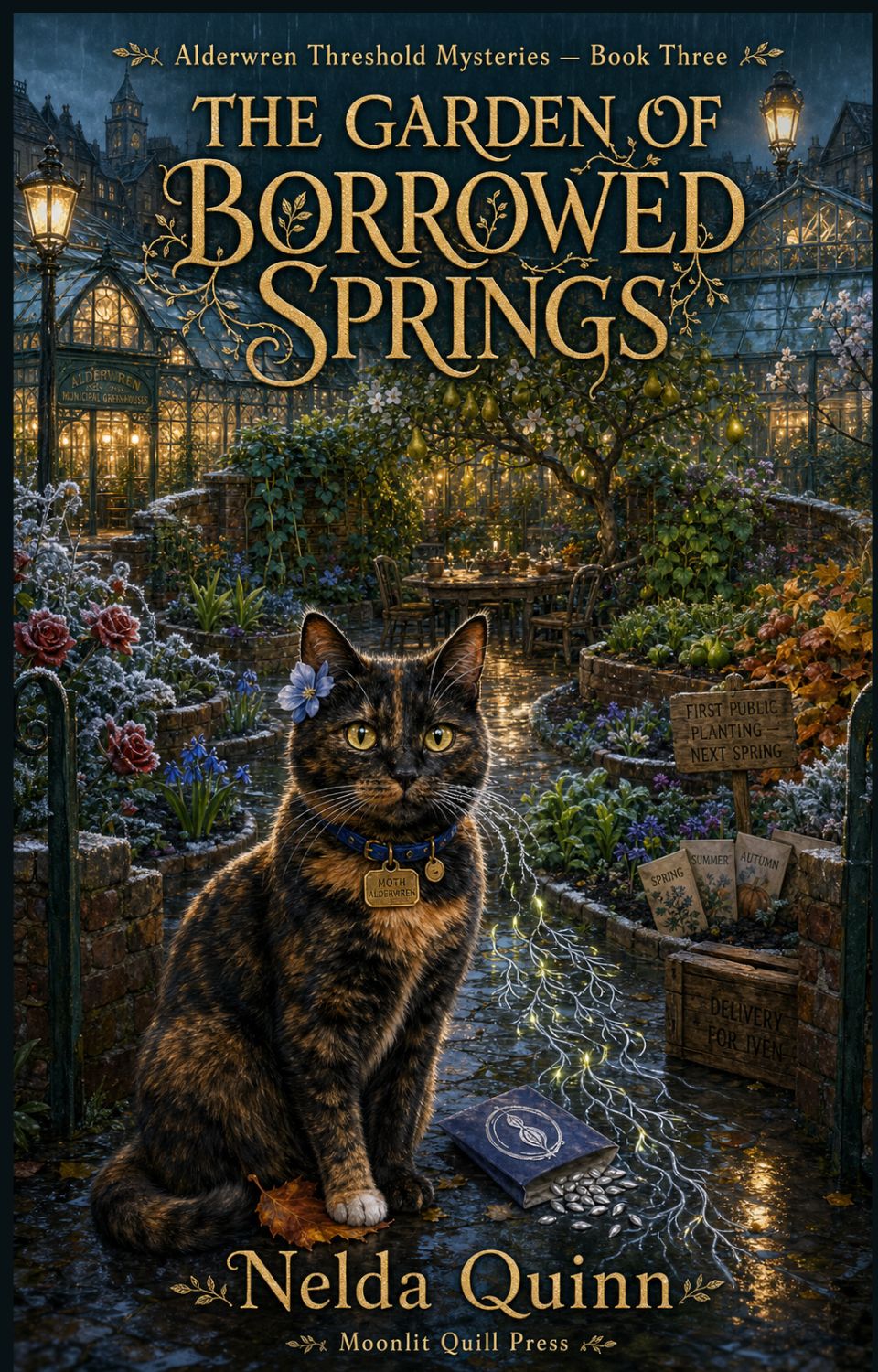
Prologue
Eight years before the winter roses bloomed in midsummer, Marian Wetherby planted a spring she expected to keep. The unused conservatory plot stood behind Alderwren’s municipal greenhouses, enclosed by low brick walls and three panes of glass that had survived every maintenance committee since the reign of the previous town clock. Rosemary had taken possession of one corner, while bindweed had occupied the remainder with the confident disorder of a tenant who believed paperwork could not reach it. Marian had spent the morning clearing both, although she had privately allowed one rosemary plant to remain because it smelled pleasant when stepped on and because complete victories made gardens suspicious.
Her daughter knelt in the newly opened soil with a pencil tucked behind one ear and mud across both knees. Rowan Wetherby was thirty-four, broad-smiled, and incapable of wearing an apron without filling its pockets with string, seed labels, and biscuits she later forgot she possessed. She held a folded plan against one thigh and studied the empty plot as though the first shoots were already visible.
“You have placed the potting table across the drainage line,” Marian said. “I have placed it where people will want to use it.”
“People rarely want to stand in water.” “They may wear boots.”
“The conservatory cannot base its design upon optimistic footwear.” Rowan glanced up. “That should go on the official sign.”
Marian drove her fork into the loosened earth and resisted smiling. Beyond the brick wall, the civic greenhouse clicked and settled beneath the April sun. One of its roof vents had developed the habit of opening whenever anyone praised the camellias, so the afternoon remained pleasantly warm only because Marian had instructed every volunteer to express admiration through quiet nods.
The plot had no official name yet. Rowan called it the Beginning Garden, but the municipal form required a purpose before it would accept a title, while the archive required a title before it would file a purpose. Mr. Pell had returned the application twice, once because Rowan had written for people who have waited too long in a box marked SOIL CLASSIFICATION.
“It was the most relevant answer,” Rowan had said. “It was not soil,” Marian had replied.
“It becomes soil eventually.” Now Rowan opened the plan across the bare ground. The beds formed an open circle, leaving a deliberate gap on the eastern side. A small teaching shed stood near the conservatory wall, while a communal table occupied the center beneath the branches of a pear tree that did not yet exist.
Marian tapped the gap with one muddy finger. “You have forgotten the final border.”
“No. That is the entrance.”
“There is already a gate.” “The gate allows people into the plot. The gap allows them to leave without pretending they failed.”
Marian looked at her daughter. Rowan’s expression had become serious. “The garden is for postponed things,” she said. “Someone might come because they meant to learn grafting twenty years ago. Someone else might plant herbs for a shop they may never open. They should be allowed to begin without promising the garden a finished future.”
“That will be difficult to explain on the application.” “Then we will use smaller handwriting.”
A gust of wind crossed the conservatory roof. Seed packets stirred inside Rowan’s apron, and one escaped onto the soil between them. The packet was blank except for a silver emblem drawn in Rowan’s hand: a small seed suspended inside an open circle.
Marian picked it up. “What is this one?”
“I do not know yet.” “You have prepared a seed packet without knowing the seed.”
“I know what it is for.” “That is not the same thing.”
Rowan brushed earth from her palms. “It is for the first thing someone hopes to grow here.”
“That could be anything.” “Yes.”
“And the garden will accept that?” “It may refuse.”
Marian examined the open-circle emblem again. “You have become alarmingly comfortable with uncertainty.”
“I learned from watching you argue with weather.” “I do not argue with weather. I provide corrective observations.”
The roof vent above the camellias opened. Rowan laughed until she had to sit back on her heels. Marian folded the blank packet and placed it carefully in the pocket of her green apron, intending to return it after lunch. She would keep it there for eight years.
They worked until the light turned amber against the conservatory glass. Rowan marked the future beds with twine, while Marian repaired the edge of the old irrigation channel. They discussed benches, tools, volunteers, and whether Tobin Reed could be persuaded to provide seed cakes without naming them after municipal departments.
At the end of the afternoon, Rowan pressed a wooden label into the center bed. FIRST PUBLIC PLANTING — NEXT SPRING “You have written a promise,” Marian said.
“I have written a plan.” “Plans are promises with filing dates.”
“Then you should be pleased.” Marian was pleased. She was pleased enough to picture the finished garden, although she did not tell Rowan. She imagined children carrying pots between the beds, elderly residents learning skills they had postponed, and people setting down plans without being mocked for failing to complete them. She imagined Rowan at the central table, older and still muddy, teaching someone how to give a young tree room around its roots.
Rowan died before the year ended. The following spring, Marian returned to the plot alone. The municipal forms had expired, the teaching shed had never been built, and the conservatory committee had redirected the allocated funds toward repairing an argumentative fountain. The bare beds remained exactly where Rowan had marked them, except that the twine had rotted and the future pear tree had become a dark circle in Marian’s memory.
Nothing grew. Marian watered the soil anyway. She loosened it, fed it, tested it, and removed every weed before it produced a second leaf. The garden accepted rain, warmth, compost, and care without offering so much as a blade of grass.
On the date Rowan had chosen for the first public planting, Marian found one green shoot in the center bed. It stood beneath the weathered label, impossibly straight and bright against the empty earth. Beside it lay the blank seed packet, although Marian still carried that packet in her apron pocket.
She opened the duplicate. A date had written itself inside. It belonged to a spring that had not happened yet.
Before Marian could touch the shoot, it opened into the flower Rowan had drawn but never lived to plant.
Chapter 1
A Rose in the Wrong Weather
Angela Lark woke because Primrose Bend had decided the rain was relevant. It had not opened a door, rung a bell, or sent a request sliding beneath her bedroom wall. Instead, the Listening House had placed one cool drop of water in the center of her empty washbasin and waited for her to notice.
Angela stood beside the basin in her nightdress, looking down at the drop while the pipes hummed softly behind the wall. Outside, midsummer sunlight lay bright across the rooftops of Alderwren, and the larkspur beneath the front step had already begun leaning toward the heat. No rain touched the bedroom window.
“Is this a request?” she asked.
The house did not answer. That was progress.
Three months earlier, Primrose Bend might have opened every cupboard and produced six towels in response to unexplained water. Since the revised threshold agreement, it had become more willing to present information without deciding what Angela should do about it. She appreciated the restraint, although the single drop remained theatrically centered.
Angela touched it with one finger. Cold moved through her hand.
Not cool water from an underground pipe. Winter cold. The sharp, dry chill of frost caught beneath a nail, followed by the faint scent of roses and iron railings.
The blue lamp on her desk lit. Angela crossed the room, dried her finger, and opened the small ledger she kept beside the lamp. She recorded the time, weather, room, temperature of the water, and the fact that Primrose Bend had chosen a basin rather than a doorway.
From the hall came a soft thump. Then another.
Moth entered carrying the brass luggage tag in her mouth. The tag had remained quiet since the Wandering Inn left Alderwren. Angela had stored it inside a padded archive box, which had been placed in the cupboard beneath the stairs, whose latch had been witnessed, recorded, and judged adequately resistant to curious cats.
Moth’s opinion of adequate resistance differed from the archive’s. She jumped onto the bed and dropped the tag on the coverlet. Her tortoiseshell fur looked warm in the morning light, while the faint blue ring around one bright green eye gave her an expression of permanent magical suspicion. The three central addresses on her collar remained unchanged: Fourteen Clover Row, Three Wren Court, and Twenty-nine Bellweather Steps. Larkspur Threshold and the Shared Edge still circled the edge.
No temporary room number had returned. Angela picked up the luggage tag.
One side read: DELIVER TO THE GARDENER WHO HAS NEVER BEEN BORN The reverse bore the tiny engraved seed inside an open circle. The seed was warm.
The tag itself was cold. Moth pressed one white-tipped paw against Angela’s wrist.
“I am aware this is significant.” Moth pressed harder.
Angela looked at the washbasin, the luggage tag, and the blue lamp. “Ordinary breakfast first.”
Moth released her. Primrose Bend opened the bedroom door.
Angela regarded the house. “That was a statement, not a request for assistance.”
The door remained open. She dressed, tied her hair back, and carried the luggage tag downstairs. The kitchen smelled of toast, black tea, and the apple scent that sometimes rose from the walls when the house was pleased with itself. A narrow bar of sunlight crossed the scrubbed table. Beside it sat a sealed envelope bearing Mr. Pell’s handwriting.
Angela opened it while the kettle poured. GUIDE-ROLE REVIEW: TAMSIN ROOK Twenty-eight days remaining in current term.
Below that, Mr. Pell had added: This notice is informational. Continued competent service will not be interpreted as renewal.
The final sentence had been underlined twice. Angela placed the notice beside her ledger. Tamsin’s review had been scheduled from the beginning of her one-year term, and the archive had promised that no silence, ancestry, usefulness, or continued presence would renew it. The explicit reminder was encouraging.
It was also evidence that Mr. Pell remained worried enough to repeat the rule.
Moth jumped onto the table and sat beside the luggage tag. Her tail curved around the brass.
Angela poured tea. The pipes hummed again.
“Do you hear another request?” The house settled.
A knock sounded at the front door. Three ordinary taps.
Angela opened it to find Jonas Thorne holding a paper bag and a folded map beneath one arm. He wore a charcoal coat over a blue shirt despite the warmth, and a streak of ink crossed the side of his hand. His dark hair had not entirely accepted whatever arrangement he had attempted that morning.
“You are early,” Angela said. “You said eight.”
“It is seven forty-three.” “I brought compensation.”
He lifted the paper bag. The smell of pear buns reached the hallway.
Angela stepped aside. “Seventeen minutes is not generally considered enough to require compensation.”
“Tobin disagrees.” “Tobin considers most intervals suitable for pastry.”
Jonas entered and hung his coat on the brass hook beside hers. Primrose Bend warmed by a degree but did not produce a second hook, a shared label, or any domestic suggestion. The house had learned from the Wandering Inn almost as carefully as the people of Alderwren had.
Jonas noticed the luggage tag on the table. “It moved?”
“Moth retrieved it from the secured cupboard.” “Then the cupboard was secured against the wrong category of intruder.”
Moth looked at him. “Relevant investigator,” Jonas amended.
He unpacked four small pear buns and placed them on a plate. Angela showed him the cold drop still clinging to her fingertip through memory rather than moisture, then described the scent of roses and iron.
Jonas unfolded the map. It showed Primrose Bend and the nearby lanes in fine brown lines. The streets remained stable, though one pale silver mark had appeared near the northern edge of the page. It resembled a thorned circle.
“That formed before dawn,” he said. “It is not an address.”
“Route?” “Not yet.”
“Possibility?” “Possibly.”
Angela gave him a level look. He smiled. “I have missed that expression.”
“You saw it yesterday.” “It was directed at Mr. Pell.”
“It remains the same expression.” “The intent differs.”
Jonas reached for a bun and waited until Angela nodded before taking one. Their relationship had developed through a collection of deliberate permissions so ordinary that no single one appeared important. Meals, keys used only when expected, books left at one another’s homes, and hands offered rather than assumed had accumulated into something steadier than declarations.
Angela touched his ink-marked fingers. “Your map table?”
“Still weather-sensitive.” “The one at Bellweather Steps?”
“Yes.” “Not the possible one.”
Jonas glanced at her. “Not the possible one.”
His private map still contained the outline of a future shared house with two workrooms, a large kitchen, interior locks, and routes preserving both Primrose Bend and Bellweather Steps. They had revised it after the Wandering Inn entered through a possibility neither had chosen. The map remained rolled in Jonas’s studio, neither destroyed nor treated as instruction.
Angela appreciated that it could remain unfinished. Moth chirped.
The luggage tag moved beneath her paw. The engraved seed had opened.
One silver leaf, no larger than a grain of rice, unfolded from the brass. Jonas leaned closer. “That was not there yesterday.”
“No.” “Did you touch it before it changed?”
“Moth was sitting on it.” The cat removed her paw.
The leaf remained. A second knock came from the front door, followed immediately by Mrs. Della Rusk’s voice.
“Angela, I have a horticultural emergency, and my clocks are making it worse.” Angela opened the door.
Mrs. Rusk stood on the step wearing a lavender housecoat beneath a heavy winter shawl. Her white hair had been pinned with two brass clock hands, one pointing toward her left ear and the other toward the sky. She carried a cut rose in a glass preserving jar.
Frost covered the flower. Behind her, midsummer sunlight shone across Primrose Bend.
“My garden has become February,” Mrs. Rusk said.
“Only the garden?” “Only the rose border. The clocks insist it is Thursday.”
“It is Thursday.” “That is not their usual tone.”
Angela looked at the frozen rose. Its petals were deep red, edged with white ice. Condensation should have formed on the jar in the warm morning, but the glass remained dry.
“Come inside.” Mrs. Rusk entered and accepted tea without sugar. Jonas moved the map aside, while Moth approached the jar and sniffed.
Frost formed along her whiskers. The cat sneezed.
A single snowflake landed on the table. Mrs. Rusk stared. “Should cats do that?”
“No,” Angela said. Moth licked one paw with injured dignity.
Angela placed the jar on a folded cloth. “Whose rose is it?”
“Mine.” “Who planted it?”
Mrs. Rusk looked toward the kitchen window.
“My husband.” Angela opened her ledger. “When?”
“Twenty-one years ago. The winter after we moved to Alderwren.”
“Is that its normal blooming season?” “No. It blooms in late autumn and complains about it.”
Jonas examined the stem through the glass. “The leaves are current growth.”
“The flower is not,” Mrs. Rusk said.
Angela looked at her. Mrs. Rusk tightened the shawl around her shoulders. “Edwin cut that rose the morning he repaired the west clock. It froze before he reached the house because he stopped to argue with Mr. Vale about municipal chimes.”
“Your husband died nine years ago,” Angela said. “Eight years, eleven months, and six days.”
The exactness came without hesitation. “Did you see him in the garden this morning?”
Mrs. Rusk’s mouth tightened. “For one moment.”
Jonas lowered his compass. “What did he do?” Angela asked.
“He was pruning the border.” Mrs. Rusk looked into her tea. “He wore the brown coat with the missing button. He looked exactly as he did that winter.”
“Did he speak?” “No.”
“Did he see you?” “I do not know.”
Elsie’s Witness magic could confirm whether Mrs. Rusk sincerely believed what she remembered, but sincerity was not yet in doubt. The question was whether the garden had produced an apparition, repeated a memory, or opened toward a season that no longer belonged to ordinary time.
“Where is the rest of the rosebush?” Angela asked.
“In my garden, covered in frost and behaving as though no year has passed since Edwin planted it.” Mrs. Rusk drank her tea. “The western clock has also stopped.”
“Only that one?” “Yes.”
“What time?” “Six seventeen.”
Angela wrote it down. Mrs. Rusk’s husband had died at six seventeen on a winter morning. The town records contained the time because Mr. Pell had once objected to the phrase shortly after six on the household amendment.
The kitchen grew quieter. Primrose Bend did not warm the room.
It had learned not to soften grief before being asked. Angela closed her ledger. “We will inspect the garden.”
Mrs. Rusk stood. “Good. Bring the cat.”
Moth had already gone to the front door. They walked two streets north beneath a clear blue sky. Alderwren’s midsummer morning had gathered around the crooked lanes in familiar warmth. Laundry moved between upper windows. Rooftop gardens spilled herbs over brick parapets, and a delivery cart argued with a lane that had narrowed after breakfast.
The cold began halfway along Copper Kettle Lane. Angela felt it first across her hands. The air smelled of snow, iron railings, and red roses. Jonas opened his compass. Its needle pointed toward Mrs. Rusk’s garden, then briefly toward the brass luggage tag inside Angela’s coat.
The Rusk house stood behind a green fence crowded with clocks. Small clocks hung from the gate. Tall ones occupied the front windows. A painted sundial had been attached upside down beneath the eaves and continued insisting it was noon.
Mrs. Rusk opened the garden gate.
Winter waited beyond it. Frost silvered the grass inside the rose border. Bare branches reached over frozen soil, though the rest of the garden remained lush with midsummer lavender and climbing beans. Cold mist hovered several inches above the ground.
At the center stood the rosebush. Every branch carried one red flower.
A man’s footprints crossed the frost. They began beside the west clock mounted on the garden wall and ended at the rosebush. No prints led away.
Moth stepped through the gate. The frost avoided her paws for two steps.
On the third, white crystals climbed her legs. Blossoms appeared briefly in her tortoiseshell fur—not roses, but tiny pale-blue flowers smelling of spring rain.
Jonas crouched beside the first footprint without touching it. “This is not a person’s full crossing.”
“What is it?” Mrs. Rusk asked.
“A route remembered by the ground.” Angela approached the frozen bush.
One branch remained green. A narrow wooden label hung from it by silver thread. The label was new, but the handwriting looked faded by years.
Angela read aloud. “WINTER KEPT UNTIL DELLA IS READY.”
Mrs. Rusk’s face hardened. “Ready for what?”
No answer appeared. Angela took out the luggage tag.
The silver leaf on its engraved seed turned toward the rosebush. A second leaf began unfolding.
Moth pushed between Angela and the frozen branch. She pressed one white-tipped paw against the wooden label.
The frost cracked. Beneath the first sentence, another line emerged.
DELIVERY PARTIAL. GARDENER NOT YET FOUND.
Jonas stood beside Angela. “The rose was delivered here by mistake.”
“Or as the first part of something larger.” Mrs. Rusk looked at her husband’s footprints. “Will taking it away remove him again?”
Angela did not answer too quickly. “We do not yet know whether what you saw was Edwin, your memory of Edwin, or the garden remembering a season connected to him.”
Mrs. Rusk nodded once. “Then do not call it nothing.”
“I will not.” The west clock struck six seventeen.
Every frozen rose opened wider. From somewhere beneath the soil came the sound of a spade entering earth.
Moth turned toward the northern garden wall. The blossoms in her fur fell one by one, forming a pale trail across the frost.
At the wall, where no gate had stood before, two green hinges began to bud.
Chapter 2
Three Seasons on One Branch
The new hinges in Mrs. Rusk’s garden wall did not become a door.
They remained two green buds fixed to the stone, each shaped like a curled leaf around a brass pin. When Jonas held his compass near them, the needle pointed north, south, and briefly downward before settling toward the frost-covered rose border. Moth sniffed the lower hinge, sneezed once, and sat several feet away with the expression of someone who had already supplied sufficient evidence.
Angela recorded the dimensions, position, temperature, and the fact that the hinges possessed no connecting frame. “Can a threshold begin with hinges?” Mrs. Rusk asked.
“It can begin with almost anything people repeatedly treat as an entrance,” Jonas said. “Hinges are more direct than most.”
Mrs. Rusk folded her winter shawl tightly around herself. “Edwin always said this wall needed a gate.”
“Did he intend to build one?” “He intended many things. Completion was not among his strongest habits.”
The frozen roses trembled behind them. One petal fell, struck the frost, and dissolved into water warm enough to release a thread of steam.
Angela looked at the luggage tag. The engraved seed still held two opened silver leaves. No third leaf had formed, although the second tilted toward the wall whenever she moved closer.
“The tag is reacting to the anomaly,” she said. “Or to the route behind it,” Jonas replied.
“Without a door, there is no route.” “There may be a destination waiting for an entrance.”
Mrs. Rusk gave him a suspicious look. “That sounds like something a map would say to avoid admitting it was incomplete.”
Jonas smiled. “It often does.”
Angela placed the wooden label from the rosebush inside an archive sleeve. Mrs. Rusk had agreed to let them remove it for examination after Angela recorded that the frozen garden would not be altered until its ownership and nature were better understood. The wording mattered. Mrs. Rusk did not want the winter destroyed merely because it frightened her, and Angela would not allow anyone to call it abandoned before asking.
They left the garden beneath ordinary midsummer sunlight. The cold followed them only as far as the gate.
Angela paused on the pavement and looked back. From outside, the rose border appeared green and warm. The frozen flowers, footprints, and budding hinges had vanished behind the fence slats, though Mrs. Rusk remained visible inside wearing her heavy shawl.
“A contained seasonal threshold,” Jonas said. “Possibly.”
“You have begun using that word more often.” “I blame your professional influence.”
“You say that as though it is unwelcome.” Angela glanced at him. “I have not classified it.”
His smallest finger touched the back of her hand as they turned toward the archive. The contact lasted only several steps, but the warmth remained after he withdrew.
Moth walked ahead with two pale-blue blossoms still caught in her fur. By the time they reached Lantern Lane, the blossoms had changed.
The first had become a curled brown leaf. The second remained spring blue.
Moth showed no concern. Tobin Reed showed enough for both of them.
He leaned out of the bakery doorway holding a flour-dusted wooden spoon and stared at the cat. “Has she joined a seasonal pageant?”
“No,” Angela said. “Is this connected to the report from the Bell orchard?”
“What report?” Tobin looked pleased to possess information before the archive. “Three separate customers arrived carrying apples from the same branch. One was blossom-scented, one was green enough to object when sliced, and the third had already made peace with becoming a pie.”
Jonas stopped. “The same branch?”
“Osric Bell insists it is one branch. May Bell insists branches are not entitled to several opinions about time before lunch.”
Angela changed direction. “The archive is that way,” Tobin said.
“The orchard is not.” “I assumed you had a plan.”
“I have revised it.” Tobin placed the spoon inside the bakery and returned carrying a covered basket. “Then I am revising mine.”
“You are working.” “My apprentice is competent.”
A crash came from behind him. Tobin glanced over one shoulder. “Competent under pressure.”
He locked the bakery door, hung a small sign reading BACK AFTER INVESTIGATING APPLES, and joined them. Angela looked at the basket. “What is inside?”
“Breakfast.” “We ate breakfast.”
“That does not prevent a later breakfast.” Jonas lifted the cloth.
Seed cakes, cheese rolls, two pear buns, and one ordinary brown loaf waited beneath it. Angela pointed to the loaf. “That one.”
Tobin appeared offended. “It has no magical response at all.”
“Exactly.” They reached the Bell orchard by the western footpath. It occupied a broad slope beneath the old watch hill, where twelve apple trees stood in uneven rows between dry-stone walls. The orchard had belonged to Osric Bell’s family for three generations and to May Bell’s management for nearly thirty years, a distinction both spouses considered important.
Osric waited at the gate wearing a straw hat and a brown waistcoat despite the heat. He was tall, narrow, and permanently bent several degrees toward whichever tree he was examining. May stood beside him in a blue apron with pruning shears tucked into one pocket. Her grey hair had been braided so tightly that Angela suspected even the wind required permission to disturb it.
“You took long enough,” May said. “It has been eleven minutes since Tobin informed us,” Angela replied.
“Osric began worrying yesterday.” “I began observing yesterday,” Osric corrected.
“You observed by pacing beneath the tree and asking it what year it thought it was.” “It did not answer.”
“That was fortunate.” Moth slipped through the gate.
The orchard smelled of warm grass, dry earth, and apples in several stages of becoming. Bees moved between blossoms near the eastern wall, while fallen fruit sweetened beneath the sun at the opposite end. Nothing appeared impossible until Osric led them to the fourth tree in the second row.
One branch extended over the path. Its tip carried white-pink blossom.
Near the center hung three hard green apples. Closer to the trunk, six ripe red fruits pulled the branch downward.
The rest of the tree remained in early summer leaf without flower or fruit. Jonas unfolded his map board.
“The branch contains a sequence,” he said. “Out of order?” Tobin asked.
“No. All at once.”
May folded her arms. “Which is worse?”
“Administratively, all at once,” Angela said. She approached without touching.
The blossom released a scent of cold rain and fresh paint. The green apples smelled of hot dust and river water. The red fruit carried woodsmoke, cinnamon, and something bitter beneath the sweetness.
“What happened in this orchard during the year the branch represents?” Angela asked.
Osric looked at May. May looked at the tree.
“That depends which part,” she said. “The blossom first.”
May’s mouth tightened. “Our daughter came home.”
Osric removed his hat. Angela knew the Bells had one daughter, Sella, who had left Alderwren fifteen years earlier after a disagreement concerning the orchard, her work, and what her parents believed she ought to inherit. Archive records showed no permanent return.
“When?” Angela asked.
“Eleven years ago,” May said. “Spring.”
“For how long?” “Six weeks.”
Osric looked at the blossom. “Seven.”
“Six weeks and three days,” May corrected. “The final days were argument, not residence.”
Angela recorded both descriptions. “What happened during the green fruit stage?”
“Sella said she wanted to sell her share,” Osric answered. May’s hand moved toward the shears in her pocket but did not remove them. “She wanted money to open a joinery shop near the coast.”
“And you opposed it?” “I opposed selling land she might later want.”
“She said she would not.” “You believed she might change her mind.”
“I hoped she would.” The branch shivered.
One blossom fell. It did not reach the ground. Halfway down, the petals tightened into a small green apple, then reddened before striking the grass.
Tobin crouched beside it. “That is efficient.”
“Do not eat it,” three people said. “I was not going to.”
Moth approached and sniffed the fallen fruit. An autumn leaf appeared beneath her front paw.
Angela looked at the ripe apples. “What happened in autumn?”
Osric’s shoulders lowered. “She left.”
May stared toward the orchard wall. “We signed the sale papers.”
“Did she open the joinery shop?” “Yes,” Osric said.
“For four years,” May added. “Then she moved north.”
“Do you speak now?” May’s expression became carefully blank. “At winter holidays.”
“Letters?” “Sometimes.”
“Visits?” “No.”
The ripe apples grew darker. The bitter scent sharpened.
Angela studied the branch. Blossom, green fruit, harvest. Arrival, conflict, departure. It did not contain one season. It contained three stages of a family year that had never been settled into one meaning.
“Did either of you ask to remember this year?” she said.
“No,” May answered. Osric hesitated.
May turned. “Osric.”
“I found a packet beneath the tree last week.” Angela opened her ledger. “What kind of packet?”
“Seeds.” “Labeled?”
“No.” “Where is it?”
Osric looked toward the farmhouse. May closed her eyes. “You planted them.”
“I planted one.” “You told me they were ordinary apple pips.”
“They looked ordinary.” “Most dangerous things do until someone waters them.”
Tobin nodded. “A principle applicable to dough.”
May ignored him. Osric led them to a potting shed built against the stone wall. Inside, hooks held pruning saws, twine, and baskets. A workbench beneath the window contained three seed packets, one opened and two sealed.
The paper was pale green. Each packet bore no plant name, date, supplier, or cultivation instructions. Instead, one silver word had been written across the front.
SPRING The second read: SUMMER The third: AUTUMN Angela examined them without touching. “Where did you find these?”
“Beneath the fourth tree,” Osric said. “Arranged in a row.”
“Did the ground appear disturbed?” “No.”
“Did anyone else enter the orchard?” “We host the seed exchange committee twice a month,” May said. “Children visit during blossom season. Tobin’s apprentice comes for windfalls. Half the town knows the side gate sticks.”
“That is not a useful access record,” Angela said. “It is an orchard, not a bank vault.”
Moth jumped onto the bench. Her collar struck the wood.
The luggage tag inside Angela’s coat warmed. The unopened spring packet moved.
Only the width of a fingernail. Then again.
It turned toward Angela. She removed the tag.
The two silver leaves on the engraved seed lay flat against the brass. As the tag neared the packets, the open-circle emblem brightened.
A third leaf began forming. Tobin set down the breakfast basket. “Is that meant to happen?”
“No one knows what it is meant to do,” Angela said. The spring packet gave a small sigh.
May took one step backward. “Seeds should not sigh.”
“Dough does,” Tobin said. “That is because you encourage it.”
Jonas held tracing paper over the packet. Fine silver lines appeared beneath the plain word. They resembled roots growing into several names, but each name faded before it could be read.
“The packet is connected to people rather than a planting date,” he said. Angela looked at Osric. “What happened when you planted the seed?”
“I used the pot by the south window. One seed, ordinary soil, ordinary water.”
“What grew?” “Nothing.”
May pointed toward the branch outside. “That grew.”
“The tree changed the next morning,” Osric admitted. “Did the seed disappear from the pot?”
“No.” They found it beneath the soil.
Jonas loosened the dirt with the end of a wooden label while Angela held the pot steady. The seed lay exactly where Osric had placed it. It had not split, rooted, softened, or changed color.
Moth chirped. She stretched one paw toward it.
Angela stopped her gently. “Not yet.”
Moth withdrew with visible disapproval. The seed was flat and pale, closer to a paper token than an apple pip. On one side, someone had drawn a tiny open circle.
The mark matched the luggage tag. Jonas placed the pot beside the three packets.
“The seed may not have grown into the branch,” he said. “It may have opened a route into what the branch remembers.”
“A seasonal route?” Angela asked.
“Perhaps.” May looked through the shed window toward the tree. “The tree did not witness the argument.”
“It was here,” Osric said. “It is a tree.”
“That does not make it inattentive.” The orchard branches rustled.
No wind crossed the shed. Angela opened the spring packet with May and Osric’s permission. Inside were five flat seeds, each marked with the open circle. The paper carried a scent of wet paint and apple blossom.
The summer packet smelled of hot dust and river water. The autumn packet smelled of smoke and cinnamon.
Exactly like the three stages on the branch. “These are not ordinary plant seeds,” Angela said.
“They are portions of a remembered season,” Jonas replied. “Belonging to the Bells?”
“Or to the orchard.” May’s expression hardened. “It belongs to no one without asking.”
The packets trembled. Angela appreciated the correction.
They returned to the tree carrying the seeds but left the packets closed after recording the contents. Jonas set his compass beneath the branch. The needle pointed first toward May, then Osric, then north beyond the orchard.
Not one owner. Not one destination.
Tobin laid the ordinary loaf on the stone wall and sliced it. “Why are you serving bread?”
“People answer difficult questions more clearly when not hungry.” “No magical reaction?”
“Only crumbs.” May accepted a slice.
Osric did as well. They stood beneath the impossible branch eating ordinary bread while Angela asked them to describe the year separately. May remembered Sella arriving in a yellow coat during cold rain. Osric remembered her carrying a wooden case of carving tools. May remembered repainting the upstairs room. Osric remembered pruning the orchard together as though the disagreement had not yet begun.
The summer recollections diverged more sharply. May remembered Sella’s anger.
Osric remembered her fear. May recalled saying the orchard would always be there.
Osric remembered Sella answering that this was exactly the problem. The ripe autumn fruit held both versions of departure. May saw Sella walking through the gate without looking back. Osric remembered her turning once.
Elsie would need to witness the statements if historical classification became necessary, but Angela already understood that no single version had created the branch. The seasonal memory contained emotional truth from several perspectives.
“Do you want the branch returned to ordinary growth?” Angela asked.
May answered immediately. “Yes.”
Osric did not. Angela waited.
“I want to understand it first,” he said. May looked at him. “You want to keep her here.”
“No. I want to know whether the tree remembers her turning.”
May’s anger softened into something less simple. Angela wrote both responses.
“The branch will not be altered until ownership and requested outcome are established.” May nodded reluctantly.
One ripe apple released itself. Jonas caught it before it struck the ground.
The skin was warm on one side and cold on the other. A line appeared around its center, dividing the red fruit into three unequal sections. Blossom-white, green, and harvest-red light moved beneath the skin.
“Do not bite it,” Angela told Tobin. “I continue not to.”
Moth sat beneath the branch. The apple pulled toward her.
Jonas tightened his hold. Inside the fruit, the seeds began rattling.
One cracked through the skin and dropped into Moth’s paw prints. It was larger than the others and made of pale silver rather than paper.
The open-circle emblem had been engraved on one side. On the other was a name.
The letters appeared only when Angela held the luggage tag above it. IVEN No one spoke.
The third silver leaf on the tag opened fully. The engraved seed now resembled a tiny living plant.
From beyond the northern orchard wall came the faint scrape of a spade. Moth turned toward it.
A pale-blue blossom appeared in her fur, followed by frost along one whisker and an autumn leaf beneath her paw. Three seasons marked her at once.
Then the orchard gate opened by itself. A wooden crate stood outside. No cart, courier, or footprints accompanied it. Painted across the side were the words: DELIVERY FOR IVEN Beneath them, in smaller letters:
PLEASE PLANT BEFORE HE ARRIVES.