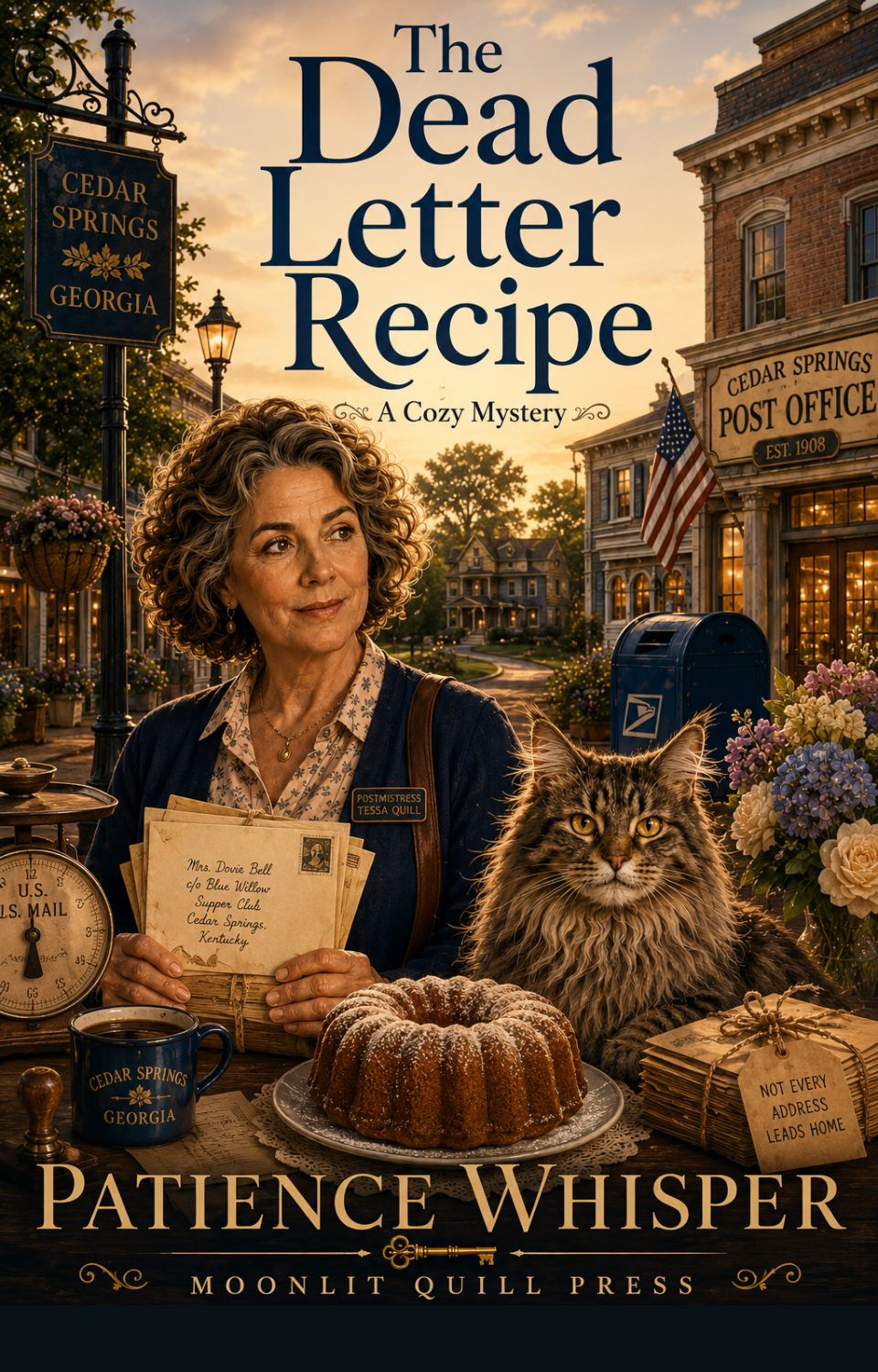
Chapter 1
Return to Sender, Twenty Years Late
By half past eight on Tuesday morning, the Cedar Springs post office smelled of raincoats, paper dust, lemon cleaner, and one suspicious parcel that had spent far too long in the company of fruitcake.
Tessa Quill stood behind the sorting counter with her sleeves rolled to her elbows, her auburn hair escaping its clip in the kind of soft, rebellious curls that always made her look more romantic than she felt. In front of her sat the morning’s shipment from the regional dead-letter office: three gray bins of forgotten intentions, misdirected hopes, and things people had mailed with optimism but no legible return address.
“Every town has a personality,” Tessa said, lifting a padded envelope and giving it a cautious sniff. “Cedar Springs’ personality is apparently preserved citrus peel and questionable tape.”
On the far side of the counter, Eula Mae Pritchett made a noise that was half chuckle, half moral objection. “Don’t you go blaming fruitcake. A fruitcake is only as suspicious as the person who baked it.”
“That sounds like something a fruitcake would say in its own defense.”
Eula Mae’s round face brightened beneath the brim of her lavender rain hat. She had come into the post office that morning to mail a bakery invoice and had stayed, as she often did, because the sight of a dead-letter shipment stirred in her the same curiosity other women reserved for estate sales and church basement cookbooks. Eula Mae owned Eula Mae’s Bakery, where the cinnamon rolls were famous, the biscuits forgiving, and the gossip usually accurate enough to be useful.
From beneath Tessa’s desk, Archibald gave a single dignified huff.
He was a cat of uncertain heritage and absolute confidence, with one ear that stood upright and one that leaned philosophically sideways. Tessa had found him the year before near the loading dock during a thunderstorm, and he had since appointed himself unofficial inspector of packages, people, and emotional weather. He was especially strict about parcels that smelled like smoked ham or trouble.
“Don’t encourage him,” Tessa said as Archibald nudged the nearest bin with his nose. “He already thinks he has federal authority.”
“Doesn’t he?” Eula Mae asked.
“Only in his own mind.”
Outside the front windows, Cedar Springs wore the morning like a damp shawl. Rain tapped lightly against the glass, softening the view of Main Street until the hardware store, the pharmacy, and the redbrick courthouse all looked as if they had been painted in watercolor. June had come in gray and humid, the kind of weather that made everyone’s joints complain and everyone’s secrets feel closer to the surface.
Tessa liked mornings like this in theory. They made the post office feel cozy, almost intimate, and Cedar Springs had always been a town that did its best confessing when the weather gave it an excuse to linger indoors.
The shipment from the dead-letter office, however, had already lowered the charm by several degrees.
She had opened a box of expired coupons from 1998, a snow globe cracked clean across the base so that one tiny plastic snowman lay forever toppled beside a glittering mailbox, and a birthday card containing a twenty-dollar bill addressed only to “Aunt Peaches, the yellow house, probably near Magnolia.”
“That one could be half the county,” Eula Mae had said.
“Exactly why Aunt Peaches never got her twenty dollars.”
Now Tessa lifted the next item from the bin. It was small, wrapped in brown paper gone soft at the corners, tied with cotton string that had yellowed with age. The package had a battered, traveled look, as if it had been wedged under counters, shoved behind cabinets, and regarded with suspicion by multiple generations of postal employees before finally finding its way to Cedar Springs.
The address was written in faded blue ink.
Mrs. Dovie Bellc/o Blue Willow Supper ClubCedar Springs, Kentucky
Tessa went still.
Not because the handwriting was dramatic. It wasn’t. It was narrow, careful, and old-fashioned, with loops so controlled they seemed to be holding their breath.
Not because the package was heavy. It weighed little more than a paperback book.
It was the name.
Behind her, Eula Mae had been folding a stack of delivery slips with the practiced efficiency of a woman who could crimp a pie crust while quoting three separate recipes from memory. The folding stopped.
“What did you say?” Eula Mae asked.
“I didn’t.”
“But you read something. Your face did.”
Tessa looked up. “Do you know the Blue Willow Supper Club?”
Eula Mae’s expression changed in a way that made Tessa set the package down more gently.
There were faces people made when they remembered something pleasant. A softening around the eyes, a little lift at the corner of the mouth, a drift toward some earlier room full of light. Eula Mae did not make that face. Her mouth parted slightly, and the color in her cheeks shifted, not quite fear, not quite sorrow.
“Oh, honey,” she said. “Everybody used to know the Blue Willow.”
Archibald rose from beneath the desk and came closer, his paws soft on the old linoleum. He sniffed the air above the package, then sneezed.
Tessa looked from the parcel to Eula Mae. “It’s addressed to Mrs. Dovie Bell.”
Eula Mae touched the edge of the counter as if she needed its steadiness. “Dovie Bell’s been gone twenty years.”
The rain kept pattering, polite and persistent.
“And the Blue Willow?” Tessa asked.
“Burned down almost as long ago.”
That was when the package stopped feeling curious and began to feel like an invitation someone had been trying very hard not to send.
Tessa had learned, since taking over as postmaster, that dead letters were not dead in any simple sense. They were stubborn. They carried birthdays that had passed, apologies that arrived too late, bills no one wanted, and heirlooms misaddressed by people who assumed love could compensate for a missing ZIP code.
But this package was different.
It had no visible return address, only a patch on the upper left corner where old tape had lifted away part of the paper. Along one side, a regional dead-letter label had been slapped on, removed, replaced, and nearly worn smooth. There were scuffs on the back, a faint stain that might have been tea or age, and a pressed-in dent where something hard had pushed against the wrapping from inside.
“Can you open it?” Eula Mae asked.
Tessa hesitated. “Under dead-letter procedures, yes. If there’s no valid recipient and no return address, we can inspect contents to determine disposition.”
Eula Mae blinked. “That sounded very official.”
“I practice in the mirror.”
“Of course you do.”
Tessa reached for her letter opener, the brass one June Whitlock had given her last Christmas with the words For Emergencies and Envelopes engraved on the handle. June, who ran the Cedar Springs Historical Trust with the fierce precision of a general and the hat collection of a retired opera singer, believed every proper office required three things: sharp blades, sharper records, and a kettle no one was allowed to scorch.
Tessa slid the opener beneath the string. The cotton gave way with a faint sigh.
Archibald sat squarely at her feet.
“No licking evidence,” she told him.
Eula Mae leaned closer. “It’s evidence now?”
“It’s old, unclaimed, and making you look like you’ve seen a ghost. That earns it at least provisional evidence status.”
Inside the brown paper was a small cardboard box, the sort that might once have held stationery or handkerchiefs. Its lid was warped, the corners softened. When Tessa lifted it, a faint scent rose into the air — smoke, sugar, and a floral note, like lavender furniture polish.
Eula Mae’s eyes closed.
“What is it?” Tessa asked.
“Smells like somebody’s parlor after a kitchen fire.”
Tessa removed the lid.
Inside lay three things.
The first was a handwritten recipe card, cream-colored, stained along one edge with dark purple smudges. Across the top, in bold, slanted handwriting, were the words Blackberry Jam Cake.
The second was a small brass key, tarnished almost black in the grooves, tied with a bit of blue thread.
The third was a folded note, fragile with age.
Tessa lifted the recipe card first. The handwriting was elegant but practical, the kind made by someone who had written while standing at a counter with flour on her wrist and no patience for decoration that delayed supper.
“Blackberry Jam Cake,” Eula Mae whispered.
“You know it?”
Eula Mae gave a laugh so soft it nearly broke. “Honey, I know of it. There’s a difference.”
Tessa scanned the ingredients. Flour, butter, eggs, buttermilk, blackberry jam, cinnamon, clove, allspice, chopped pecans, raisins. She could almost smell it, dark and spiced and sticky at the edges, the sort of cake that would sit heavily on a plate and even heavier in memory.
“Dovie Bell’s?” Tessa asked.
Eula Mae nodded. “If that card is what it looks like, you’re holding a recipe half this town has argued over for two decades.”
“That seems like a lot of civic energy for cake.”
“That’s because you didn’t taste Dovie’s cake.”
“I take it the cake was good.”
“Good?” Eula Mae pressed a hand to her chest. “Dovie Bell’s blackberry jam cake could make a deacon reconsider Lent.”
Tessa smiled despite herself.
Then Eula Mae’s face clouded. “It also caused more hard feelings than a badly divided will.”
Tessa laid the card on a clean sheet of postal paper. “Why?”
Eula Mae did not answer right away. She picked up the brass key instead, holding it between thumb and forefinger. The little blue thread dangling from it trembled slightly.
“Dovie ran the Blue Willow Supper Club out near County Road 9,” she said. “White building, blue shutters, big porch, willow-pattern plates on the wall. Folks went there after church, after funerals, after engagements, and after fights they weren’t ready to call fights yet.”
“That covers most of life.”
“It did at the Blue Willow.” Eula Mae set the key down carefully. “Dovie had a way of feeding people that made them feel forgiven before they’d apologized.”
The phrase settled between them.
Tessa had known Eula Mae for years, and she had heard the bakery owner speak reverently about butter, sternly about margarine, and emotionally about peach season. But this was different. This was not recipe admiration. This was grief with an apron on.
“What happened?” Tessa asked.
Eula Mae’s gaze stayed on the card. “People started saying Dovie stole recipes. First from Harriet Pike Sloane, then from the ladies’ auxiliary cookbook, then from cousins and church friends and anyone who had ever brought a casserole to a gathering. Some said Dovie flattered women into sharing their secrets, then put those dishes on her menu.”
“Did she?”
“No.” Eula Mae’s answer came too quickly to be polite. Then she softened. “At least, I never believed it.”
“But other people did.”
“People often believe whatever lets them feel superior without having to check a fact.”
Tessa thought of June Whitlock and smiled faintly. “June would embroider that on a pillow.”
“June would correct the punctuation first.”
The folded note remained in the box.
Tessa slid a thin piece of archival paper beneath it before lifting it out. The crease resisted slightly, then opened. The paper was brittle but intact, the words written in the same faded blue ink as the address.
Forgive me before the last slice is served.
That was all.
No name. No date. No explanation.
Eula Mae inhaled sharply.
Tessa looked at the note again, waiting for more words to appear. “That’s cheerful.”
“It’s a love note,” Eula Mae said.
“Or a threat.”
“Sometimes in Cedar Springs, those are separated mostly by tone.”
Tessa turned the note over. Blank.
Archibald leaned forward and sniffed. Then, quite suddenly, he backed away from the counter and retreated beneath Tessa’s desk, where he turned in a circle and lay down with his head on his paws.
Tessa narrowed her eyes at him. “You were brave thirty seconds ago.”
“He doesn’t like it,” Eula Mae said.
“He dislikes vacuum cleaners and men who wear too much cologne. His standards are not always admissible.”
But Tessa had noticed something too.
When she unfolded the note, the scent of smoke and lavender had become sharper. Not fresh, exactly. More like something old disturbed after years in a closed drawer.
“Who would send this now?” Tessa asked.
Eula Mae did not look away from the recipe card. “Someone who wants Dovie remembered.”
“Or someone who wants trouble started.”
The front bell jingled, and both women flinched.
Harold Finch, Cedar Springs’ retired mail carrier and current connoisseur of everyone else’s errands, stepped inside with his umbrella tucked under one arm. He wore his usual brown cardigan despite the humidity and carried an expression of mild disappointment, as if the entire morning had failed to meet his standards.
“Morning,” Harold called. “You got my seed catalog?”
“Good morning to you too, Harold,” Tessa said, sliding the recipe card and note farther from view.
“I said morning.”
“And I treasured it.”
Harold approached the counter, shaking rain from his hat onto the floor despite the mat placed directly beneath the Please Shake Umbrellas Here sign. “Anything interesting?”
“No.”
Eula Mae answered at the same time. “Fruitcake.”
Harold’s eyebrows rose. “Fruitcake?”
“A very preserved one,” Tessa said.
“Whose?”
“The nation’s.”
He seemed to consider whether that answer satisfied his curiosity. It did not. Harold Finch had spent forty years delivering mail through sleet, storms, heat, and private scandals. Retirement had not dulled his instinct for a hidden envelope.
His gaze slid toward the open dead-letter bin. “Regional office sent oddities again?”
“Administrative miscellany,” Tessa said.
“Hmm.” Harold leaned slightly. “Looks old.”
Tessa placed both hands on the counter. “Harold.”
“What?”
“Your seed catalog is in your box.”
He sighed. “Fine. A man asks one neighborly question and gets treated like he’s rifling through a purse.”
“Only because you were leaning in the direction of the purse.”
Eula Mae laughed, and the sound loosened something in the room.
Harold shuffled to the lobby boxes, muttering about modern suspicion, old-fashioned friendliness, and the decline of community trust. The moment his back turned, Tessa slipped the contents of the package into a clean evidence sleeve she used for damaged-mail documentation.
Eula Mae watched her. “You’re not going to throw it away.”
“No.”
“Or send it somewhere official to disappear under fluorescent lighting.”
“Not yet.”
“Good.”
Tessa met her eyes. “You understand that legally, I can’t just hand over mail addressed to a dead woman at a burned-down business because the cake smells emotional.”
Eula Mae’s mouth twitched. “That’s a sentence no one expected to hear before lunch.”
“I can document it. I can try to determine whether there’s a living heir. Dovie Bell had family?”
“A granddaughter. Ruthie. Ruthie Bell Collier now, I think. She moved away years ago.”
“Do you know where?”
“No, but June will.” Eula Mae’s expression sharpened with purpose. “June knows where everyone went, why they left, and whether they packed in anger.”
Tessa glanced at the recipe card. “What about the Blue Willow building? Anything left?”
“Foundation. Some storage pieces, maybe. After the fire, folks hauled off what could be saved. Tables, dishes, cabinets. Cedar Springs never lets tragedy go to waste if there’s usable furniture involved.”
“And the key?”
Eula Mae rubbed her thumb along the counter. “Could open anything. Pantry cabinet, cash drawer, office desk.”
“Or something someone didn’t want opened.”
The rain thickened, running down the windows in wavering lines.
Harold returned with his seed catalog tucked under his arm. “I heard Blue Willow.”
“No, you didn’t,” Tessa said.
“Yes, I did.”
“You heard fruitcake.”
“I am not old enough to confuse fruitcake with Blue Willow, and I am plenty old.” Harold’s face had changed. The nosiness remained, but beneath it was something more sober. “What about Blue Willow?”
Eula Mae straightened. “Nothing that needs repeating in the lobby.”
“That place always did have too much not needing repeating.” Harold tapped the catalog against his palm. “Dovie Bell was a fine cook.”
Eula Mae looked at him. “You said that like it cost you something.”
“It didn’t cost me. Cost her plenty, though.” He glanced at Tessa, then away. “People like a tidy villain. Saves them from sweeping their own porch.”
Before Tessa could ask what he meant, Harold set his hat firmly on his head and shuffled toward the door.
“Harold,” she called.
He paused.
“Did you believe Dovie stole those recipes?”
For once, Harold Finch did not answer quickly.
“I believed what folks told me,” he said at last. “That ain’t the same as believing the truth.”
Then he stepped back into the rain, leaving the bell to jingle behind him.
Eula Mae was very quiet.
Tessa looked down at the package contents, neatly arranged now beneath plastic: the recipe, the key, the note. Three small pieces of the past, all delivered to a woman who could no longer receive them.
“What was the Blue Willow fire?” Tessa asked.
Eula Mae folded her arms, hugging herself in a way Tessa had never seen her do. “Late October, twenty years ago. After closing. It burned fast. Kitchen, pantry, office, dining room. Nobody died, thank the Lord. But the place was gone by morning.”
“Accidental?”
“That’s what the report said.”
“What did people say?”
“That Dovie set it herself to hide the recipe scandal.” Eula Mae’s voice thinned. “Insurance money, spite, shame. Pick your poison.”
“And you didn’t believe that either.”
“No.” This time her answer was quieter but firmer. “Dovie Bell fed people who couldn’t pay. She hired girls nobody else trusted. She sent casseroles to widows who had family too proud to ask for help. She made room at her tables for women who came in smiling but left with their hands shaking.”
Tessa felt a prickling at the back of her neck. “Women in trouble?”
Eula Mae looked toward the rain-streaked windows. “I was young. I didn’t understand everything I saw. But I understood kindness when it stood in front of me wearing an apron.”
The old package seemed to take up more space on the counter.
Tessa had built her life around addresses. Names, routes, forwarding orders, mismatched labels, the fragile trust that something placed in a box might reach the right hands. But every so often, the mail delivered more than paper. It delivered a question the town had avoided asking.
Forgive me before the last slice is served.
“Eula Mae,” Tessa said gently, “why did you never talk about Dovie?”
Eula Mae’s smile was small and sad. “Because Cedar Springs had already decided what story it liked best.”
“And now?”
“Now,” Eula Mae said, tapping one finger lightly beside the recipe card, “somebody mailed us a different ending.”
The front door opened again, this time with a gust of wet air and the brisk click of heels. June Whitlock swept in wearing a navy rain cape, pearl earrings, and an expression that suggested she had already corrected two historical inaccuracies before breakfast.
“Tessa,” June announced, “I require stamps, discretion, and possibly a witness.”
“Good morning, June.”
June paused, taking in Tessa’s face, Eula Mae’s posture, Archibald’s retreat beneath the desk, and the open dead-letter bin.
Her eyes narrowed.
“What,” she asked, “has the mail done now?”
Eula Mae let out a breath that was almost a laugh.
Tessa lifted the evidence sleeve just enough for June to see the top of the recipe card.
June’s gaze dropped to the words Blackberry Jam Cake.
For the first time in Tessa’s memory, June Whitlock appeared to lose track of her sentence.
“Oh,” June said.
It was not surprise. It was recognition.
Then, from beneath the desk, Archibald gave another low huff, nose pointed toward the package as if warning them all that something old had been opened and was not finished speaking.
Tessa looked from June to Eula Mae to the rain-washed windows beyond them. Somewhere in Cedar Springs, a person had wrapped up a recipe, a key, and a note and sent them toward a dead woman at a burned supper club.
Twenty years late.
Or exactly on time.