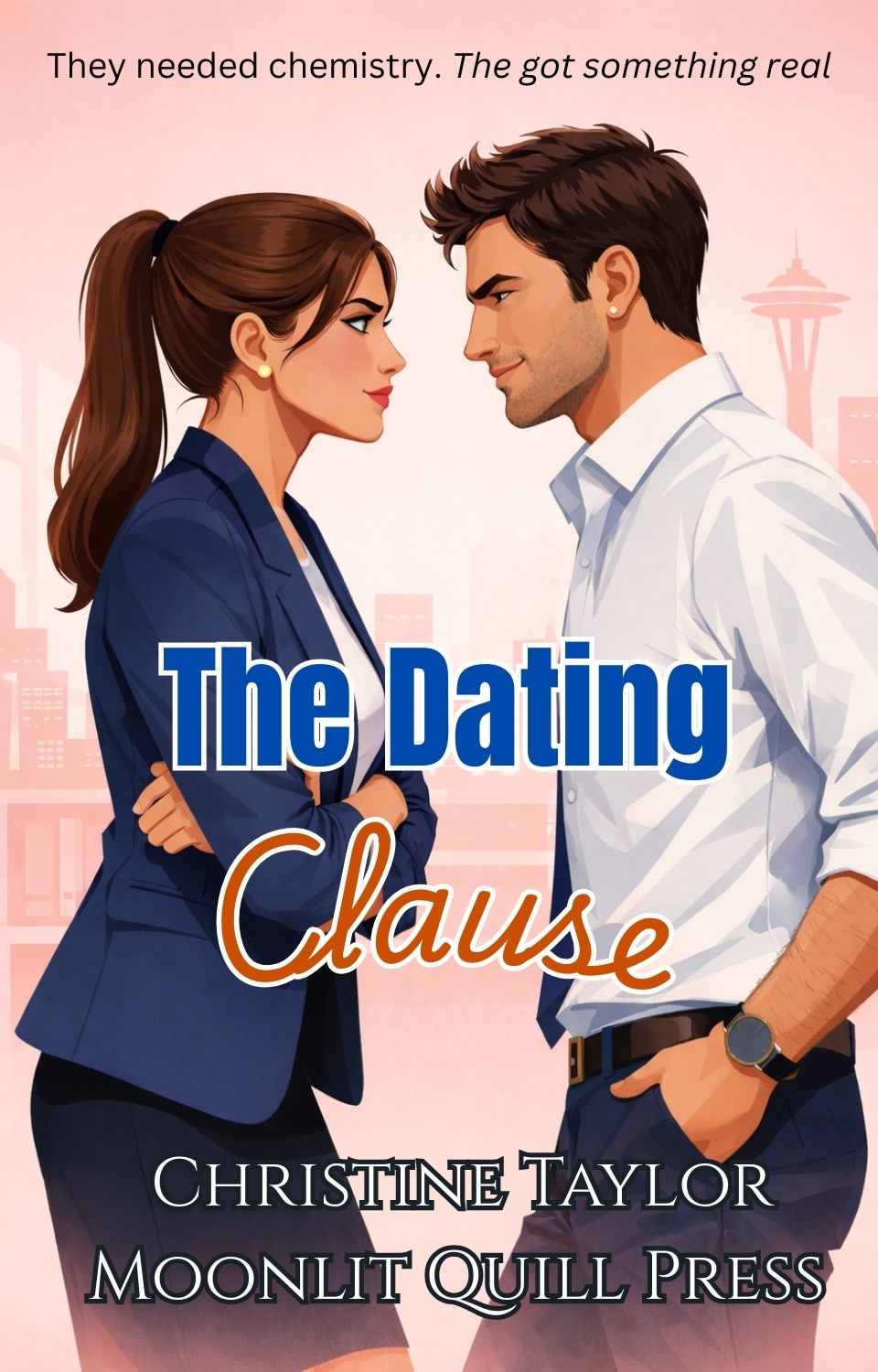
Chapter 1
Public Disaster
Idon't lose. Not pitches, not clients, and certainly not to men who show up seven minutes late with a smile like they've already won.
I check my watch—8:53 AM—then return my attention to the presentation deck displayed across my laptop screen. Every slide is perfect. Every transition, timed. Every data point, verified twice. The Bellmont Hotel Group pitch represents six months of research, three weeks of strategy refinement, and approximately forty-seven hours of sleep I'll never get back.
Worth it.
My office overlooks downtown Seattle, floor-to-ceiling windows framing the Space Needle like a postcard I'm too busy to appreciate. The morning light cuts sharp angles across my desk—organized, minimal, controlled. Everything in its place. That's how you win.
I smooth my navy blazer, adjust the slim gold watch on my wrist, and run through my opening one more time. "The modern luxury traveler doesn't want to be sold a destination. They want to be understood." Clean. Confident. Impossible to argue with.
The tailoring on this suit cost me three billable hours, but it's worth every penny. Armor doesn't have to be metal. Sometimes it's Italian wool and a perfectly structured shoulder line that says I belong here before you even open your mouth.
My phone buzzes.
Victoria Reeves entering building—conference room B in 5
Perfect. I gather my materials with practiced efficiency—laptop in its sleeve, presentation remote, portfolio of supplementary materials I probably won't need but always bring. Preparation isn't paranoia. It's professional excellence.
I head down the hall, heels clicking a steady rhythm against the polished concrete floors. The Bellmont Group owns seventeen luxury properties across the Pacific Northwest, and Victoria Reeves, their CMO, has a reputation for two things: impeccable taste and zero tolerance for bullshit. If I land this account, I'm looking at a seven-figure contract and a corner office with an even better view.
When I lose—if I lose—it won't be because I wasn't prepared.
Conference room B is already set up exactly as I requested: presentation screen tested, lighting adjusted to showcase the visuals without washing out faces, water glasses positioned at precise intervals. I did a dry run yesterday at 4 PM, same lighting conditions as this morning's meeting. Details matter.
I connect my laptop, pull up slide one, and allow myself exactly thirty seconds of controlled breathing.
In. Hold. Out.
The door opens. Victoria enters first—fifties, elegant in that effortless West Coast way that only comes from having enough money to make expensive things look casual. Silver hair cut sharp at her shoulders, minimal jewelry, a cashmere sweater that probably costs what I pay in rent. Two associates trail behind her, tablets out, game faces on.
"Harper." Victoria's handshake is firm, her rings cool against my palm. "Looking forward to this."
"Thank you for the opportunity." I gesture to the seats I've strategically chosen—angled so they'll focus on the screen, not me. Let the work speak.
"I should mention," Victoria says, settling into her chair with the kind of grace that suggests Pilates and personal trainers, "we've invited one other agency to present this morning. Just to keep things—"
The door swings open.
"—competitive," Victoria finishes, but I'm no longer listening.
Mason Hale walks in like he owns the building, despite the fact that his boutique agency operates out of a converted warehouse in Fremont and his idea of business formal is dark jeans and a blazer that probably costs more than my entire outfit. He's carrying two coffee cups—two—and wearing that smile. The one that says he knows exactly how late he is and finds it charming.
Of course it's Mason. Of course.
"Victoria, sorry to keep you waiting." He hands her one of the coffees like they're old friends meeting for brunch. "They were out of oat milk. I had to wait."
She laughs. Actually laughs, taking the cup like it's the most delightful surprise of her morning. "Mason. Good to see you."
He turns that smile on me, and I watch it shift—just slightly—into something more challenging. "Harper."
"Mason." I don't smile back. Don't give him the satisfaction.
Seven minutes late. No materials visible. No laptop. No portfolio. Just coffee and confidence and those dark eyes that have probably talked him out of every consequence he's ever deserved.
We've crossed paths at industry events, competed for the same clients twice before—once he won, once I did—and every interaction has been exactly like this. Him, acting like work is a game he can't help but win. Me, knowing that games have rules and winners prepare.
"Shall we begin?" Victoria checks her watch—the expensive kind that doesn't need to tell time to prove its worth, all rose gold and understated luxury. "Harper, why don't you start?"
I rise smoothly, claiming the front of the room. "Of course."
The first slide appears: the Bellmont logo dissolving into a serene mountain landscape, the transition timed perfectly. "The Bellmont Group has built its reputation on creating unforgettable experiences. But in today's market, experience isn't enough. Your guests don't just want luxury. They want to feel seen."
I click to the next slide—demographic data, beautifully visualized in Bellmont's brand colors. "Our research shows that seventy-three percent of luxury travelers aged twenty-five to forty-five prioritize authentic connection over amenities. They're not buying hotel rooms. They're buying the feeling of being understood."
"Interesting." Victoria leans forward, her attention fully locked on the screen.
This is what I'm good at. Taking abstract desires and turning them into measurable strategies. Making the intangible tangible.
I'm three slides in, building momentum, walking them through the customer journey mapping, when Mason speaks.
"Can I ask a question?"
I don't pause, don't let him break my rhythm. "After the presentation, I'd be happy to—"
"It's quick." He's leaning back in his chair, completely relaxed, like we're having coffee instead of competing for a seven-figure contract. "When you say 'authentic connection,' what does that actually mean?"
"I was about to explain—"
"Because in my experience," he continues, smooth as anything, "the moment you try to engineer authenticity, you've already lost it. It's like trying to schedule spontaneity."
Victoria's associate stifles a smile, and I feel a flush of irritation heat my neck.
I meet Mason's eyes. He's enjoying this. "The data suggests—"
"The data can suggest whatever you want it to suggest." He shifts forward, elbows on the table, turning the full force of his attention on Victoria. "People don't fall in love with data, Harper. They fall in love with stories."
"Which is why," I say, voice level, refusing to let him derail me, "our campaign integrates narrative storytelling with strategic placement across multiple touchpoints—"
"Narrative storytelling." He repeats it like he's tasting wine and finding it wanting. "So, marketing copy."
"So, authentic guest testimonials woven into a cohesive brand narrative that—"
"There's that word again. Authentic." Mason stands, moving to the window like he owns the room, like the skyline is his backdrop and we're all just audience. "You know what's authentic? When something surprises you. When it feels real because it is real, not because twelve people workshopped it in a conference room."
I should ignore him. Present my strategy, prove it works, win the contract. That's the plan. Stick to the plan.
But my jaw is tight and my hands want to grip something harder than a presentation remote. "You know what's also real, Mason? Results. Return on investment. Brand growth. Things that require more than just hoping your creativity shows up on schedule."
"Ouch." But he's still smiling, and I hate how much that smile gets under my skin.
Victoria clears her throat, diplomatic but clearly entertained. "Perhaps we should let Harper finish, and then—"
"Of course." Mason drops back into his chair, gesturing magnanimously like he's granting me permission. "Please. Continue with your... strategic integration."
The condescension drips like honey.
I finish the presentation. All sixteen slides. Every data point, every market analysis, every carefully crafted strategy for turning the Bellmont Group into the destination of choice for discerning travelers seeking meaningful experiences. It's flawless. It's thorough. It's exactly what a professional CMO needs to take back to her board.
It should be enough.
But I can feel Mason's attention on me the entire time, and I hate that I'm aware of it. Hate that some part of my brain is tracking his reactions—the slight tilt of his head when I present the social media strategy, the way his fingers tap against his coffee cup during the budget breakdown, the moment his expression shifts from skeptical to genuinely interested when I show the mock-ups for the experiential campaign.
When I conclude, Victoria nods slowly, making a note on her tablet. "Impressive, Harper. Very thorough."
Thorough. That's what you call something when you're too polite to say boring.
"Mason?" Victoria turns to him, expectant. "Your turn."
He doesn't stand. Doesn't pull out a laptop or cue up slides. Just leans forward, hands clasped on the table, and starts talking like we're all friends sharing ideas over dinner.
"Here's what I know about the Bellmont Group. You don't need another marketing agency to tell you who your customers are. You already know. What you need is to make people feel something when they think about your properties. Not data. Not demographics. Feeling."
He's not presenting. He's having a conversation. And Victoria is leaning in, giving him the same focused attention she gave my slides.
"Every one of your hotels has a story," Mason continues, his voice dropping into that warm, engaging cadence that probably works on everyone. "The couple who got engaged at the Bellmont Portland on a Tuesday afternoon because he couldn't wait for the planned romantic dinner. The family who scattered their mother's ashes off the balcony of the Bellmont Whistler—with permission, of course—because she spent twenty years dreaming about that view. Those stories? That's your campaign."
"User-generated content," I say. Can't help it. "We have a whole section dedicated to—"
"Not content, Harper. Moments." He doesn't even look at me, keeps his attention on Victoria like I'm just background noise. "Real people, real emotions, real connections. You film them. You share them. You let other people see themselves in those stories. That's how you sell luxury. You don't sell the thread count or the view. You sell the possibility of feeling that alive."
Damn him, it's good. I can see Victoria responding to it, that slight softening around her eyes, the way she's nodding.
He continues, painting pictures with words—the sound of champagne glasses at midnight, the weight of a grandmother's wedding ring being passed down during a family reunion, the quiet moment when someone realizes they're exactly where they're supposed to be. He makes it visceral. Makes you want to be there.
It's everything I'm not.
And the worst part? Some small, traitor part of me wants to know how he does it. How he walks into a room without preparation and makes people believe.
Victoria exchanges a look with her associates, and I can read the calculus happening behind her eyes. She's impressed. By both of us.
"Both approaches have merit," she says finally, and I feel the ground shifting under my feet.
"Thank you," I say, already calculating my follow-up email strategy, the additional materials I can send, the ways I can shore up my position.
"Which is why," Victoria continues, and there's something in her voice that makes my stomach drop, "I'd like you to work together."
The room goes very quiet.
I can hear the air conditioning, the faint hum of the building's ventilation system, the sound of my own heartbeat picking up speed.
"I'm sorry?" I say, because surely I misheard.
"Together." Victoria smiles, and it's the smile of someone who's just solved a problem. "Harper, your strategic framework is exactly what we need. The research, the planning, the measurable outcomes—that's the foundation. Mason, your emotional instinct is what we've been missing. The heart. The story. Combine them, and we have something special."
"You want us to—" I can't even finish the sentence.
"Joint campaign. Both agencies. You'll co-lead." Victoria stands, signaling the end of discussion with the finality of someone used to making decisions and having them followed. "I'll need a unified proposal by Friday. Show me what you can do when you're not competing against each other."
She's already halfway to the door, her associates gathering their things with practiced efficiency.
"Friday," Mason says, and I can't read his tone. "That's forty-eight hours."
"Is that a problem?" Victoria pauses, one hand on the door, eyebrow raised.
"Not at all." He's looking at me now, and there's something in his expression I can't quite parse. Challenge? Amusement? "Harper and I work great together. Right, Harper?"
Every muscle in my body wants to say no. To explain that working with Mason Hale would be like trying to build a house with someone who thinks hammers are suggestions and blueprints are just limiting your creative vision.
But Victoria is watching, and I don't lose. I don't walk away from contracts. I don't let personal feelings interfere with professional opportunities.
"Absolutely," I hear myself say, and my voice sounds normal, controlled, professional. "We'll make it work."
"Excellent." Victoria's smile widens. "I'm excited to see what you come up with. Oh, and one more thing—the campaign is for our new romantic getaway package. Couples, anniversaries, proposals. I need a team that understands chemistry."
She lets that word hang in the air for just a moment.
"So convince me you do."
Then she's gone, her associates trailing like well-dressed shadows, and the door clicks shut with a sound like a jail cell locking.
Silence.
I'm still standing at the front of the room, presentation remote in my hand, my entire carefully constructed morning demolished in the span of thirty seconds. Work with Mason. Create a campaign about romance. Prove we have chemistry.
This is a nightmare.
Mason breaks the silence first, naturally. "Well. This should be fun."
I'm gathering my materials, fingers tight around my laptop, moving with the kind of controlled precision that's keeping me from saying something I'll regret. "We need to establish ground rules."
"Ground rules." He laughs, actually laughs, like I've said something adorable. "Of course you want ground rules."
"Unless you'd prefer to wing a seven-figure campaign and hope it works out?" The words come out sharper than I intend, but I don't take them back.
"I'd prefer," he says, and he's moving closer now—too close, actually, close enough that I have to stop organizing my portfolio and acknowledge his presence—"to work with someone who doesn't treat creativity like it's a disease that needs managing."
"And I'd prefer to work with someone who shows up on time and understands that clients need more than charm and vague promises about feelings." I shoulder past him toward the door, needing space, needing air, needing to be anywhere but in this room with him.
He catches up in the hallway, matching my pace with those long strides that make it look effortless. "You know what your problem is?"
"I'm sure you'll tell me."
"You think if you control everything, nothing can touch you."
I stop. Turn. He's right there, close enough that I have to tilt my chin up to meet his eyes, and for the first time I notice things I shouldn't be noticing. The way his blazer fits across his shoulders. The faint scruff along his jaw that suggests he doesn't obsess over details the way I do. The scent of his cologne—something woodsy and warm that's annoyingly appealing.
"And you think if you're charming enough, you don't have to try," I say, and my voice is quieter now, more dangerous.
Something flickers across his face. For just a second, the smile drops, and I see something real underneath it. Something that almost looks like—vulnerability? Recognition? Whatever it is, it makes my breath catch, makes me aware of the space between us, makes me wonder what would happen if—
But then it's gone, replaced by that infuriating smirk. "Friday, Harper. Forty-eight hours. Try not to schedule all the spontaneity out of it."
He walks away, hands in his pockets, like he doesn't have a care in the world.
I stand there for exactly five seconds, allowing myself the luxury of pure, unadulterated frustration. My hands are shaking slightly—from anger, I tell myself. Just anger.
Then I force my feet to move, force myself back to my office where everything makes sense. Where I have control.
My assistant looks up as I pass. "How'd it go?"
"Fine," I say, because what else can I say? I have to work with the one person in Seattle who makes me want to throw my carefully organized presentation binders at his perfectly confident face?
"Great! Want me to—"
"Hold my calls for an hour."
I close my office door, drop into my chair, and pull out my laptop with hands that are steadier now. This is what I do. Someone throws chaos at me, I create order. Someone gives me a problem, I solve it.
Mason Hale is just another problem. A particularly annoying, unfortunately attractive problem, but a problem nonetheless.
I open a new document and start typing.
BELLMONT CAMPAIGN - UNIFIED PROPOSAL
Timeline: 48 hours
Objective: Combine strategic framework with emotional narrative
Challenge: Work with Mason without killing him
I delete that last line.
Challenge: Integrate opposing methodologies into cohesive campaign
Better.
My phone buzzes. A text from an unknown number, though I know exactly who it is before I even look.
Coffee tomorrow? 8am. We should probably talk before we kill each other. —MH
I stare at it. Consider ignoring it. Consider telling him to schedule it through my assistant like a professional, with a proper meeting invite and an agenda.
Consider the fact that Victoria Reeves is expecting chemistry and all we've demonstrated so far is the kind that ends in explosions.
I type: 7:30. And bring your ideas, not just your attitude.
His response is immediate: Bold of you to assume they're different things.
Despite everything, I feel my mouth twitch. Almost a smile. I catch it, kill it.
I toss my phone on my desk and stare out at the Seattle skyline. The Space Needle stands there like always, perfectly positioned, exactly where it's supposed to be.
Forty-eight hours.
I pull up my calendar and start blocking out time. Research session, strategy development, creative brainstorming—I pause on that one, because "brainstorming with Mason" sounds like an oxymoron. But I add it anyway.
This is either going to be brilliant or a complete disaster.
Knowing Mason, probably both.
But I didn't get here by backing down from challenges. I got here by being better, smarter, more prepared than everyone else.
So that's exactly what I'll be.
I just have to figure out how to be all of those things while working with someone who thinks preparation is optional and control is a weakness.
How hard can it be?