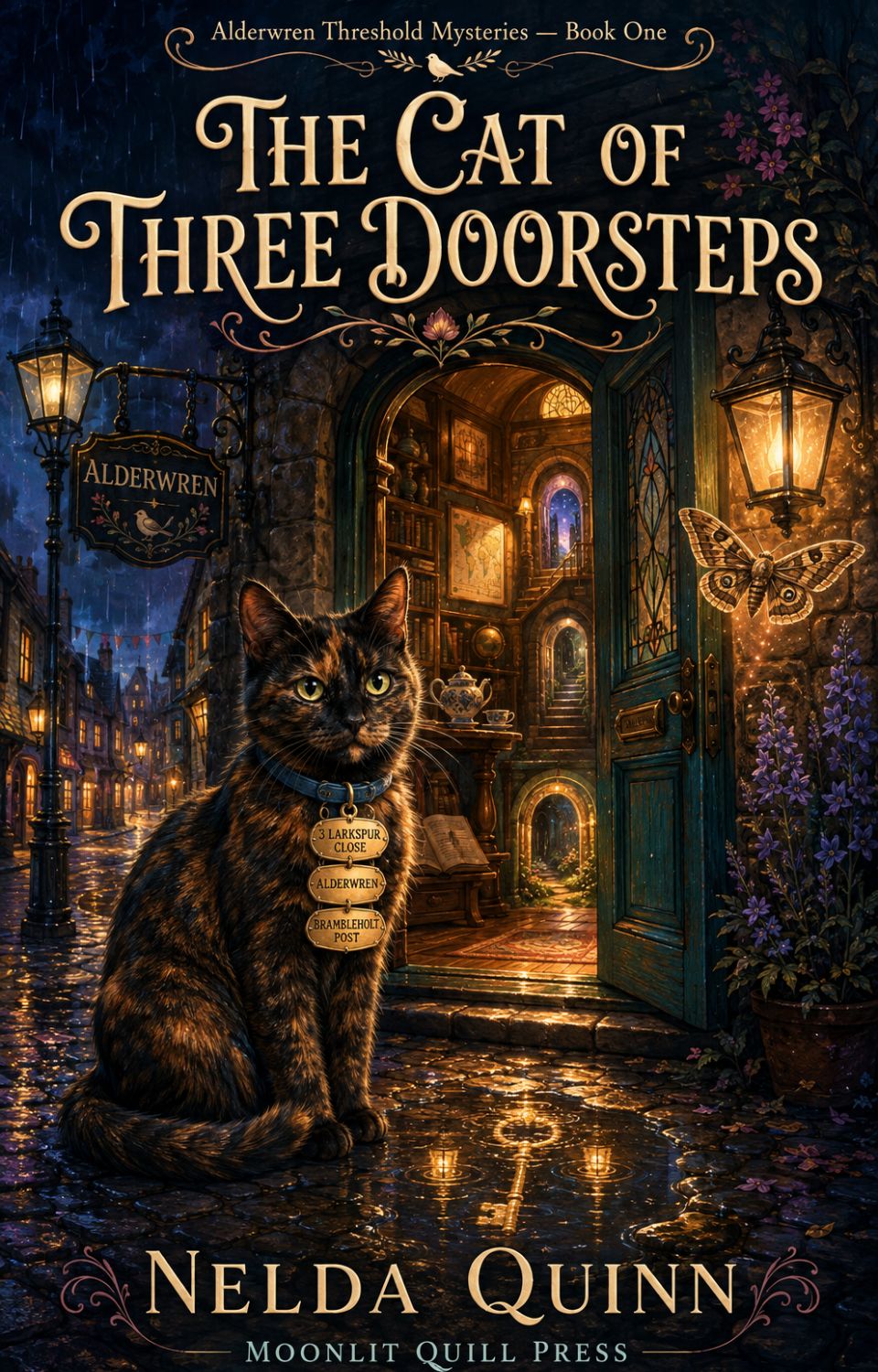
Prologue
The first time Angela Lark saw the tortoiseshell cat, the bells above the town archive were chiming six, although the largest clock in Alderwren insisted it was only ten minutes past five. Such disagreements were not uncommon in a town where clocks sometimes remembered happier hours and refused to move on, but Angela disliked them all the same. She paused beneath the archive’s green awning, buttoned her wool coat against the evening mist, and recorded the discrepancy in the small ledger she carried for irregularities no one else considered worth noting.
The cat sat across Lantern Lane with her tail curled neatly around her white-tipped paws. She was broad-faced, bright-eyed, and entirely dry despite the drizzle silvering every roof, railing, and window ledge in sight. A blue collar encircled her neck, and from it hung a brass tag large enough to look uncomfortable, although the animal wore it with the dignity of a mayor displaying a ceremonial chain.
Angela glanced toward the bakery beside the archive and saw Tobin Reed turning his sign from OPEN to CLOSED. Warm light filled the windows behind him, gilding rows of currant buns and sugar-dusted moon cakes, while the scent of cinnamon slipped through the door and softened the damp evening air. For one small and inconvenient moment, Angela considered going inside and buying something she had neither planned nor required.
The cat rose before Angela could surrender to the impulse and took three deliberate steps toward the middle of the lane. She stopped there and looked back at Angela as though expecting her to follow, which was presumptuous behavior from an animal they had not been introduced to. Angela closed her ledger and crossed the wet cobbles.
“You appear to be lost,” she said, keeping her voice low so she would not startle the creature. The cat blinked once, which Angela interpreted as skepticism, then lifted her chin until the brass tag caught the glow of the nearest lantern. Three lines had been engraved upon it in cramped, delicate letters, each one naming a different house: 14 Clover Row, 3 Wren Court, and 29 Bellweather Steps.
Angela frowned and turned the tag between two careful fingers. The metal felt warm, almost as if it had been resting beside a fire, and beneath the addresses was a tiny symbol shaped like three keys sharing a single ring. Maintaining Alderwren’s address ledger was among her least glamorous and most exacting duties, and she knew every registered residence in town. She had never, however, encountered three properties listed for one cat.
“You are administratively impossible,” she murmured. The cat placed one paw on Angela’s boot, apparently accepting this as praise, and began to purr.
Behind them came the sharp crack of breaking glass. Angela spun toward the bakery as Tobin hurried outside with flour on his sleeves and alarm whitening his usually cheerful face. The broad display window remained intact, but a narrow pane beside the door had shattered inward, scattering glass across the tiled floor. From somewhere behind the counter came a faint, unsettled chiming, light and high as teaspoons striking crystal cups.
“My honesty bell,” Tobin said, stepping carefully around the shards. A small silver bell hung from a red ribbon behind the counter, swaying despite the stillness of the room. He leaned closer, then stared at the empty space inside it. “Someone’s taken the clapper. Who steals part of a bell?”
Angela looked down to see whether the cat shared her concern, but the tortoiseshell had vanished. Only a dry patch of cobblestone remained beside Angela’s boot, perfectly outlined against the rain-darkened street.
By the time Constable Niall arrived, the drizzle had thickened into proper rain. He inspected the broken pane, questioned Tobin, and listened with patient disbelief while Angela described the cat, the warm brass tag, and its three addresses. When he suggested that the animal might simply belong to an indecisive family, Angela recorded his exact phrasing in her ledger and underlined indecisive twice.
The missing clapper was worth very little, and the damaged window could be repaired before morning. No one had been hurt, nothing else had been taken, and Tobin’s honesty bell had always been more amusing than essential. It merely rang when someone told a lie in the bakery, and in Angela’s experience, most people lied perfectly well without musical accompaniment. Even so, as she walked home beneath the shining lanterns, she could not forget the cat’s warm tag or the symbol of three joined keys.
Her rooms occupied the upper floor of a narrow house on Primrose Bend, where the walls smelled faintly of old apples and the pipes sang whenever someone nearby boiled water. Angela lit the blue lamp beside her desk, removed her damp coat, and opened the official copy of Alderwren’s residential registry. The familiar columns of names, dates, and property descriptions settled her more effectively than tea, although she put the kettle on as a precaution.
She found Clover Row first, followed by Wren Court and Bellweather Steps, marking each address with a square of yellow paper. Number 14 Clover Row belonged to Pippa Vale, a licensed charm-maker whose renewal applications were always submitted early and blotted with nervous fingerprints. Number 3 Wren Court belonged to Elsie Morrow, retired from the town watch, while Number 29 Bellweather Steps had once belonged to the Thorne family and was now occupied by Jonas Thorne, map conservator.
Three unrelated households were connected by no obvious business, bloodline, or municipal concern. Yet when Angela traced the addresses on the old street map pinned above her desk, she discovered that they formed a near-perfect triangle around the center of Alderwren. At its heart stood the archive, the bakery, and Lantern Lane, where the cat had waited moments before Tobin’s bell was damaged.
Angela checked the scale of the map, then checked it again because coincidences generally became less impressive when measured properly. This one did not. The three houses remained positioned like watchful points around the town center, and the shape between them looked disturbingly similar to the three-key symbol engraved on the cat’s tag.
The kettle began to whistle in the kitchen, but before Angela could rise, something tapped softly against her window. Her rooms were two floors above the street, with no balcony, drainpipe, or conveniently placed tree branch. She turned slowly and found the tortoiseshell cat sitting on the outer sill, dry once again, with her brass tag pressed against the glass.
Angela opened the window a cautious inch and felt cold rain brush her knuckles. “How did you get up here?” she asked, although she suspected the answer would create several additional categories of irregularity.
The cat pushed one paw through the gap and released a small silver object onto Angela’s desk. It rolled across the blotting paper, circled once beside the registry, and came to rest against Angela’s ledger with a faint musical chime. She recognized the missing clapper from Tobin’s honesty bell.
Angela reached toward it, but the cat gave a soft warning sound and fixed her bright eyes on the map instead. Following the animal’s gaze, Angela saw the three yellow markers trembling against the paper, although no breeze had entered the room. Fine golden lines appeared between them, joining Clover Row, Wren Court, and Bellweather Steps into a glowing triangle.
Then every door in Angela’s quiet little house clicked open at once.
Chapter 1
The House That Opened Itself
Angela Lark had lived in the narrow house on Primrose Bend for six years, and in all that time it had never shown the slightest interest in her comings or goings. It creaked in winter, smelled faintly of apples in autumn, and sang through its pipes whenever anyone nearby boiled water, but these were ordinary inconveniences of an old building rather than signs of personality. The doors had always remained firmly shut unless Angela opened them herself, which was exactly how she preferred doors to behave.
Now every one of them stood ajar. The bedroom door had eased inward by the width of a hand, the linen cupboard gaped onto its orderly stacks, and the small kitchen door rested against the wall as though inviting an inspection. Even the narrow door beneath the stairs, which Angela had never managed to unlock despite repeated requests to her landlord, had opened onto a darkness that smelled of dust, cold stone, and something faintly green. The tortoiseshell cat remained outside the window, watching Angela with the calm satisfaction of someone whose arrangements had gone precisely as planned.
Angela picked up the silver clapper with a folded handkerchief. It gave a delicate chime against her palm, although no bell surrounded it, and the sound seemed to travel through the house rather than the air. One by one, the doors trembled on their hinges.
“No,” Angela said to the cat. She lowered her voice when the animal’s ears tilted back, because she had no wish to be unreasonable even under unusual circumstances. “Whatever this is, I am not participating until I have recorded the details.”
The cat yawned, and Angela pulled her ledger closer. She wrote the time, the weather, the condition of the clapper, and the exact number of open doors. There were seven, including the cupboard beneath the stairs, which she counted twice because she disliked the idea of an impossible door altering her figures. When she looked up again, the cat had squeezed through the narrow gap in the window and was sitting beside the registry with one paw resting upon the address at 14 Clover Row.
“You could at least have the courtesy to drip on the floor,” Angela told her. The cat was perfectly dry.
She leaned down, caught the missing clapper gently between her teeth, and leapt from the desk before Angela could stop her. With her tail raised like a banner, she trotted through the open bedroom door and down the stairs.
Angela followed because the clapper belonged to Tobin, because an unidentified animal was loose in the building, and because allowing a mystery to leave with municipal evidence would have been irresponsible. She did not follow because she was curious. Curiosity, in Angela’s experience, was often an undisciplined form of paperwork.
At the bottom of the stairs, the cat waited beside the open cupboard. The space beyond should have been scarcely deep enough for brooms and coal buckets, but a flight of worn stone steps descended into darkness beneath the house. Tiny green lights glowed along the wall, no larger than pinheads, and the air carried the scent of crushed mint after rain.
Angela stared for several long moments. Then she took her coat from its peg, put on her boots, and fetched the blue lamp from her desk.
“This does not constitute consent,” she said as she stepped through the doorway. “It constitutes responsible retrieval.” The cat began down the stairs.
The passage beneath Primrose Bend was too old to have been included in any modern plan. Its walls were built of smooth grey stone, and the ceiling curved low enough that Angela had to duck beneath thick roots pushing through the mortar. Here and there, small brass plaques had been fixed into the wall, each engraved with an address rather than a name.
She passed 8 Primrose Bend, 2 Cobbler’s Turn, and 41 Juniper Lane. Several addresses had been scratched through, while others glowed with a dim honey-colored light. When Angela paused beside one, she heard muffled laughter from somewhere beyond the stone, accompanied by the clink of cups and the soft scrape of chairs.
The cat looked back impatiently, and Angela lowered her voice. “This is an unauthorized access route,” she whispered. Her words sounded too loud in the passage, and she lowered the lamp as if that might make her less visible. “There are procedures for reporting unauthorized access routes.”
The cat continued onward without visible concern for procedure. They descended farther than the foundations of Angela’s house should have allowed, then emerged into a round chamber beneath a domed ceiling. Three archways opened from it, each framed by a different kind of wood: pale birch, dark oak, and red-brown rowan. A faded mosaic covered the floor, showing three keys joined at a single ring.
The same symbol was engraved upon the cat’s tag. Angela crouched and examined the mosaic without touching it. Hairline cracks ran through two of the keys, while the third remained intact. A scattering of pale grit lay near the birch archway, and something dark had stained the edge of the rowan frame.
The cat dropped Tobin’s clapper at the center of the mosaic. A faint blue shimmer spread from the silver piece into the floor. For an instant, the three keys brightened, and the chamber filled with the mingled scents of bread, lavender smoke, and old paper. Then one of the cracked keys flickered and went dark.
The cat made a low, troubled sound, and Angela had never heard a cat sigh before, but there was no other word for it. The animal sat beside the dead line in the mosaic and looked up at her with an expression so direct that Angela felt absurdly accused. She opened her ledger and sketched the pattern, adding notes about the lights, the stains, and the change in the cat’s behavior.
“You are attempting to communicate,” she said. “Unfortunately, you have chosen someone with no training in animal interpretation, underground architecture, or spontaneous domestic passageways.”
The cat nudged the clapper toward the birch arch. Angela lifted the lamp and stepped closer. A narrow wooden door stood within the archway, painted the soft green of early spring leaves. In its center was a brass number fourteen.
It was Clover Row, and Angela’s unease sharpened into something more useful. She knew 14 Clover Row as a tall, pale house at the edge of the old market district, registered to Pippa Vale and licensed for the manufacture of protective household charms. It should have been nearly half a mile from Primrose Bend, yet a door bearing its number now stood beneath Angela’s stairs.
The cat scratched once at the wood, but Angela did not move. “I am not knocking on a stranger’s underground door after midnight,” she said.
A muffled thump came from the other side, and Angela held still. The cat’s ears flattened, and another thump followed, this one accompanied by the brittle tinkling of many small objects striking the floor. Someone cried out, though the sound was too blurred to make out the words.
Angela knocked hard. “Pippa Vale?” she called. “This is Angela Lark from the municipal archive. Are you in need of assistance?”
There was a pause, followed by hurried footsteps. The green door swung inward, and warm lavender-scented smoke rolled into the chamber.
A young woman stood on the other side wearing a quilted dressing gown over a nightdress and one striped stocking. Her dark hair had been tied into a loose knot with a ribbon, and a pair of brass spectacles sat crookedly on her nose. Behind her, dozens of tiny charms spun through a cluttered workshop, colliding with shelves, lamps, and one another as if caught in a private storm.
“Oh,” the woman said. “You came through the threshold passage.”
Angela looked beyond her. The workshop occupied the lower floor of a narrow house, with a staircase climbing toward rooms above and rain tapping against ordinary street windows. She could see the painted sign for Pippa Vale’s shop hanging backward through the front glass.
“You know this passage exists,” Angela said. Pippa winced as a silver acorn struck the wall beside her head.
“I was hoping it didn’t anymore,” Pippa said. The cat slipped past Angela and trotted into the workshop. She jumped onto a table where loose ribbons writhed like worms, then placed one paw firmly on a spinning blue charm. It stopped at once.
Pippa stared at her. “You found Moth.”
“Moth?” Angela repeated, and the tortoiseshell lifted her chin.
“That is what my grandmother called her,” Pippa said. “She said Moth belonged to the crossings, not to any person, which was a poetic way of avoiding every practical question I ever asked.”
Angela stepped into the workshop and closed the green door behind her. The threshold passage vanished as soon as the latch clicked, leaving an ordinary panel of wood set into the wall beside a cabinet of bottled feathers. She opened it again and found only a shallow cupboard filled with twine.
“This evening is becoming increasingly difficult to document,” Angela said. A glass star whizzed past her ear, and Pippa lunged for it, missed, and nearly stumbled into a basket of bells. Angela caught her elbow, then ducked as three copper keys spun across the room in a glittering cluster.
“What happened?” Angela asked. Pippa steadied herself against the table.
“I was finishing a ward for the Finch family,” Pippa said. “Nothing complicated, just a hearth-binding charm to keep their chimney from sulking during wet weather. Then every protection charm in the shop woke at once and began trying to leave.”
Angela looked around at the chaos. Dozens of charms pulled toward the walls, windows, and doors as if drawn by invisible threads. Some glowed, others rattled, and several whispered in tiny overlapping voices.
“Has this happened before?” Angela asked. Pippa caught a charm shaped like a wooden spoon and shoved it into her pocket, where it continued to wriggle.
“Not since I inherited the shop,” Pippa said. “My grandmother used to say charms become restless when the town’s thresholds are frightened, but she also claimed turnips can hold grudges, so I did not preserve all her opinions with equal care.”
Moth jumped down from the table and carried Tobin’s clapper to Pippa. The charm-maker’s face changed when she saw it.
“Where did she get that?” Pippa asked. Angela watched her closely, though the blue light in the room made expressions difficult to read.
“She brought it to my window after someone stole it from Tobin Reed’s honesty bell,” Angela said. “A pane was broken at the bakery shortly before the town watch arrived.”
Pippa crouched beside Moth and examined the clapper. “This is not merely part of a novelty bell.”
“Tobin described it as amusing rather than essential,” Angela said. Pippa turned the silver piece over in her fingers.
“Tobin describes everything that matters as amusing.” A tiny mark had been stamped near the base of the clapper, almost too small to see. “This belonged to his grandmother, who belonged to one of the three threshold houses.”
Angela opened her ledger. “Which three?” she asked.
Pippa looked toward the cupboard where the hidden door had appeared. “Mine, Elsie Morrow’s, and Jonas Thorne’s.” The charms around them gave a sudden collective shiver.
Angela wrote down the names, though she already knew them from the registry. “What is a threshold house?”
“A house that holds one part of an old protective agreement.” Pippa stood and began gathering scattered charms into a wooden tray. Her hands moved quickly, but her explanation came slowly, as if each word had to be weighed before release. “Long ago, before Alderwren had proper roads, certain doorways connected distant parts of town. The crossings helped people find shelter, carry medicine through storms, and reach neighbors when ordinary paths were blocked.”
“And the agreement?” Angela asked. Pippa glanced at Moth.
“Three houses kept the crossings safe,” she said. “Each guarded a key, though not always a literal one, and none could control the passages alone. The cat moved between them. She noticed trouble before people did.”
Angela thought of the mosaic beneath her house and the two cracked keys. “The agreement has been damaged.”
Pippa stopped moving and stared at her. “You saw the chamber?”
“Yes,” Angela said. Pippa tightened her grip on the tray.
“How many keys were lit?” she asked. Angela did not look away.
“One,” she said. The color drained from Pippa’s face, and a little brass horseshoe escaped her tray and clattered onto the floor. She did not bend to retrieve it.
“Then two of the threshold bonds have already failed,” Pippa said. Angela waited for an explanation, but none came, so she closed her ledger with deliberate care.
“Which one remains?” Angela asked. Pippa looked embarrassed by the admission she was about to make.
“I don’t know,” she said. “The houses were meant to meet every year and renew the bond, but the tradition faded after my grandmother died. Elsie said the crossings had gone quiet, and Jonas refused to discuss his family’s part in it.”
“And Tobin?” Angela asked. Pippa studied the clapper again.
“His family kept a listening object, not one of the three keys,” she said. “The honesty bell could detect strain in the agreement because crossings dislike deception. Without this piece, the bell cannot warn us.”
Angela considered the broken pane, the missing silver piece, and Moth’s arrival before the crime. “Someone removed it intentionally.”
Pippa hugged the tray of restless charms against her dressing gown. “That seems likely.”
“Why?” Angela asked. Pippa gave her a helpless look.
“I was hoping you might know,” she said. Angela almost laughed, though the feeling passed before it reached her face. She had spent years being asked to locate misplaced permits, settle contradictory property records, and explain why the town’s fountain occasionally mailed invoices to people who had never used it. No one had ever expected her to solve a magical conspiracy before breakfast.
Moth sprang onto a stool and tapped the brass tag against its wooden seat. The three addresses chimed faintly.
“We should return the clapper to Tobin,” Angela said. “Then we should visit the other two houses and determine the condition of their keys.”
Pippa shook her head at once. “Not tonight.”
“Why not?” Angela asked. Pippa pushed her spectacles higher.
“Because Elsie sleeps with a loaded whistle beside her bed, and Jonas once threatened to bury a tax assessor inside an obsolete map,” she said. “Also, the charms have not stopped trying to escape.”
Angela surveyed the room. “Can they be contained?”
“Probably,” Pippa said. Angela regarded her steadily.
“That answer lacks useful confidence,” she said. Pippa adjusted the tray in her arms.
“It is the best available answer,” she replied. Angela removed her coat and hung it on a peg beside several cloaks embroidered with protective symbols. She then began sorting the loose charms by material, size, and direction of attempted flight. Pippa watched her for a moment before following the system, placing wood in one tray, metal in another, and glass beneath a mesh cover.
The work settled Angela. There were objects to count, patterns to identify, and a clear improvement each time a charm stopped rattling against a lid. Pippa brewed a pot of lavender tea between rescues, and Moth supervised from the highest shelf with her paws tucked beneath her chest.
By half past one, the workshop had grown quiet. Only the chimney charm continued to mutter from Pippa’s pocket, and even that sounded more offended than dangerous. Pippa poured the tea into mismatched cups and placed a plate of honey biscuits between them.
“You are not what I expected from the archive,” she said. Angela added half a spoonful of sugar.
“What did you expect?” Angela asked. Pippa considered the question.
“Someone older,” she said. “Dustier. Possibly translucent.”
“That describes Mr. Pell in property disputes,” Angela said. Pippa smiled, and the expression transformed her tired face.
“I meant someone less willing to walk through an impossible door,” she said. Angela glanced down at her tea.
“I believed a stolen object was being removed from my custody,” she said. Pippa’s smile deepened.
“Of course,” she replied. Angela glanced toward Moth. The cat had closed her eyes, but the tip of her tail moved at every mention of the crossings.
“Why does her collar list all three addresses?” Angela asked. Pippa broke a biscuit in half.
“Because she can be called from any threshold house, or could be when the agreement was intact,” she said. “My grandmother said Moth never truly belonged to any of us. She belonged to the promise between us.”
“That is not a legally recognizable form of ownership,” Angela said. Pippa nodded.
“No,” she agreed. “But it sounds nicer.”
Someone knocked at the shop’s front door, and both women froze. The knock came again, slow and measured, though the sign still displayed CLOSED and the lamps had been turned low. Moth opened her eyes, and the fur along her back rose in a dark ridge.
Pippa set down her cup. “Customers generally wait until morning.”
Angela moved quietly to the window and looked through a gap in the curtain. Lantern light lay across the empty pavement, and rain gleamed on the cobbles, but no one stood before the door. She could see no shadow, no retreating figure, and no movement beneath the awning.
The third knock came from the cupboard behind them. Moth leapt from the shelf, Pippa gripped Angela’s wrist, and every charm in the workshop began to tremble.
The cupboard door opened by itself, revealing the round underground chamber. The mosaic had changed. Two keys remained cracked and dark, while the third glowed with a thin green light. At the center of the floor lay a cream-colored envelope sealed with black wax.
Angela crossed the threshold before Pippa could stop her. The envelope bore no name, only the three-key symbol pressed into the wax, and its paper felt cold despite the warmth of the chamber.
She opened it carefully and found a strip of official archive paper cut from the edge of a municipal ledger. Seven words had been written across it in deep green ink.
You have already recorded the wrong crime.
Chapter 2
A Map with a Missing Street
By morning, the rain had polished Alderwren into a town of bright roofs, dark cobbles, and windows full of reflected sky. Angela crossed Lantern Lane with the cold envelope tucked inside her ledger and Tobin’s silver clapper wrapped in a handkerchief beneath her arm. Moth walked beside her with the grave assurance of an official escort, pausing only once to inspect a fishmonger’s basket and twice to glare at pigeons whose conduct appeared suspicious.
Pippa had insisted on accompanying them, though she had changed from her dressing gown into a moss-green coat with deep pockets for charms. Every few steps, one pocket gave a faint rattle or whispered a warning in a voice too small to understand. Pippa pretended not to notice, but Angela saw her press one hand against the noisiest pocket whenever they passed a doorway.
Tobin Reed was already at work behind the bakery window. He stood at a long wooden table dusted with flour, shaping a row of buns while three copper ovens glowed behind him. His expression brightened when he saw them, then shifted into concern when he noticed Moth.
“You have brought back the criminal,” he said as he unlocked the door. “I assume she has negotiated favorable terms.”
“Moth did not steal the clapper,” Angela replied. She entered the warmth of the bakery and closed the door against the damp morning air. “She recovered it and delivered it to my window.”
Tobin looked down at the cat. “Then I withdraw the accusation, though I reserve judgment on the cream she took last spring.” Moth wound between his ankles without remorse.
The bakery smelled of yeast, cinnamon, toasted sugar, and the darker spice Tobin used in his honesty buns. Rows of glazed pear tarts cooled near the front window, while a tray of tiny savory pies clicked their crusts together as if engaged in quiet conversation. Angela usually found the place too warm and too full of people, but at this hour it felt almost private.
She unwrapped the silver clapper and placed it on the counter. Tobin’s humor faded at once.
“Where was it?” he asked. Angela rested one hand on her ledger.
“In my rooms,” she said. “Moth brought it after the watch left.”
Pippa leaned closer. “It passed through a threshold route.” Tobin rubbed flour from his hands onto his apron.
“I had hoped those had stopped working,” he said. Angela glanced toward Moth.
“That seems to be a common hope,” she replied. “It has not been realized.”
Tobin picked up the clapper and crossed to the small bell hanging behind the counter. The bell itself was plain silver, no larger than a plum, with a pattern of three leaves etched around its rim. He fastened the clapper into place, then steadied the bell before letting it swing.
The sound was soft and clear. A pale blue shimmer moved through the bakery, passing over ovens, shelves, and tables before fading into the walls. Several of the savory pies stopped clicking.
Tobin listened with his head tilted. “It is not right.”
Angela opened her ledger. “In what way?” she asked.
“It should ring once for an honest return.” He touched the bell again, but it remained silent. “When something is restored freely, the note warms. This one sounds frightened.”
Pippa removed a small charm shaped like a woven eye from her pocket and held it near the bell. The threads tightened until the eye narrowed.
“There is strain in the ward network,” she said. Angela glanced at the restored clapper.
“There was strain last night,” Angela replied. “The underground mosaic showed two broken keys and one intact key.”
Tobin swore softly beneath his breath, then glanced at a nearby tray. One of the pear tarts had developed a dark crack across its glaze.
“The three houses have not renewed their promise in years,” he said. “I did not think neglect could break it this badly.”
“Someone removed the clapper deliberately,” Angela replied. “We also received a message stating that we recorded the wrong crime.”
Tobin’s eyebrows rose. “We?” he asked.
Angela placed the envelope on the counter and unfolded the strip of archive paper. The green words had not faded overnight, though the ink shifted slightly whenever the paper was tilted.
You have already recorded the wrong crime. Tobin read the sentence twice before looking up.
“That is municipal stock,” he said. Angela nodded.
“Yes,” she replied. Tobin studied the watermark.
“Could someone have taken it from the archive?” he asked. Angela turned the strip over, showing the faint mark pressed into its lower edge.
“Possibly, though paper of this weight is kept in the secure records room,” she said. “This batch was issued before I began working there. I would need to inspect the accession register to determine which ledger it came from.”
Pippa touched the black wax seal. “The ink has threshold residue.” Tobin frowned.
“Meaning?” he asked. Pippa withdrew her finger quickly.
“Meaning it was written near one of the old crossings, or by someone who has handled their magic for a long time,” she said. “The message may not have come through an ordinary door.”
Moth jumped onto a chair and placed both front paws on the table. Her tail flicked toward the rear of the bakery, where a narrow staircase led to Tobin’s rooms above.
Angela followed the direction of the cat’s gaze. “Is there a hidden passage beneath this building?”
“Not that I know of.” Tobin hesitated before glancing toward the stairs. “My grandmother kept a locked pantry under them, but there is nothing magical about it unless stale marmalade has become a branch of enchantment.”
Moth jumped down and trotted toward the staircase. The others followed her through the bakery.
They found the pantry at the end of a short corridor behind the ovens. Its door was painted cream and fitted with a brass latch rubbed smooth by decades of use. Tobin produced a key from a hook above the frame, and the lock opened reluctantly.
Inside were shelves of jars, sacks of flour, old baking tins, and a stack of festival banners smelling of cloves. Nothing suggested a secret route, though Moth went straight to the back wall and began scratching at the baseboard.
Pippa crouched beside her. “There is magic here.”
Angela held the blue lamp near the wall, though daylight already reached the pantry through a small high window. Faint lines appeared between the boards, forming the outline of a door no wider than a cupboard. Three tiny keyholes marked its center.
Tobin stared at the wall. “I grew up in this bakery.”
“Did your grandmother ever forbid you from touching this wall?” Angela asked. Tobin gave her a dry look.
“She forbade me from touching nearly everything,” he said. “She believed children had a special talent for awakening dormant objects.”
Pippa ran her fingers above the first keyhole without making contact. “This is a listening door, not a crossing door. It would have been used to hear changes in the three-house agreement.”
“Can it be opened?” Angela asked. Pippa examined the three keyholes.
“Not without three keys,” she said. Moth tapped the silver bell clapper against the floor.
Tobin looked from the cat to the hidden outline. “That cannot possibly be a key.”
“It is associated with an object that listens for dishonesty,” Angela said. “The door is meant to listen. The connection is plausible.”
“Plausible is a generous word,” Tobin replied. Angela took the clapper from him and held it near the first keyhole.
The metal warmed in her hand, and the keyhole widened until it matched the clapper’s narrow shape. She inserted it carefully.
A tone sounded inside the wall. The boards faded into translucence.
Beyond them appeared not a room but a shifting view of Alderwren from above, as if the pantry wall had become a window suspended over the town. Streets glimmered like threads of light, roofs shone in muted reds and greens, and the river curved around the eastern hill in a band of silver.
Three points glowed more brightly than the rest. Clover Row pulsed faintly green, Wren Court shone amber, and Bellweather Steps remained dark.
“That would suggest Pippa’s house still holds the intact key,” Angela said. Pippa looked unconvinced.
“The color last night was green, but threshold colors do not always belong to a single place,” she said. “They can reflect condition, intent, or even the person looking.”
Tobin leaned closer to the wall. “What is that?” he asked.
A thin black line moved across the map. It began near Lantern Lane, passed beneath the archive, and curved toward a cluster of buildings in the old market district. Wherever it traveled, the glowing streets dimmed.
Angela followed its path with one finger held above the surface. “It resembles ink bleeding through paper.”
The line reached a point between Clover Row and Wren Court, then stopped. A small shape appeared there, dark against the shining map.
Moth hissed, and the wall snapped back into solid wood. The clapper fell from the keyhole, but Tobin caught it before it struck the floor.
“What was at the end of the line?” Pippa asked. Angela opened her ledger and sketched from memory.
“A building, perhaps,” she said. “The shape was rectangular, but it did not align with the streets around it.”
“There is nothing between Clover Row and Wren Court except the old fountain square,” Tobin said. Angela finished the outline.
“Nothing registered,” she corrected. The distinction did not improve anyone’s expression.
The archive opened at eight, and Angela intended to be there before Mr. Pell began his morning circuit of complaints. She left Tobin with instructions not to remove the clapper again, though he objected that he had not removed it the first time. Pippa promised to meet them at midday after she had checked the stability of her shop, while Moth followed Angela toward the municipal quarter without invitation.
The Alderwren Archive occupied a long stone building with green copper gutters and windows too narrow for comfort. Its front steps were worn into shallow curves, and its main doors bore brass plates engraved with the names of every archivist who had served since the town began keeping official records. Angela’s name did not appear there, because clerks were expected to preserve history rather than join it.
Inside, the building smelled of dust, binding glue, wool coats, and the peppermint polish used on the reading tables. A chandelier floated above the central hall without chains, glowing brighter whenever someone told the truth beneath it. This made public disputes unusually efficient and staff meetings unnecessarily revealing.
Mr. Pell stood at the accession desk with a stack of property forms clutched to his translucent chest. He was not literally a ghost, though poor circulation, pale skin, and forty years among old papers had produced a convincing approximation. His eyebrows lifted when Angela entered with Moth at her heels.
“Animals are not permitted in the records hall,” he said. Angela looked down at Moth.
“Moth is relevant to an active municipal irregularity,” she replied. Mr. Pell frowned.
“That phrase does not constitute a category,” he said. Angela removed her gloves.
“It should,” she replied. Mr. Pell looked at the cat, who sat upon the polished floor and curled her tail around her paws. The chandelier brightened slightly above Angela.
“You are early,” he said. Angela glanced at the clock.
“I am four minutes late,” she replied. Mr. Pell slid the stack of forms toward her.
“That is early for anyone investigating an irregularity,” he said. “The paving committee has submitted three versions of the same petition, all with different street names.”
Angela removed her coat. “I will review them after I inspect the paper accession records from twenty to thirty years ago.”
Mr. Pell’s pale eyebrows rose farther. “Why?” he asked.
She placed the green message on the desk. He read it without touching it, and the chandelier dimmed.
Angela noticed the change. “Do you recognize the paper?”
“No,” he said. The chandelier darkened another shade.
Mr. Pell cleared his throat. “I recognize the stock. That is not the same as recognizing the paper.”
“Which ledger used it?” Angela asked. Mr. Pell shifted the property forms.
“Several,” he replied. The chandelier flickered.
Moth stood and placed one paw on Mr. Pell’s shoe. He sighed and looked down at her.
“The old threshold registry,” he said. Angela had never seen such a title in the catalog.
“Where is it kept?” she asked. Mr. Pell pressed his lips together.
“It was removed from circulation before you joined the archive,” he said. Angela rested both hands on the desk.
“By whom?” she asked. Mr. Pell glanced toward the council offices.
“The council,” he replied. Angela did not move.
“On what grounds?” she asked. Mr. Pell looked toward the chandelier.
“Obsolescence,” he said, then added, “And concern.”
Angela waited, and Mr. Pell pressed his fingertips together. “The registry documented properties linked to the old passage network. After several routes collapsed, the council judged the records unsafe for public access.”
“Why were they unsafe?” Angela asked. Mr. Pell lowered his voice.
“Because addresses are not merely descriptions in Alderwren,” he said. “A properly recorded address can anchor a place. An altered address can confuse it. A deleted address can cause a building to forget where it belongs.”
Angela thought of the moving black line on Tobin’s hidden map. “Where is the registry now?”
“In the sealed collection,” Mr. Pell said. Angela held out her hand for the accession keys.
“I require access,” she said. Mr. Pell drew them closer to himself.
“You do not have authorization,” he replied. Angela kept her hand extended.
“Then authorize me,” she said. Mr. Pell shook his head.
“I do not have that authority,” he replied. Angela lowered her hand.
“Who does?” she asked. Mr. Pell looked toward the rear staircase.
“Archivist Sable,” he said. Angela glanced at the clock.
The head archivist rarely arrived before noon and had not appeared at all for the previous three days. Her absences were never explained, though they often coincided with the archive receiving deliveries no one remembered ordering.
“I will examine the accession index until she arrives,” Angela said. Mr. Pell placed one hand over the green message.
“Angela, there are records that should remain quiet,” he said. She looked at his hand.
“The records are not quiet,” she replied. “Someone cut this strip from one of them.”
His face tightened. For the first time, he looked less like a tired clerk and more like a man who had spent years guarding a door no one else knew existed.
“The sealed collection is beneath the east wing,” he said. “You did not hear that from me.”
The chandelier brightened, and Angela took the message from beneath his hand. She walked toward the accession room with Moth following closely behind.
The room contained thirty-seven cabinets arranged by year, material, and degree of magical sensitivity. Angela began with the oldest paper logs and worked forward, checking watermark codes against the strip.
It took nearly an hour to identify the batch. The paper had entered the archive twenty-four years earlier and had been assigned to a single ledger: Threshold Register, Supplement Three. The ledger’s location box had been overwritten in darker ink, but the original notation remained faintly visible beneath it.
East Wing, Lower Collection, Shelf 9. Angela copied the entry into her ledger.
Moth stood on her hind legs and pressed one paw to a second line below it. The line listed three items withdrawn on the same date.
The threshold register was one, while the others were a ward map of Alderwren and a volume titled Civic Offenses Relating to Unstable Places. All three had been signed out by E. Morrow.
“Elsie,” Angela murmured. Moth chirped in response.
A crash sounded from the public hall, and Angela hurried from the accession room. She found papers swirling beneath the chandelier while Mr. Pell stood behind the desk with both hands raised.
A dark ribbon of ink crawled across the floor toward the property cabinets. Wherever it touched, brass labels changed.
Juniper Lane became Juniper End, and Lantern Lane became Lantern Walk. Primrose Bend flickered between three different names before settling on a blank plate.
Angela felt a cold pressure in her chest. Her home had not merely been omitted; its name had been erased.
Moth sprang onto the desk and slapped one paw onto the green message. The ink crawling across the floor stopped, and for a heartbeat, the archive held perfectly still.
Then every address label on the western wall shifted at once. Angela ran to the map cabinet and pulled open the drawer containing Alderwren’s current municipal plan.
Streets curled across the parchment in neat black lines, each labeled in her own careful hand. Near the center of town, between Clover Row and Wren Court, a new lane had appeared.
It was narrow, crooked, and shaded darker than any other street on the map. At its end stood a single unnamed building marked with the symbol of three joined keys.
Mr. Pell came to stand beside her. “That street does not exist.”
Angela looked at the fresh line of ink and thought of the hidden shape on Tobin’s listening map. “It does now.”
At the bottom of the parchment, letters began writing themselves in deep green ink.
COME BEFORE THE THIRD ADDRESS DISAPPEARS.