Prologue
Thirty-five years before Alderwren forgot a day that had never happened, Clemency Dorr baked twelve possible tomorrows and believed the kindest one ought to win. The Lantern Bakehouse lay beneath the festival kitchens, warm with banked heat and the mingled scents of yeast, orange peel, nutmeg, and old brick. Eleven wall ovens had already gone dark for the night, but the great iron oven at the center continued glowing behind its round pane of blue glass.
Clemency stood before it with a brass tasting spoon hanging from a ribbon around her wrist. She was thirty-eight then, strong-backed and flour-streaked, with her grey-brown hair braided tightly to keep it from falling into the dough. “The household cake is ready,” she said, although no one had asked.
Agatha Reed looked up from the long preparation table. “That is precisely why I distrust it.”
The cake waited beneath a white cloth at the center of the table, six layers high and iced with pale blue sugar. It had been commissioned by the Fenlow and Marr households, who intended to combine their adjoining bakeries after the festival. The families had asked to experience the following morning so they could learn whether the arrangement would feel harmonious before signing the final papers.
Oona Bellglass sat near the recipe drawers with the witness ledger open across her knees. “The stated question was whether sharing one kitchen would serve both households,” she said. “The question was not which household should own the combined business.”
“The oven understands context,” Clemency replied. “The oven understands attention,” Agatha said. “Those are not the same thing.”
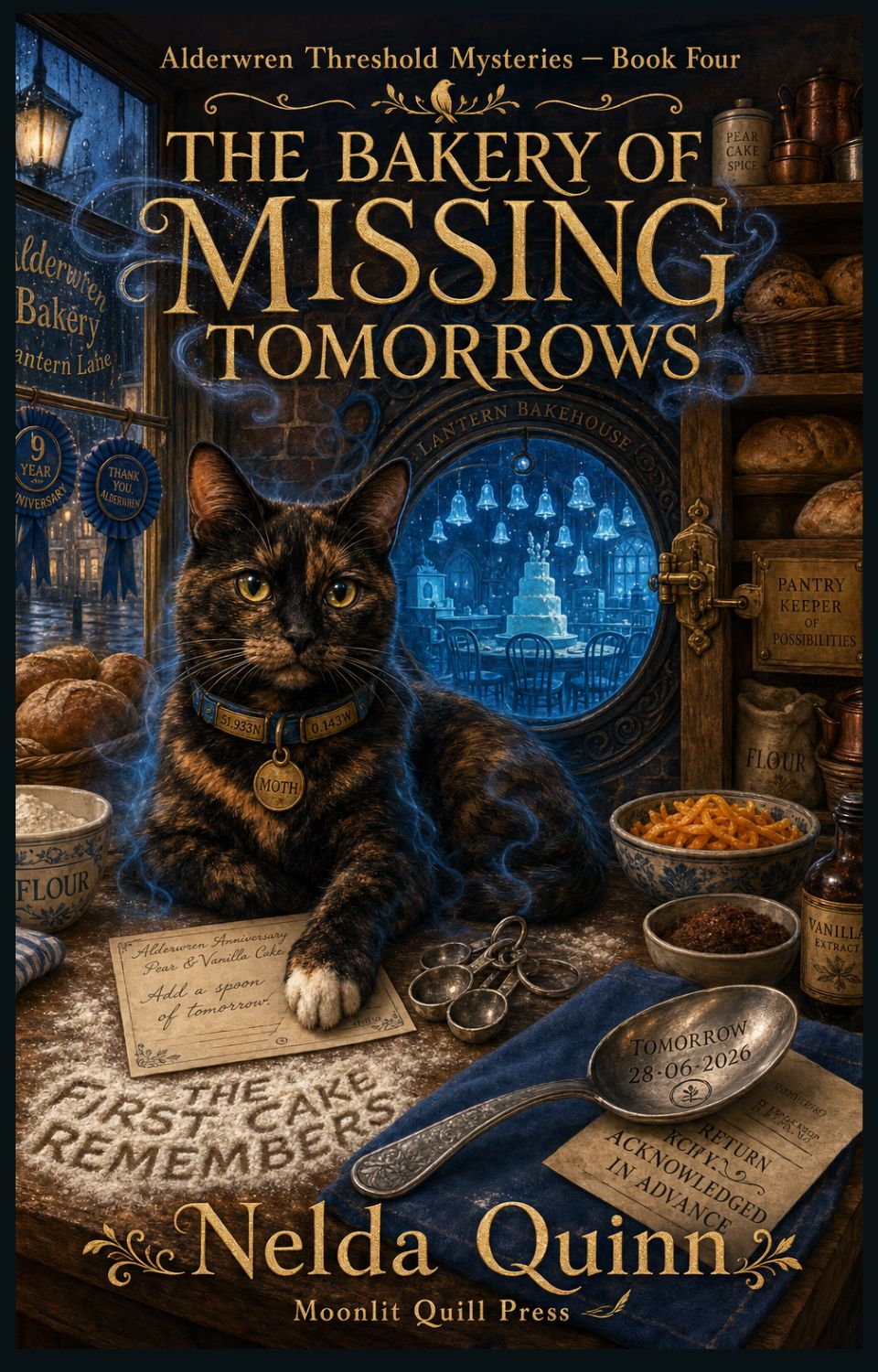
Clemency lifted the tasting spoon. Its shallow bowl reflected the blue oven light, while the date engraved along its handle remained tomorrow’s. “They have discussed the arrangement for six months. Everyone in Alderwren knows they will agree.”
Agatha dusted flour from her square hands. She had already baked three plain brown loaves and placed them near the exit, where the ordinary stair remained visible between two blue-tiled walls. “Everyone in Alderwren knowing a thing has never prevented the thing from being wrong.”
The supper bell sounded overhead. Footsteps descended the stairs, followed by laughter, festival music, and the faint clatter of lantern poles being stacked for the night. The two families entered together, carrying the nervous cheerfulness of people determined to regard uncertainty as celebration.
Mara Fenlow came first, dressed in green silk with sugar pearls sewn along her cuffs. Her brother Edric followed beside Tomas Marr, while Tomas’s widowed mother and two adult daughters brought up the rear. All six had signed the reflective-baking notice. All six had agreed that the cake offered possible experience rather than prophecy.
Clemency believed they meant it. Agatha served everyone a slice of ordinary bread before uncovering the cake. Mara accepted hers with visible impatience. “Is this part of the magic?”
“No,” Agatha said. “That is its chief advantage.”
They ate the bread while Oona read the terms aloud. The experience would last no longer than one remembered morning. No statement made within the memory would establish consent. No imagined signature, promise, appointment, inheritance, or household agreement would possess civic standing. Every participant could decline the cake after hearing the conditions.
No one declined. Clemency cut six slices. The icing gave a soft sigh beneath the knife, and the Lantern Oven brightened as each plate crossed the table. Blue light entered the crumb like morning settling through curtains.
The diners ate. For several breaths, nothing happened. Then Mara dropped her fork.
She stared across the table at Tomas. “You gave the north ovens to Edric.”
Tomas turned pale. “No. You closed the Marr bakery and dismissed my daughters.”
One daughter began crying. “Neither of you came to the opening.”
Her sister shook her head violently. “There was no opening. The roof collapsed because Edric removed the central chimney.”
“I did not,” Edric said, but his voice carried the horror of someone who remembered doing exactly that. Their mother pressed both hands against the table. “Tomorrow morning, Mara signs the ownership papers alone. I watched her.”
Mara rose so quickly that her chair struck the floor. “You asked me to.”
“I remember refusing.” “I remember you thanking me.”
All six spoke at once. They described the same blue morning, the same kettle whistling beside the eastern window, and the same festival bells sounding nine times. Beyond those details, every tomorrow contradicted the others.
Oona raised her witness pen but did not write. “Each account is sincere.”
Clemency looked toward the Lantern Oven. Its blue pane had grown bright enough to show a kitchen behind the glass. In that kitchen, the two bakeries stood combined beneath one name.
DORR & REED, the sign above the counter read. Agatha saw it too. She crossed the Bakehouse and shut the oven vent.
The imagined kitchen vanished. “You cannot close it before we determine which memory is useful,” Clemency said.
“Useful to whom?” “To them.” Clemency pointed toward the arguing families. “One of those mornings may show the mistake before they make it.”
“One of those mornings may manufacture the mistake because we expected a decision.” Agatha gathered the remaining cake and placed it inside a covered tin. “No more tasting.”
Mara seized the witness ledger. “I want my account recorded before Tomas changes his story.”
“They are not stories,” Clemency said. “They are consequences.”
Agatha placed one ordinary loaf in the center of the table. “Then we begin with what happened before anyone ate.”
The room quieted reluctantly. She looked at Mara. “Did Tomas give the ovens to Edric?”
“No.” “Tomas, did Mara close your bakery?”
“No.” “Did anyone sign the ownership papers?”
No one had. “Did anyone dismiss either daughter, remove a chimney, refuse an opening invitation, or agree upon the business name?”
Each answer was no. Agatha cut the ordinary loaf and gave everyone another slice. “Then tomorrow has provided no evidence. You may consider what frightened or appealed to you, but you may not accuse one another of acts that occurred only inside a cake.”
The Lantern Oven groaned. Its iron door pressed outward, wanting attention.
Clemency rested her hand on the handle. Behind the blue glass, another morning appeared. Her younger brother Ambrose stood in their family bakery, older and smiling, with flour across his sleeves. He had not yet told her he intended to leave Alderwren.
In the oven’s morning, he never would. Clemency’s breath caught. Agatha came to stand beside her but did not look through the glass.
“Close it,” Agatha said. “What if it shows something we could prevent?”
“What if it shows something you would prevent only because you fear it?” Ambrose lifted one hand inside the blue-lit kitchen. Clemency knew the gesture. He used it when asking her to wait before judging an idea he had not yet explained.
She closed the oven door. Together, Agatha and Oona removed the recipe drawers, sealed the vents, and locked the public routes. The families left carrying six contradictory accounts and explicit instructions not to use them in the morning’s negotiations. Clemency remained until the Lantern Bakehouse had cooled and the ordinary stair no longer smelled of possible rain.
Agatha placed the brass tasting spoon on the table. “This measures distance from now. It does not bring knowledge back.”
Clemency nodded, though she was still thinking of Ambrose behind the glass. When Agatha climbed the stairs, Clemency slipped the spoon into her apron pocket. Its engraved date faded beneath her thumb, then returned as the next day.
Far inside the cooling oven, nine festival bells began to ring for a morning that had not arrived.
Chapter 1
The Anniversary Inventory
Tobin Reed’s bakery had been open for twenty-nine years, eleven months, three weeks, and six days when the first recipe altered itself. Tobin discovered the change at half past five in the morning, while Alderwren remained blue with early light and the ovens had only just begun warming the flour-scented air. He read the new line twice, considered blaming insufficient tea, and then carried the page beneath the brightest lamp.
The anniversary recipe had belonged to his grandmother. Agatha Reed had written it in brown ink on thick cream paper, with quantities large enough to suggest that she regarded twelve guests as a disappointing turnout. Her handwriting leaned slightly forward, as though each ingredient had somewhere more useful to be. Tobin knew every blot, correction, and butter stain well enough to notice the unfamiliar sentence immediately.
ONE SPOONFUL OF TOMORROW, MEASURED EARLY. The line appeared between the grated orange peel and the instruction to beat the eggs until they had forgotten the shell. It had been written in silver ink rather than brown, though the letters curved themselves into a good imitation of Agatha’s hand. A faint scent of smoke and vanilla rose from the paper whenever Tobin moved it.
“That is not an ingredient,” Flora Beck said from behind him. She had entered through the bakery’s side door without knocking, as permitted by her apprentice agreement before six in the morning, and stood tying a blue apron over her grey dress. “It is not even a useful instruction.”
Tobin folded the recipe before she could take it. “Tomorrow may be highly nutritious.”
“Then you may serve it to the committee.” Flora crossed to the worktable and began checking the bowls laid out for the morning dough. Her dark hair had been cut to her chin during the previous week, which meant it no longer escaped its pins but had developed the more deliberate habit of falling into her eyes whenever she wanted to appear unimpressed. “They ordered six dozen seed rolls, three pear cakes, and something described as memorable but not controversial.”
“That last phrase excludes most successful pastries.” “It excludes the anniversary cake.” Flora lifted the bowl of measured flour and frowned. “This is short by one cup.”
“It is not.” Tobin had measured it himself after closing the previous evening. He opened the flour bin, reached inside, and found the silver measuring spoon lying on top of the white surface.
For a moment, neither baker moved. The spoon was small enough to measure a generous teaspoon, with a shallow bowl and a narrow handle engraved with an exact civic date. The date belonged to the following day.
Flora lowered the flour bowl. “Was that here last night?”
“No.” “Did you borrow it from the archive?”
“No.” “Did someone else borrow it from the archive on your behalf?”
“That remains unlikely, although the archive has occasionally improved my life without informing me.” Tobin lifted the spoon by the end of its handle. It was warmer than the flour, and the scent of vanilla smoke sharpened around it. “Angela placed this in sealed evidence after the community planting.”
Flora looked toward the bakery’s front windows, beyond which the stone bulk of the Alderwren Archive stood quiet under green copper gutters. “Then perhaps we should mention that their evidence has joined our ingredients.”
Tobin set the spoon on a clean plate. “We will mention it after breakfast.”
“We have not made breakfast.” “Then the schedule remains orderly.”
A soft thump came from the pantry. Both turned as Moth emerged through the narrow listening door behind the shelves, carrying an ordinary silver teaspoon in her mouth. Her tortoiseshell coat was sleek and unseasonal, with no frost on her whiskers or blossoms caught in her fur. The permanent brass tag on her blue collar displayed the same five addresses it had carried since the end of the spring disturbances, while a dry seed husk remained tucked beneath the collar by her own choice.
Moth crossed the bakery, jumped onto the worktable, and dropped the spoon beside the tomorrow-dated measure. Then she returned to the pantry.
“What was that meant to establish?” Flora asked.
“That she can distinguish one spoon from another.” Moth returned with a second teaspoon.
By the time Angela Lark arrived twenty minutes later, Moth had assembled eleven pieces of cutlery in the center of the worktable. The collection included three teaspoons, one soup spoon, two narrow tasting spoons, a sugar scoop, a small ladle, a butter knife, Tobin’s best icing spatula, and an object Flora insisted was a fish server despite no fish having been served in the bakery since Tobin’s grandmother had retired from supervising festival lunches.
Angela stopped inside the back door and regarded the pile. She wore a dark blue coat over her archive dress, and her hair had been tied back with the same practical precision she applied to disputed records. A small ledger occupied one hand, while the other held a paper bag that smelled of ordinary toasted bread.
“I was told there was an evidence problem,” she said. “There is also a cutlery problem,” Tobin replied. “The second may be investigative.”
Moth sat beside the spoons with her white-tipped paws placed neatly together. The faint blue ring around one bright green eye gave her the expression of someone prepared to object to careless classification.
Angela set down the paper bag. “Which object appeared first?”
“The dated spoon,” Flora said. “Moth began collecting the others after Tobin touched it.”
Angela looked at Tobin. “Did you use it?”
“No.” “Did you wash it?”
“No.” “Did you place it in the flour?”
“No.” “Did you consider using it?”
Tobin glanced at the folded anniversary recipe. “Only in the broad philosophical sense that most utensils hope eventually to become useful.”
Angela opened her ledger. “I will record that as no.”
The bakery’s main oven clicked behind them as the warming bricks expanded. A pleasant heat had begun spreading through the room, loosening the butter and waking the yeast bowls beneath their cloths. Outside, Lantern Lane remained almost empty, but blue anniversary ribbons already hung between the bakery and archive windows. The ribbons were intended to mark nearly thirty years of bread, cakes, emergency pastries, municipal meeting buns, and refreshments Tobin had supplied to gatherings that would otherwise have become hostile before the first agenda item.
Angela unwrapped the ordinary toast she had brought and placed one piece near the dated spoon. Nothing happened. She held her hand above the silver bowl without touching it, then looked toward Moth.
“May I move this?” Moth placed one paw upon the icing spatula but left the spoon uncovered. Angela interpreted the distinction with care. She used a folded square of archive cloth to lift the utensil and examined the engraving.
“Tomorrow’s date remains unchanged,” she said. “The archive evidence spoon carried the same date when it was sealed last week.”
“Then either this is the same spoon,” Flora said, “or tomorrow has begun producing matching kitchenware.” “The second possibility would require a new intake form.” Angela turned the handle. A tiny seed inside an open circle had been engraved near the bowl, matching the emblem from the previous investigation. “The surface shows no flour embedded in the metal. It may have appeared on top of the bin rather than inside it.”
Tobin opened the folded recipe and placed it several inches away. The silver sentence brightened at once.
Angela’s attention sharpened. “That line was not present when the recipe was submitted for anniversary review.”
“The recipe was submitted for review?” Flora asked.
“Mr. Pell created a voluntary inherited-recipe registry after a pudding attempted to appoint a household treasurer.” Angela looked at Tobin. “You signed the form.”
“I sign many forms in exchange for being allowed to feed public officials.” “You annotated the margin with complaints about typeface.”
“The typeface lacked appetite.” The silver spoon shifted on the archive cloth. Its handle turned toward the recipe card until both objects aligned across the table. Moth struck the worktop once with her tail.
Angela copied the new wording. “Did Agatha ever use the phrase measured early?”
“No,” Tobin said. “She considered early a condition rather than a quantity.”
“Did she write any recipe involving tomorrow?” “Not that I remember.”
A brass cottage charm chimed faintly from Flora’s apron pocket. She had carried it from Clover Row so Agatha could attend part of the anniversary preparations under her existing refuge agreement. The charm was no larger than Flora’s palm, with a blue-and-gold roof, a green door, and a tiny brass window that opened only when the preserved memory within chose to participate.
The window flew up. Agatha Reed’s voice emerged with the brisk clarity of someone who had already heard enough. “He has put too much peel in it.”
Tobin looked at the charm. “You have not seen the batter.”
“I know your habits.” “We have not made the batter.”
“Then there remains time to correct it.” Flora placed the charm carefully on a folded cloth near the worktable. The green door opened, revealing a warm interior no larger than a cupboard and suggesting a bright kitchen beyond its physical depth. Agatha appeared at the little window, silver-haired and square-faced, wearing the same flour-dusted apron preserved in the refuge memory. Her presence had softened at the edges during recent weeks, but her eyes remained exact.
Angela showed her the altered recipe. “Do you recognize this sentence?”
Agatha read it. Her mouth flattened.
“That is not mine.” “The handwriting resembles yours,” Angela said.
“So does Tobin’s when he wants a committee to approve a glaze.” Tobin pressed one hand to his chest. “I am wounded by the accuracy.”
Agatha ignored him. “I never instructed anyone to add tomorrow. It has poor shelf life.”
“Did you ever work with a dated spoon?” Angela asked.
The preserved kitchen behind Agatha dimmed by a degree. “Festival measures sometimes carried the following day.”
“What did they measure?” “Distance.”
Flora looked at the spoon. “Distance to where?”
“Not where. When.” Agatha’s gaze moved from the utensil to the recipe. “The measure was meant to keep a reflective bake close to the present. One morning ahead, never farther.”
Tobin’s humor faded. “You told us the old future-baking practice had been closed.”
“It was.” “Was this spoon part of it?”
Agatha studied the engraved open circle. “Not originally. That emblem came later.”
Angela recorded the distinction. “The spoon was found in the Possibility Garden after the abandoned-springs crisis. It may have acquired the mark there.”
“Or someone wanted it connected to that work.” Agatha looked toward Moth. “Has she tasted anything?”
Moth’s ears angled backward. “No one has baked with the spoon,” Angela said. “Moth has only collected substitutes.”
“Good. Keep it that way.”
The bakery’s ovens all opened. Three iron doors dropped forward at once, releasing waves of warm air into the room. No bread occupied the chambers. No flames showed behind the bricks, and the morning fire had not yet been built high enough to account for the sudden heat.
From beneath the floor came a fourth door. The sound was unmistakable: old iron hinges, a heavy latch, and the deep hollow movement of an oven larger than Tobin’s bakery possessed. Flour trembled inside the bins. The spoons collected by Moth turned toward the pantry.
Angela closed her ledger around the dated measure without touching it directly. “Has that happened before?”
“Twice,” Tobin said. “According to the continuity notices you insisted I read.”
“You read them?” “I read the food-related portions.”
Agatha remained very still at the charm window. “The lower oven did not heat last time.”
“It has not heated now,” Flora said. Tobin held his hand several inches above the floorboards. Warmth rose through the wood, gentle at first and then steadily stronger. It smelled of old brick, vanilla, and the dark edge of sugar just before it burned.
Moth jumped down from the table and walked to the pantry. She stopped before the lowest flour shelf, where a brass latch had appeared in the wall.
Tobin crouched beside her. “That was not there yesterday.”
Angela joined him but did not touch the latch. Small letters were engraving themselves around its edge.
ANNIVERSARY ROUTE — PREPARATION ACCEPTED. “No preparation has been accepted,” Angela said.
The words faded immediately. For one hopeful moment, the brass remained blank. Then a revised inscription appeared.
ANNIVERSARY ROUTE — PREPARATION OBSERVED. Angela considered it. “More accurate.”
“You are encouraging the wall,” Tobin said. “I am correcting it.”
The latch gave one quiet click but did not open. Moth sniffed the seam, then returned to the worktable. She jumped onto the chair nearest the silver recipe and sat squarely on the folded page.
Agatha watched her with approval. “The cat has better procedural instincts than most bakers.”
“Moth is not a baker,” Tobin said. The bakery’s honesty bell rang from its hook beside the main oven. Its silver clapper moved once, producing a clear note that traveled through the floor rather than the room.
A second bell answered below. Flora looked at Tobin. “Should we cancel the anniversary cake?”
He looked around the bakery he had inherited, repaired, expanded, and filled with years of ordinary mornings. Ribbons waited beyond the windows. Six dozen seed rolls were due before noon, and half the town intended to arrive the following day carrying opinions about icing. His grandmother’s chosen period of preserved presence would end seven days after the celebration, though he had managed not to speak about that fact since she selected the date.
“We should investigate before deciding,” he said. Agatha’s expression sharpened. “That is often what people say when they dislike the likely decision.”
Tobin turned toward her. “You chose the anniversary week.”
“Yes.” “You might have mentioned that the old oven had anniversary routes.”
“I believed them closed.” “You believed or you knew?”
The question landed more heavily than he intended. Agatha’s little kitchen darkened, and the edges of her preserved figure flickered against the brass window.
“I knew when I left it,” she said. “That is not the same as knowing now.”
Tobin wanted to soften the moment with a joke. He had several available, including one concerning ovens with poor respect for retirement. None reached his mouth.
Angela looked between them and then closed her ledger. “The cake will not be baked with the dated spoon. The recipe card will be returned to the archive for comparison, and the pantry route will remain closed pending inspection.”
“We still need an anniversary cake,” Flora said. Tobin looked at the shelves, bowls, oranges, butter, and eggs already waiting under the morning lamps. “We have the ordinary recipe.”
Moth shifted upon the folded paper. “Another copy,” Tobin amended.
Flora found a blank card. Tobin began rewriting the recipe from memory, speaking each ingredient aloud while she checked the pantry stores. Flour, butter, eggs, orange peel, vanilla, dark sugar, milk, and a pinch of salt. Nothing prophetic entered the list.
When he reached the final line, he paused. Agatha had always ended the recipe with an instruction rather than a temperature.
“Bake until the kitchen smells like people have decided to stay for tea,” he said. The refuge charm’s brass window softened. “That part is mine,” Agatha replied.
“I know.” Flora wrote it down.
Angela carried the dated spoon and altered recipe toward the archive in separate evidence wraps. Before leaving, she asked Tobin not to discuss the lower oven publicly, especially during anniversary preparations. He agreed, though both of them looked through the front window at the blue ribbons already advertising the bakery to half the town.
Moth did not follow Angela. She remained beside the clean recipe copy until Tobin turned toward the ovens.
Then she seized every silver measuring spoon on the table, one after another, and carried them into the pantry. Flora watched her disappear behind the flour shelves. “Should we retrieve those?”
“Eventually.” “Before we bake?”
“That would be professionally advisable.” A final metallic clink sounded behind the wall. Moth returned without the spoons and jumped onto the worktable. Smoke and vanilla clung faintly to her fur, along with the scent of a cool morning that had not yet happened.
Tobin looked at the blank space beside the mixing bowls. Written in flour across the table were four small words.
THE FIRST CAKE REMEMBERS.
Chapter 2
A Spoon Dated Wednesday
The Alderwren Archive did not approve of missing evidence. It expressed this disapproval through the chandelier in the public reading hall, which lowered itself by three inches whenever someone used the phrase misplaced object and another inch when Mr. Pell heard the phrase from his accession desk. By nine o’clock, the chandelier hung low enough that Willa Dane had removed her hat as a precaution.
“The spoon was not misplaced,” Angela said. She stood beside the evidence table with her ledger open and the wrapped utensil resting inside a shallow blue tray. “It left a sealed box without opening the box, appeared in Tobin’s flour bin, and returned to archive custody through ordinary transport.”
Mr. Pell sharpened a pencil until its point became professionally severe. “That description is not an improvement.”
“No.” “Was the evidence seal intact?”
“Yes.” “Was the box intact?”
“Yes.” “Was the accession record intact?”
“No.” Mr. Pell stopped sharpening. Willa looked up from the lower end of the table, where she had arranged three ledgers, two evidence receipts, and a stack of clean provisional-record forms. She was twenty-six, with dark curls pinned beneath an archive scarf and an ink stain crossing the side of her thumb. Her expression remained composed, although Angela had learned that Willa became most interested when documents began contradicting one another.
“What changed?” Willa asked.
Angela handed her the evidence ledger. “The original entry recorded that the spoon was sealed after being found beneath the Possibility Garden soil. This morning, the entry states that Tobin Reed borrowed it yesterday afternoon for anniversary preparation.”
Mr. Pell took the ledger before Willa could. “Mr. Reed did no such thing.”
“Tobin denies it.” “His denial is unnecessary. No archive evidence may be borrowed for baking.”
Angela looked at the peppermint sweet partly visible beneath the flood-claims cabinet. “There are several possible exceptions.”
“There are not.” The chandelier rose by half an inch, apparently encouraged by certainty. Willa leaned over the altered entry without touching the page. The sentence had been written in Tobin’s familiar hand, broad and slightly sloped, with the final letters of each word leaning as though drawn toward an oven. Beneath it appeared a receipt acknowledging temporary removal.
PURPOSE: ANNIVERSARY PREPARATION. RETURN: AFTER TOMORROW.
The signature line remained blank. “That is not a valid release,” Willa said.
Mr. Pell adjusted his spectacles. “Obviously.”
“It also does not claim to be one.” He looked at her. “It appears in the evidence ledger.”
“The entry records an expected borrowing, not an authorized borrowing.” Willa traced the air above the wording. “The purpose is future-facing. So is the return date.”
Angela moved nearer. “The record may be remembering a transaction rather than documenting one.”
Mr. Pell’s expression tightened. “Records do not remember transactions that have not occurred.”
The truth-sensitive chandelier gave a small uncertain swing. Angela glanced upward. “The chandelier recommends caution.”
“The chandelier has recently been influenced by unresolved horticultural material.” “It has not visited the Possibility Garden.”
“It can see through the east windows.” Willa opened the original intake file. The paper inside remained unchanged. It listed the recipe card, the tomorrow-dated measuring spoon, the silver separation shears in separate storage, and the condition of each object at the end of the Garden case. The spoon had been sealed as inactive.
Willa compared the ink. “The false receipt is newer than the ledger entry surrounding it.”
“That was evident from color,” Mr. Pell said.
“The pressure is wrong too.” She turned the page toward him. “Tobin presses hardest on downward strokes because he usually writes standing at a bakery counter. This was written flat.”
Mr. Pell inspected the letters. “The capitals are unusually disciplined.”
“Tobin’s capitals become disciplined when he is annoyed.” “He was not present to be annoyed.”
“Then someone copied his annoyed handwriting.” Angela made a note. Willa had identified the distinction in less than two minutes, although Mr. Pell had kept the ledger on his side of the table until she asked to see it.
The evidence box stood inside a witness-marked circle near the archive’s red door. Its brass corners remained sealed with amber thread from Elsie’s whistle. The lid bore three signatures confirming closure: Angela’s, Willa’s, and Mr. Pell’s. None had changed.
Elsie arrived carrying a folded umbrella despite the clear morning. The umbrella had submitted a claim of professional relevance after predicting rain inside the lower collections, and Mr. Pell had permitted it to remain under review. She placed it beside the red door before approaching the evidence table.
“You said a witnessed seal failed without breaking,” she said. “It may not have failed,” Angela replied.
Elsie’s silver whistle hung against her dark coat. She examined the amber thread around the box, then asked each witness whether they had opened, altered, transferred, or knowingly released the contents.
All three answered no. Elsie blew one low note. Amber light passed through the signatures, the thread, the box, and the written record. It returned divided.
“The seal truthfully records that no witnessed opening occurred,” she said. “The ledger truthfully records that it now contains an expected borrowing.”
Mr. Pell’s pencil snapped.
Willa quietly supplied another. “Neither proves the spoon physically remained inside.”
“The spoon was not inside when Angela brought it back,” Mr. Pell said.
“That is also true.” He accepted the pencil without thanking her, which Angela understood as evidence that his distress had reached an administratively meaningful level.
Elsie touched the air above the altered entry. “This record does not feel forged in the ordinary sense.”
“It contains a false event,” Mr. Pell said.
“It contains an event that has not occurred.” “That is a category of false.”
“Possibly.” He closed his eyes. Angela allowed the silence to settle before asking Elsie whether Witness could determine who wrote the entry.
“No. I can confirm that the writing belongs to the page’s current experience. I cannot confirm whose hand it imitates or what caused the page to accept it.”
Willa looked toward the evidence box. “Could the box remember giving the spoon away without opening?”
Mr. Pell stared at her.
She continued with greater caution. “If the transaction belongs to a possible tomorrow, the record may have adopted the result without adopting the physical route.”
“That is not archival behavior,” he said. “It may be oven behavior acting upon an archive.”
The chandelier lowered again. Angela thought of Tobin’s flour-dusted worktable, the sentence written in silver across Agatha’s recipe, and the heat rising through the pantry floor. The lower oven had not opened into the bakery, but it had heard the anniversary preparation clearly enough to describe itself as observing.
“We need to compare the altered ledger with the silver recipe card,” she said. Mr. Pell lifted the evidence box and carried it to the central table. He did not delegate the weight, although Willa moved instinctively to assist. The box was not heavy, but his refusal had more force than the object required.
Angela noticed. Willa noticed that Angela noticed and returned to the ledgers without comment.
Elsie confirmed the outer seal remained valid. Mr. Pell removed the amber thread under witness, then lifted the lid.
The silver recipe card lay inside its dark blue sleeve. The compartment beside it was empty except for the shaped indentation where the measuring spoon had rested.
A receipt had been placed in the hollow. Angela did not touch it. “Was that present when the box was sealed?”
“No,” Willa said. Mr. Pell looked at her sharply. “You are certain?”
“I prepared the fitted lining.” He had assigned her that task because her provisional-object training included materials likely to change shape. The receipt would have been visible.
Elsie witnessed their statements separately. Both remained sincere.
The new paper smelled of flour and cold vanilla. Across its front, in Tobin’s apparent handwriting, were the words: THANK YOU. I WILL NEED IT AGAIN.
Below them, the archive had stamped: RETURN ACKNOWLEDGED IN ADVANCE. Mr. Pell turned toward the nearest clerk. “Who authorized that stamp?”
No one answered. The archive stamps occupied a locked drawer behind the accession desk. The drawer opened by itself.
Inside, every stamp remained neatly arranged. One bore flour along its wooden handle.
Willa moved first. She stopped a careful distance from the drawer and looked without touching. “That is the provisional return stamp.”
“It has not been used this week,” Mr. Pell said.
“The ink pad is warm.” Angela carried the blue tray closer. The tomorrow-dated spoon lay wrapped inside it, apparently ordinary except for the date and open-circle engraving. When she brought it within three feet of the flour-marked stamp, the utensil turned beneath its cloth.
Its bowl pointed toward the drawer. Elsie’s whistle gave a faint tone. “The spoon recognizes the record.”
“Or the procedure,” Angela said. Mr. Pell frowned. “Objects do not recognize procedure.”
The archive’s red door opened. No one had approached it. Beyond the frame stood the lower collections corridor, lined with stone shelves and green lamps. The route appeared ordinary except for a narrow trail of flour crossing the floor.
Angela took out her ledger. “Was flour present in the lower collections this morning?”
Willa shook her head. “I completed the opening inspection at seven.”
Mr. Pell looked at her. “I completed the opening inspection.”
“You reviewed my sheet.” “I walked the corridor.”
“After I did.” His mouth tightened. “Then flour was not present during either inspection.”
The distinction allowed them to proceed without deciding whose inspection held priority. Angela appreciated Willa’s restraint.
Jonas arrived while they prepared the route. His charcoal coat was unbuttoned despite the cool archive hall, and one edge of his folded map had stained his sleeve blue. He looked first at Angela, then at the open evidence box, the lowered chandelier, and Mr. Pell’s broken pencil.
“I assumed the spoon had become more difficult,” he said. “It has altered a record,” Angela replied. “Possibly without leaving the archive.”
“That sounds efficient.” “It is not.”
Jonas accepted an ordinary cup of tea from Willa before examining the spoon. He placed his compass beside the blue tray. The needle turned toward Tobin’s bakery, then downward through the archive floor.
A second needle appeared. The compass possessed only one.
The new needle was silver, thin as a scratch in glass, and pointed toward the flour trail leading through the red door. “Two routes,” Jonas said. “One physical and one remembered.”
“Which is which?” Mr. Pell asked.
“The brown needle follows the spoon’s present location toward the bakery. The silver one follows the location the archive believes the spoon occupied.”
Angela studied the directions. “The present spoon is here.”
“Physically, yes. But its route continues toward Tobin’s flour bin as though the borrowing has not ended.”
“Despite its return.” “Return may not close a future route if the future still expects the object.”
The silver needle trembled. A pale line drew itself across Jonas’s map board, beginning at the archive evidence room and passing beneath Lantern Lane. It reached Tobin’s bakery, continued through the pantry, then descended into an unmapped space below.
At the lower edge of the parchment, a rectangle appeared. It resembled an oven door.
The date beneath it was tomorrow’s. Angela looked at the measuring spoon. “The spoon may be anchoring an expected use.”
“Or measuring distance toward it,” Jonas said. Agatha’s explanation returned to her. The spoon measured when, not where.
They followed the flour trail through the red door under Elsie’s witness. Mr. Pell insisted upon accompanying them, and Willa carried the provisional ledger after he assigned her to remain in the reading hall.
“You require someone familiar with the altered entries,” she said. “I am familiar with them.”
“You require someone whose handwriting has not been imitated.” Mr. Pell stopped walking.
Angela allowed him time to object. He looked from Willa to the flour trail and then toward the accession desk, where two junior clerks had begun processing morning requests without catastrophe.
“You may attend as recording clerk,” he said. “Under supervision.”
Willa inclined her head. “Whose?”
“Mine.” “Then continuity is preserved.”
The answer was respectful enough to pass and dry enough that Jonas looked briefly toward Angela. The lower collections smelled of stone, old paper, lamp oil, and the faint medicinal sweetness of binding paste. Flour marked the floor in pale prints shaped unlike shoes or paws. Each mark resembled the bowl of a spoon pressed into dust.
They passed the founding registry, the sealed tool cabinet containing the silver separation shears, and the provisional seasonal-memory shelves. None reacted.
The trail ended before an empty section of wall. Mr. Pell checked the collection plan. “There is no chamber behind this point.”
Jonas placed the map against the stone. The silver needle pointed through it, while the brown needle continued toward Lantern Lane.
Angela held the spoon near the wall. Warmth spread through the cloth.
Letters appeared between the stones: RETURN ROUTE AVAILABLE AFTER USE. “The archive believes the spoon has not yet been used,” Willa said.
“The archive should not form expectations about evidence,” Mr. Pell replied.
“Perhaps the expectation does not belong to the archive.” Angela looked at the stone. “Who is expecting the spoon?”
The wall warmed. No answer appeared, but the smell of vanilla smoke deepened. A small brass slot opened at waist height, shaped precisely for the spoon’s handle.
Jonas stopped Angela before she moved closer. He did not touch her, but his hand opened between her and the slot.
“Placing it there may strengthen the route.” “I was not going to.”
“I know.” The practical trust inside the answer warmed her more than the wall.
Moth arrived without using the red door. She emerged from behind a shelf of disputed boundary notices, carrying Tobin’s best icing spatula. Flour marked her white-tipped paws, and smoke darkened one side of her whiskers. She crossed to the wall, ignored the spoon slot, and pushed the spatula into the narrow gap beneath it.
The brass slot snapped shut. The letters vanished.
Mr. Pell looked at the cat. “That object belongs to Mr. Reed.”
Moth sat on the spatula. “She has prevented the measuring spoon from being inserted,” Willa said.
“That does not establish lawful custody of the spatula.” Moth’s tail struck the floor once.
Angela crouched. “Did you come from the bakery?”
Moth looked toward the wall. “From beneath the bakery?”
She placed one paw on the stone. The wall gave a hollow sound.
Jonas unfolded a second map. Bellweather Steps, the archive, Lantern Lane, and Tobin’s bakery appeared in brown ink. A warm line formed between the bakery floor and the archive wall, crossing under the lane.
“The abandoned oven route passes beneath both buildings,” he said. “The evidence room may have inherited one of its record connections.”
“Why would a bakery threshold connect to the archive?” Willa asked.
“Festival bakes required documentation,” Mr. Pell said before anyone else could answer. His tone had changed. “The archive may have held the questions, participant notices, and expiration terms.”
Angela looked at him. “Do you remember such records?”
“No.” “Does that mean none exist?”
His face tightened at the shape of the question. “No.”
The admission cost him. Willa opened the provisional ledger. “I can search the discontinued trade classifications.”
Mr. Pell reached for the book, then stopped. “Begin with festival kitchens, reflective food, and structures without stable frontage.”
Willa wrote the categories down. “I will add future-facing utensils.”
“That is not an approved term.” “It is a search phrase.”
He considered and nodded once. The wall cooled after Moth blocked the slot. The silver needle on Jonas’s compass remained, but its point weakened. The expected route had not closed, only lost an immediate connection.
Angela carried the spoon back to the evidence hall in a new ceramic container with no fitted handle recess. Willa proposed recording it as present without declaring it returned, since the previous record appeared to believe the borrowing still lay ahead.
Mr. Pell objected for three minutes, then approved the wording: SILVER MEASURING SPOON — PHYSICALLY PRESENT.
FUTURE TRANSACTION CLAIM DISPUTED. NO USE AUTHORIZED.
The chandelier rose to its usual height. Tobin arrived shortly before noon carrying a basket of ordinary seed rolls and an expression of deliberate innocence. Flour covered his forearms, though none resembled the fine pale dust from the lower collections.
“I have brought lunch and no enchanted cake,” he said. Mr. Pell looked into the basket. “Crumbs are prohibited near altered evidence.”
“The rolls are structurally sound.” One immediately shed a seed onto the table.
Willa moved the evidence ledger aside before Mr. Pell could. Tobin noticed the motion and gave her a grateful nod.
Angela showed him the receipt from the sealed box. “Did you write this?”
“No.” “Does it resemble your handwriting?”
“It resembles my handwriting after someone has returned a tray without washing it.” “Were you annoyed about an unwashed tray yesterday?”
“I am annoyed about several in principle.” “Did you expect to use the spoon?”
“No.” The spoon moved inside its ceramic container.
Everyone looked at it. Tobin frowned. “I did not.”
“Did you expect to bake the anniversary cake?” Jonas asked.
“Yes.” “Did you expect the cake to be memorable?”
Tobin glanced toward the basket. “The committee used that word.”
“Did you repeat it?” “Possibly.”
Angela waited. “Frequently,” he admitted.
The spoon’s handle turned toward him. Not because he expected to use it, Angela thought. Because he expected a result the old oven associated with it.
She asked Tobin to describe the anniversary plans. He listed the tasting table, the six dozen seed rolls, the ordinary cake, the blue ribbons, the community toast, and the expectation that nearly everyone in Alderwren would attend at some point.
With every named expectation, the spoon warmed. When he said the cake would be cut before noon, the date engraved on the handle brightened.
Tomorrow. Jonas’s map line strengthened beneath Lantern Lane. The oven rectangle at its end gained a blue-glass window.
Angela closed Tobin’s planning list. “The route responds to anticipation.”
“Whose?” he asked.
“Possibly everyone’s.” “That seems an unreasonable number of people to interview before icing.”
“We may not need every expectation. We need to determine which expectation the oven is using.”
Mr. Pell opened the altered evidence ledger. “The record expects Mr. Reed to borrow the spoon.”
“The bakery expects an anniversary cake,” Willa said. “The town expects the cake to be memorable,” Jonas added.
Tobin looked between them. “I expected breakfast to be less accusatory.”
Moth jumped onto the accession desk. She had carried the icing spatula upstairs and now placed it across the altered borrowing entry.
The ink beneath it blurred. For several seconds, the false receipt read: PURPOSE: ANNIVERSARY PREPARATION.
Then the final word changed. PURPOSE: ANNIVERSARY REMEMBRANCE.
Angela copied the revision. Tobin stopped smiling. “That is not what I am baking.”
“No,” she said. “But it may be what something beneath Lantern Lane expects people to receive.”
The archive clock struck twelve. The spoon’s engraved date vanished.
A new date formed one day farther ahead, keeping itself fixed upon tomorrow. At the same moment, Jonas’s map darkened beneath Tobin’s bakery. Heat moved along the drawn route, crossed Lantern Lane, and reached the archive wall. Inside the ceramic container, the spoon gave one clear metallic chime.
From somewhere far below, an oven door opened in answer.