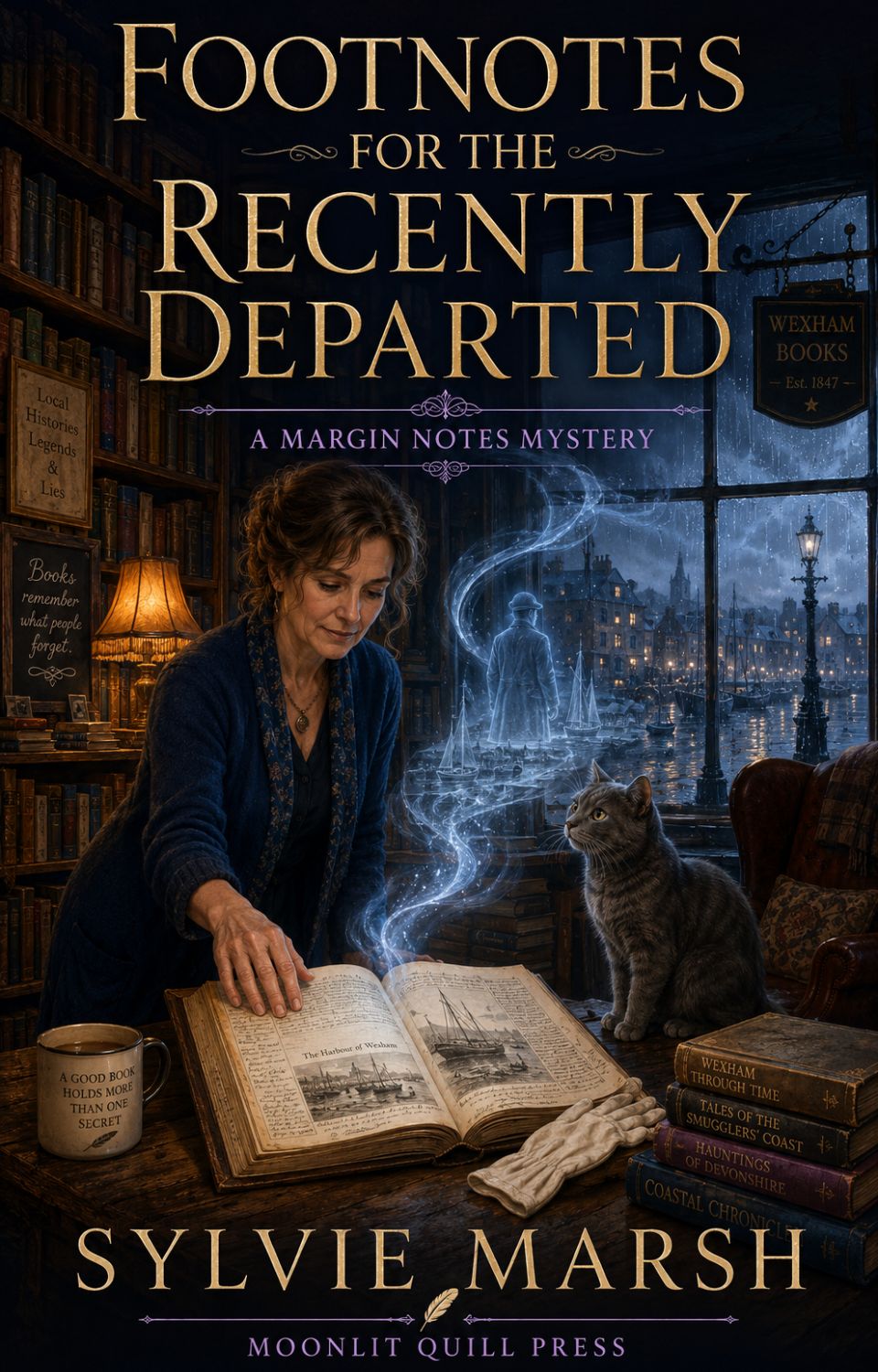
Chapter 1
The Morning Shelf
The lock was stubborn on cold mornings. Cecily turned the key just so: a quarter turn, a bit of upward pressure, then a full rotation. The door to The Margin Note opened with the familiar sound of a book closing, that small, certain thud. She stepped inside and closed the door behind her.
The smell arrived first, as it always did. Aged paper and the cedar of the old floor, and underneath both of them, the harbour, present on even the stillest morning, threading in through the Victorian brickwork as though it had never agreed to be outside. Salt and something greener, vaguely mineral. She had stopped noticing it for the first few months, then started noticing it again, and now she thought she would find it strange to breathe air that smelled of anything other than that.
She moved through the shop in the dim light, touching things out of habit: the light switch by the door, which always took two tries; the lamp on the central table, which worked right away; the second lamp near the wingback chair by the front window, which cast a warm glow over the nearest shelf and made the spines look like sleeping animals. She left the overhead fluorescent light off. It made the shop feel like a stockroom, and she didn't want that.
The harbour outside the window was grey and absolute. October fog sat in the basin without any apparent intention of leaving, blurring the mooring lines into suggestions of themselves, softening the trawlers to shapes. The sky above it was a shade lighter — not light, exactly, just the particular less-dark that passed for morning at this time of year on this stretch of coast. A very white gull moved through it and disappeared. Cecily watched it go and then turned to the shop.
She put the kettle on in the back room, set her bag on the hook behind the counter, pushed the loose brown hair back from her face, and put on her reading gloves.
They were cotton, thin and slightly yellowed from washing, the kind sold as archivists' gloves. She kept them on the shelf behind the register, folded together. Some mornings she reached for them without thought, the way she reached for her reading glasses or her keys. Other mornings, she forgot. This morning, she put them on.
Tuesday's donations sat in two cardboard boxes on the sorting table. They had been dropped off the previous afternoon, while she was at the far end of the shop explaining to a man that Dickens was under D, not British Literature A through C, and that both categories had their own shelves. She had sorted the top box yesterday evening: eight paperbacks, three hardbacks, a water-damaged atlas for the school's art department, and a copy of Coastal Birds of the British Isles that would go straight to the Nature shelf. She could tell from its smell alone that it had spent time in a shed.
The second box waited.
She sorted through the box with her gloves on, making quick decisions about condition, category, and price. Her handwriting in the log was small and slanted. Heyer, G — Regency romance, acceptable — 1.50. Rankin — crime, VG — 2.00. She worked as she once had with a stack of essays: steadily, without sentiment, noting what was there instead of what she might have wished for.
Near the bottom was a paperback romance, the kind with a blurry couple on the cover, a lighthouse behind them, and a title in gold letters worn down to almost nothing. She didn't recognise the author. The pages were tight and a bit swollen, the way books get when they've been read many times in a warm room. Someone had loved this book. You could always tell.
She set it aside and finished sorting the box, making three more quick decisions and putting the books in their piles. Then she poured her tea, returned to the romance novel, and took off her gloves.
She picked it up with both hands, the way she always did, her thumbs resting lightly on the front cover, her fingers spread across the back, and waited.
It came as it always did, not as a picture but as a feeling—a pressure behind her eyes that was almost a headache, but also its opposite. It was like another room briefly appearing around her. The smell changed. It was no longer the shop, but something domestic and warm: toast, laundry, a window open to a garden. Afternoon light, slanted and golden, the kind you get in late summer in a south-facing room. Hands that were not her own — older, with rings she didn't wear — smoothing the same cover she was holding now. Contentment was the dominant note, the particular variety that contains something valedictory about it, the pleasure of returning to something well-loved on a day when you have given yourself permission to simply sit. The feeling had an edge of tiredness that made sitting down more earned. Someone coming home to herself after a long stretch away. Not her. Someone else's afternoon.
Then a name appeared—not spoken, but present, like how a familiar smell can bring someone's face to mind. There was brief laughter at something in the text, and then the ordinary feeling of a scene ending. No distress. No drama. The afternoon had been what it was, and now it was gone.
Cecily set the book down on the counter.
She took a small notebook from the shelf below the register. It wasn't the log, but a different one, smaller and bound in dark green cloth. She uncapped her pen and wrote the date in the top left corner. She wrote: Romance — summer afternoon — kitchen, south-facing — rings, older hands — deep familiarity, valedictory pleasure — nothing alarming. She thought for a moment, then added: Second or third reading, at least. She capped the pen, closed the notebook, and put it back.
She put her gloves back on.
This was her system. Impressions went in the green notebook; the log was for provenance and pricing. She had kept the green notebook since opening The Margin Note, and there were four more at home, going back to the year she first realised that what she sensed from other people's objects was consistent enough to write down. Her grandmother had had it too — had called it touching the echo, in the offhand way of a woman who had never quite decided whether it was a gift or a draught under a door — and had written none of it down, which Cecily had concluded, young, was a mistake she did not intend to repeat. She had never shown them to anyone. She couldn't think of a useful conversation to have about them, and she had never minded that.
She priced the romance novel at two pounds and put it on the Romantic Fiction shelf, which she organised by emotional tone instead of author name. She thought this system was more useful, even if no one else seemed to agree.
She had drunk half her tea and was writing Heyer in the stock log when the back door opened and Ptolemy arrived.
He entered as he always did: quietly, without hurry, with the calm authority of a building inspector on a routine visit. He was a large British Shorthair, heavy and dense-coated, a deep blue-grey like wet harbour slate, with a slightly torn left ear and a tail that moved with its own purpose. His expression mixed long-suffering with something that, in a person, Cecily might have called philosophical.
He paused just inside the door and looked around the shop from left to right, as if checking that everything was as he had left it. Then he crossed the floor, stepped easily onto the middle shelf of the Local Interest section, nudged a slim book on coastal wildflowers half an inch to the left, and settled along the shelf with his front paws tucked in and his eyes half-closed.
"Good morning," Cecily said.
He gave no indication that this was interesting.
Once, she had asked Audrey if Ptolemy liked the bookshop or just found it warm. Audrey said she thought he liked it, though she knew that wasn't really an answer. It wasn't enough, but it was all they had, and Cecily had accepted it.
He settled. She turned back to the stock log.
For the next twenty minutes, the shop was quiet in the way she liked best: no customers, no decisions, just the sound of the harbour clearing the fog, the faint noises from the lane outside, her pen in the log, and Ptolemy shifting now and then. The amber lamps made the space feel cosy and focused. She worked through the new stock, moving between the counter and the shelves, making small choices—this title goes between these two, this author is out of place—that she had come to see as a kind of thinking. Running a bookshop, she realised, was another way of thinking.
She was putting a travel memoir back in its section when she heard Audrey's door. Then the connecting passage between their shops opened. They had removed the original bolt long ago. Audrey appeared, carrying a mug in each hand and wearing a cream-coloured cardigan she had probably made herself, its cable stitch a bit uneven in one spot, which was the giveaway.
"I've brought yours properly this time," Audrey said, handing across the better mug. "Not the chipped one. You had the chipped one on Tuesday."
"I hadn't noticed," Cecily said.
"You noticed." Audrey looked around the shop with the comfortable proprietary interest she always brought to it. "You've done a box already."
"Two boxes."
"Before eight." Audrey shook her head, not with disapproval exactly, but with the affectionate recognition that this was simply Cecily's nature. She settled herself against the counter, wrapping both hands around her own mug. She had flour on one thumb, which Cecily noted and decided against mentioning.
"Terrible news this morning," Audrey said, in the tone that telegraphed its own category. "Desmond Farr."
Cecily looked up.
"Found in the harbour shallows. This morning, very early. Ted Birch, I think, was out for the fleet. He'd been there some time." Audrey paused. "They think he went in last evening."
Cecily put down the book she was holding. Something settled in her, which wasn't quite the same as feeling nothing. She had known Desmond the way everyone in Bellhaven did: thoroughly, involuntarily, and with a certain wariness she guessed was mutual. He had come into the shop. He often talked about the town's prospects and his own part in them, which she found tiring in the way of a man who confused momentum with vision. She hadn't liked him, which she thought was a reasonable position, backed by reasonable evidence. Still, it meant something to hear he was dead.
"They're treating it as accidental," Audrey continued, her voice carrying its natural gentleness alongside its natural speed. "Investigation pending, someone was saying. Probably slipped on the harbour wall in the dark, that's what the fishmonger's is saying, but you know how it goes. Everything's a question this morning." She tilted her head. "People are sad. Mostly."
Cecily remembered how Desmond entered a room, always confident in a way she found both exhausting and oddly revealing. He had learned early that if you said something with enough certainty, many people would just believe you. She thought of his wife, whom she sometimes saw at the café, and felt the messier side of it all.
"Mostly," she agreed.
"His poor wife," Audrey said it with feeling.
"Yes."
"Though." Audrey let the word hang between them, which said enough on its own.
"Yes," Cecily said again.
Audrey looked at her over her mug. "You've always known more about people than they wanted you to," she said, as she usually did—directly, without much emphasis, as if it were just another observation. "One day that'll get you into trouble."
Cecily said nothing. She moved the travel memoir, which was still in her hand, to its correct position on the shelf.
It already has, she thought. But that's another story.
Audrey set her mug on the counter and started telling Cecily what the harbour master's assistant had told the fishmonger, which was apparently a lot. Cecily listened. Outside, the fog hadn't lifted but had grown lighter, making the harbour visible but still blurry. The trawlers looked like themselves again, clear and solid. Somewhere out there, in the cold grey water, a man she had known well enough to distrust had been found face-down in the shallows. The town was dealing with it as small towns do: all at once, loudly, and with a grief that was also, in part, the pleasure of having something to talk about.
Ptolemy had not moved from the Local Interest shelf. He sat with his eyes half-closed and his torn ear slightly angled, as though he were listening to something at a frequency unavailable to anyone else.
Cecily turned back to the counter, picked up her pen, and made a note in the log.
Chapter 2
What the Town Said
By nine-thirty, Cecily had been told about Desmond Farr's death four times.
The first was Audrey, before opening, which didn't really count as it had been fresh news delivered in the moment. The second was a customer who came in for walking memoirs and stayed for twenty minutes, establishing everything he had personally witnessed from the harbour wall at half seven that morning, which was the vehicles and a cordon and a good deal of fog, and from which he had nevertheless constructed a remarkable account. The third was a woman, Cecily vaguely recognised from the coastal path, who bought a large-print Catherine Cookson and said, with the particular relish of the deeply sympathetic, that it was very sad and they would all be thinking of Judith. The fourth was the postman, who did not buy anything.
By ten, the variations had refined themselves into two or three coherent versions competing for dominance, and by half past ten, one of them had pulled ahead sufficiently that it was being stated rather than offered. Slipped on the harbour wall in the dark, returning from what the fishmonger's had now upgraded from a probable evening walk to a confirmed meeting, though no one had been able to specify who with. The harbour wall was slippery after the rain. It had rained. Desmond Farr had always walked the harbour at night. These facts combined in people's accounts with a neat inevitability that Cecily recognised, from years of reading unsolicited manuscripts, as the shape of a conclusion someone had already reached and was now filling in from behind.
She shelved books and listened.
The shop had its Tuesday rhythm — or rather its post-Tuesday rhythm, since Tuesday had been thrown off — slow enough that she could give each customer adequate attention without feeling pressed, busy enough that there was always something in her hands. She worked along the Fiction shelves, returning the strays that had drifted from their sections over the weekend, and let the conversation flow past her with the calm of someone who has learned that people will tell you considerably more if you seem to be doing something else.
"He had enemies," said a man who had been browsing the military history section for twenty minutes without selecting anything. He said this as though offering useful context. "Well. One in particular."
Cecily reshelved a Penelope Fitzgerald that had wandered into Classics. "Did he?"
"Rowena Chalke has been after him for two years. Over this development business." The man picked up a book about the Falklands and turned it over. "She was at the post office this morning, and someone asked her about it, and she didn't say a word. Rowena Chalke, not saying a word. Draw your own conclusions."
Cecily drew several, privately, and none of them was the one the man intended. Rowena Chalke choosing not to speak in a public setting on the morning of a death she had very strong feelings about was not, to Cecily's reading, evidence of guilt. It was evidence of intelligence, or something at least adjacent to it — the decision not to be seen celebrating or condemning before the ground had settled. Rowena was tactically unsound much of the time, but she was not without instincts for self-preservation.
She did not share this with the military history browser, who bought the Falklands book and said on his way out that it was all very unfortunate.
She thought about Rowena's silence as she worked her way along the shelf. Performed restraint was its own kind of statement — she had seen enough of those in years of editorial meetings to know. Rowena had things to say about Desmond Farr that she had been saying, at considerable volume and with impressive consistency, for several years. The specific deliberateness of saying nothing, in a public place, on a morning when everyone expected her to say something — that was a choice. What it meant was another matter.
At half eleven, she had a better picture of Desmond Farr than the town had perhaps intended to give her.
He had been on the council for eleven years, which was long enough to have accumulated significant capital in the form of favours extended and received. Several people mentioned this straightforwardly as a quality — "he knew how to get things moving," one woman said, "and God knows this town needed someone who could." The harbour café renovation, the resurfacing of the upper lane, the grant that had saved the community library for another three years: Desmond's name was in the background of all of them. This was not an invention. He had been useful, and the people who had benefited from that usefulness had not simply imagined it.
But the development scheme was something else, and the town knew it, and the line between those who saw it as another step in his useful tradition and those who saw it as a line crossed somewhere irrevocable ran through nearly every conversation Cecily had that morning.
The scheme itself — she had heard about it in pieces over the past months, enough to understand the broad shape — proposed a commercial and residential development across the harbour’s southern reach. New moorings for leisure craft, a small hotel, the kind of renovation language that said contemporary waterfront and meant displacement of what was there before. The heritage district was not directly in its path, but close enough that Rowena's society had been formally opposed from the start. The fishing community — mooring rights going back generations in some cases, practical working arrangements that predated the harbour charter — had rather more to lose than historical character. The council's vote had been balanced and likely to tip. Desmond had been the tipping point.
"He had the two swing votes in his pocket," a man told her, not in confidence exactly, but with the specific intimacy of a piece of knowledge shared between people who both know the town and therefore understand the weight of it. "Goodwin and Farleigh. He'd done them favours. Not anything you could call corrupt, just — favours. The way he did." He paused. "With him gone, that's finished. The scheme's finished."
Cecily thought about the weight of that. Not triumph, not grief — just the practical calculation that ran under every conversation today, the reconfiguring that happened when a person who had been at the centre of a significant arrangement was suddenly and irrevocably not at the centre of anything.
She thought about Judith Farr and what that weight must be, compounded, arriving all at once with everything else grief brought. She had seen Judith a handful of times over the years — at the coastal café, occasionally at community events, once at a bookshop evening Cecily had hosted where Judith had sat quietly at the back and asked a question of such precision that Cecily had noticed it and then found she could not, later, remember exactly what it had been. A composed woman. The kind that held things without letting them show. Cecily had respected that without particularly wondering about it.
"Poor Judith," she said when a customer mentioned the wife. "She's been running that café for years."
"Twenty years," the customer confirmed, with the satisfaction of someone who has the correct number. "Built it from nothing. Desmond knew everyone, of course, so that helped. But the work was hers." A pause. "Lovely woman. Very private."
The morning moved on. A school group passed the window, noisy in its freedom. The tide came up, and the fog came down again, briefly, and the harbour reassembled itself in grey. Cecily worked and listened and made her judgements and made no notes, because there was nothing yet to note — only the town settling into its grief and its opinions, the familiar adjustments of a small place processing the removal of one of its components.
At two o'clock, she ate a sandwich in the back room. At two-fifteen, a man came in to buy a gift and spent thirty-seven minutes unable to decide whether the recipient preferred history or biography, a distinction Cecily eventually resolved for him in a way that gave her some satisfaction.
At a quarter past three, the door opened, and a new customer came in.
She knew she wasn't a regular before she had fully entered. There was a quality of assessment in how she moved — not suspicious, not aggressive, just the habitual taking of inventory that in some people meant anxiety and in others meant profession. She was of medium build, the kind of slightly weathered that lived in sea air long enough to be specific rather than general. Dark hair, going grey at the temples. Her coat was a good one; she could see that immediately, but she wore it as if she thought about something else when she put it on in the morning, so the collar sat wrong and bunched slightly at one shoulder.
She worked her way along the shop in the way of someone who reads titles rather than authors, which was slightly unusual, and came to a stop at the Local and Walking section, which was at the back left and which she often observed as a reliable indicator of someone who genuinely intended to use what they bought.
"Walking guides," she said, not as a question. Her voice was unhurried in a way that she recognised as deliberate rather than slow.
"Coastal path, or further inland?" she asked.
"Coastal first." She selected one, looked at the maps inside, appeared satisfied, and brought it to the counter. She noted the title — a good, sensible choice, properly detailed — and she paid with cash, which she also noted without significance.
She was putting the change away when she said, without preamble and with the particular professional flatness of someone managing their own tone: "You knew Desmond Farr. I believe he came in here."
Cecily looked up from the register. "Several times. Is there something I can help you with?"
Hale met her eyes. She had the quality of someone who had heard a great many explanations and believed perhaps a third of them — not unkindness, not suspicion, exactly, but a trained calibration. "DS Hale. Bellhaven station. I've been speaking to a few people today." She paused. "Routine, at this point."
"At this point," she said.
"His death is being investigated. Not currently treated as suspicious — we're still in the early stages. I wanted people who knew him to be aware that if anything occurs to them, the station is available." She said this with professional evenness, as though she had said it several times today, which she probably had.
Cecily put the walking guide in a paper bag and folded the top. "He wasn't a close acquaintance. He bought books occasionally. He had opinions about local history, which he shared."
"As people do."
"As people do."
A brief silence, which Cecily had the impression Hale had created deliberately, waiting to see if she would fill it. She did not.
"And you haven't noticed anything unusual in the last few days? Anything related to him, or the development scheme — anyone in the shop with something on their mind?"
"Everyone has been in the shop today," Cecily said, "and everyone has had something on their mind. That's a slightly larger category than I can narrow down."
Something shifted in Hale's expression that was not quite a smile but occupied the same neighbourhood. She took the bag. "Of course." She glanced around the shop in the way people did when they were actually looking at it rather than scanning it, taking in the lamps, the shelves, the crowded quiet of it. Then back to Cecily. "Nice shop."
"Thank you."
She was at the door when she said it, turned back slightly, in the manner of someone who had planned to say this last: "We're not expecting it to be treated as suspicious. For what it's worth. Probably a week before it's formally concluded."
Cecily kept her expression steady. "I appreciate you saying so."
She nodded and went.
She stood at the counter for a moment, looking at the door. Probably a week before it's formally concluded. The word probably doing considerable work in that sentence. The specific detail of a timetable offered when no one had asked for one.
She turned back to the shop. Ptolemy had shifted from the Local Interest shelf to the counter while she wasn't looking — he did this, occasionally, apparently in response to nothing — and sat watching the door with the long-suffering attention of a building inspector noting a violation he was not authorised to address.
He had watched the detective, Cecily realised, for the whole of her visit — not in the way he failed to watch customers, which was total, but with the still, considering interest he otherwise reserved for particular books.
"Well," Cecily said, which was not directed at him, exactly.
He said nothing, which was his position on most things.
She began tidying the counter, and thought about the word probably, and the careful professional neutrality of a woman who had come in for a walking guide and left her with the distinct and clearly intended impression that she would, most likely, be back.